
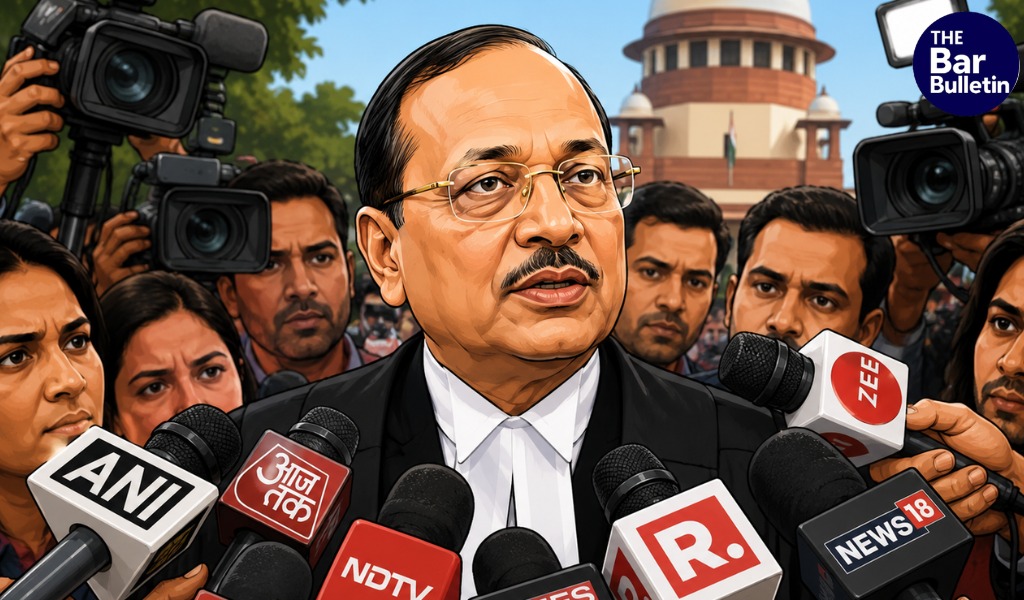

In an exclusive conversation with The Bar Bulletin, Chief Justice of India Surya Kant clarified that his oral remarks during the mentioning of a matter relating to the recent student protests were not a refusal to hear the issue, but were made because no petition had been filed before the Supreme Court.
The CJI explained that before every court sitting, the Registry briefs him on matters seeking urgent listing. On the day in question, he had specifically enquired whether any petition concerning the student protests had been filed and was informed that none had been instituted. Despite this, a lawyer sought an urgent mentioning on the basis of a one-page representation addressed to the Secretary General.
“
“I cannot say in open court, ‘Go and file a petition’, because I cannot invite litigation. But if somebody wants to file a case, I will never say no. The Supreme Court is definitely open for everyone.”
The Chief Justice explained that the Secretary General is not the authority to decide whether a communication should be treated as a judicial proceeding, and that a lawyer practising before the Supreme Court is expected to file a proper petition before seeking urgent judicial intervention through mentioning.
Responding to criticism over his observation that the Court did not have time to watch videos, the CJI said his remarks had been taken out of context, stressing that the issue before him was procedural and not a comment on the merits of the student protests.
The CJI also called for a protocol governing the reporting of oral mentionings, observing that mentionings are essentially administrative exercises undertaken to determine whether a matter warrants urgent listing and should not be reported as judicial pronouncements.
“
“Either the media should receive a proper briefing or, frankly speaking, mentionings should not be reported at all.”
Reiterating that there is no gag on the press, the Chief Justice said his concern was with reporting that selectively reproduces oral observations without context, creating a misleading impression of the judiciary’s functioning.
“
“My concern is that the people of this country, who are entitled to know what is actually happening, should not be fed filtered and one-sided information.”