
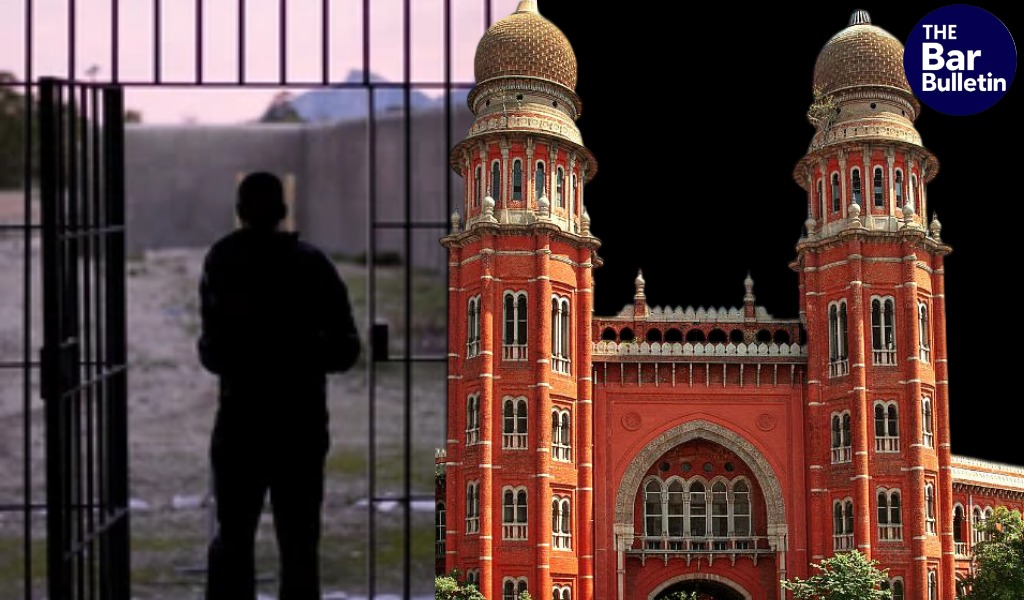

In a batch of criminal writ petitions filed before the Madras High Court regarding the interpretation of the Tamil Nadu Suspension of Sentence Rules, 1982 (Rules) as well as the extent of the State’s executive power to grant ordinary or emergency leave to convicts whose appeals are currently sub judice, a Full Bench of Chief Justice Sushrut Arvind Dharmadhikari, Justice C.V. Karthikeyan, Justice A.D. Jagadish Chandira, Justice M. Nirmal Kumar, and Justice Sunder Mohan passed an interim order along with directions for leave petitions of prisoners to be entertained.
The Larger Bench was constituted to resolve a judicial dichotomy emerging from conflicting pronouncements of two coordinate Full Benches regarding the interpretation of the Rules, 1982. By the order of reference, the Division Bench sought an authoritative opinion on the following questions:
• Whether leave under the Rules can be granted to a prisoner under Article 226 of the Constitution, when his appeal against conviction is pending either before the High Court or the Supreme Court.
• Whether the power to exempt under Rule 40 of the Rules can be exercised by the State to grant leave to a prisoner outside the scope of the Rules when his appeal against conviction is pending before the High Court or Supreme Court in light of the Supreme Court’s Constitution Bench’s decision in K.M. Nanavati v. State of Bombay AIR 1961 SC 112.
The Amicus submitted that the Supreme Court is in the process of navigating the complexities of State-specific prison rules to evaluate the feasibility of a “Pan-India” policy.
The Court referred to Lila Vati Bai v. State of Bombay (1957) 1 SCC 411 and found merit in the argument that while an appeal is pending, the conviction is not “finally fixed” even though the status of an individual legally transitions from an “under-trial” to a “convict”. It was opined that by necessary implication, the Rules were a potent instrument for reformative leave for all other categories of prisoners, including those in the appellate stage. The Court said that to deny the benefit of the Rules would be to ignore the explicit exclusionary boundary set by Rule 35 of the said Rules.
ALSO READ: Jharkhand HC Acquits Man in 1996 ‘Witchcraft’ Murder Case, Says Sole Eyewitness Not Reliable
The Court stated that its power under Article 226 to ensure the protection of constitutional rights remains an indestructible part of the basic structure of the Constitution. Hence, the Court held that leave and temporary release are facets of human dignity that cannot be suspended indefinitely merely due to the pendency of a judicial appeal. Further, the Court held that to apply K.M. Nanavati (supra) as a per se bar to the Rules would be to misapply a precedent born of executive overreach to a field governed by settled statutory policy.
The Court held that a state of legal uncertainty could not be allowed to prejudice prisoner liberty while the resolution of the above mentioned questions and the Supreme Court’s decision in Mukesh Kumar v. State [MA No. 1658/2023 in Crl. A. No. 1343/2012], which is stated to govern the whole nation, were pending. It was noted that the order of reference directed the Registry not to entertain any leave application, which creates an immediate and potentially irreparable hardship.
The Court stated that the decision in T. Ramalakshmi v. State (2025) 1 LW (Cri) 310, was the most suitable precedent to govern the present field. Hence, the Court proceeded to pass interim directions. The above-mentioned direction in the order of reference restraining the Registry from entertaining applications for emergency or ordinary leave was kept in abeyance and the Registry was directed to entertain the petitions as per the decision in T. Ramalakshmi (supra).
The Court ordered that T. Ramalakshmi (supra) to hold the field and govern the grant of leave while the final determination of the reference and the Supreme Court’s decision in Mukesh Kumar were pending. The competent prison authorities were directed to process ordinary and emergency leave applications on individual merits as per the Rules and T. Ramalakshmi (supra) guidelines. It was held that the decision in K.M. Nanavati (supra) was not to be construed as an automatic bar to the consideration of leave applications during the interim period.
The Court ordered the writ petitions to be listed before the Division Bench concerned for necessary orders and directed the Registry to list the reference back before the Court after the Supreme Court renders its decision in the Mukesh Kumar case.
