
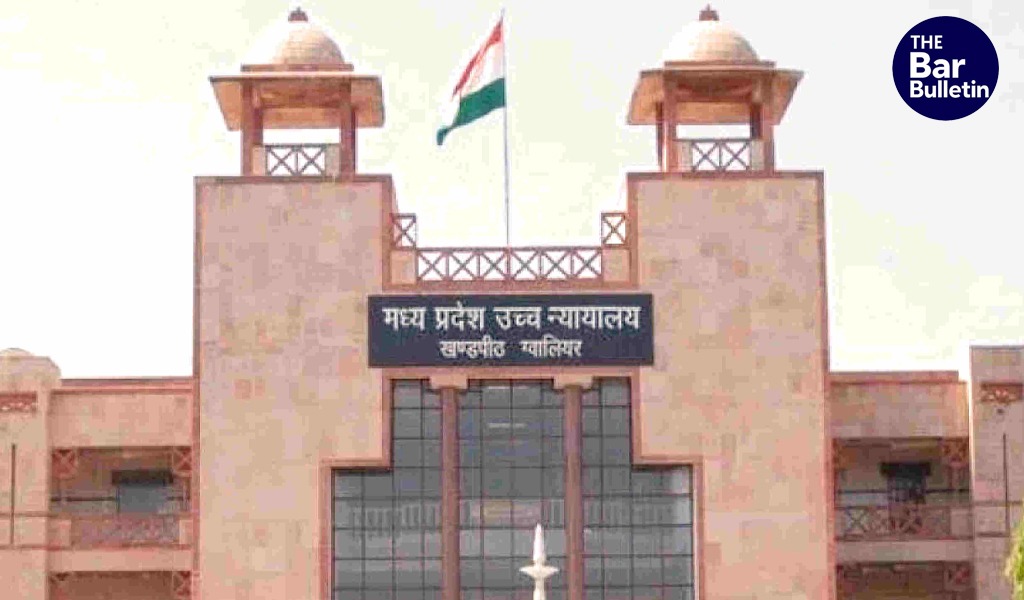

The Madhya Pradesh High Court (Indore Bench) has clarified that where the examination rules and information bulletin make compensatory time available to PwD candidates subject to disclosure in the application form and submission of the prescribed Annexure-II certificate format, a candidate who answers the relevant disability-related questions in the negative and does not submit the mandatory form cannot later claim denial of compensatory time as an actionable illegality.
Essentially, the High Court treated compliance with the prescribed procedural mechanism as mandatory for claiming the accommodation, and held that in the absence of such compliance, denial of compensatory time by the examination authorities could not be faulted.
Accordingly, the Court dismissed Akshat Shivhare’s writ appeal, holding that a candidate who marked “No” in the disability-related columns of the JEE Advanced application form and failed to submit the mandatory Annexure-II certificate format could not later seek compensatory marks, revised rank, or seat allotment on the ground of denial of extra time.
The Division Bench comprising Justice Subodh Abhyankar and Justice Alok Awasthi observed that it was too late for the appellant to argue that he had been deprived of a legal right to claim compensatory time when he had answered both relevant questions in the application form in the negative, namely “No” to whether he was a PwD candidate and “No” to whether he had disability and difficulty in writing.
The Court also found that submission of the prescribed Annexure-II certificate format was mandatory for a PwD candidate seeking compensatory time. Since the appellant admittedly did not submit that letter in the required format, the Court held that no fault could be found with the authorities or the invigilator for not granting additional time in the examination hall.
Briefly, the appeal arose from the petitioner’s claim that he was wrongly denied compensatory time and other reasonable accommodation as a PwD candidate in JEE Advanced 2025. The petitioner had sought multiple reliefs, including award of 4 compensatory marks in Chemistry for the regular rank list, or 2 compensatory marks for preparatory course rank, re-computation of his score and rank, allotment of a PwD preparatory or regular IIT seat, allocation of an unfilled OBC-NCL-PwD reserved seat, permission to appear in JEE Advanced 2026 with one additional attempt as a PwD candidate, and directions for uniform implementation of reasonable accommodation norms under the Rights of Persons with Disabilities Act, 2016.
His case was that although he was a certified person with disability, he was not given compensatory time in JEE Main in April 2025 and again was denied compensatory time in both Paper 1 and Paper 2 of JEE Advanced on 18 May 2025 despite making an express request to the invigilator. He argued that this amounted to discriminatory treatment because other PwD candidates across India were given extra time. He also stated that he scored a total of 35 marks, including -1 in Chemistry, and missed the preparatory rank by 2 marks and the IIT cutoff by 4 marks.
The appellant argued that the online registration form created confusion. According to him, the form asked, first, “Are you a PwD Candidate?” and second, “Do you have disability and having difficulty in writing? (This is for persons having less than 40% disability and having difficulty in writing).” He contended that because he had more than 40% disability and did not have difficulty in writing, he answered “No”, and that this led to an incorrect impression that he was not claiming disability-related benefits. He also submitted that he suffered from obsessive compulsive disorder and could not properly understand the questions.
