
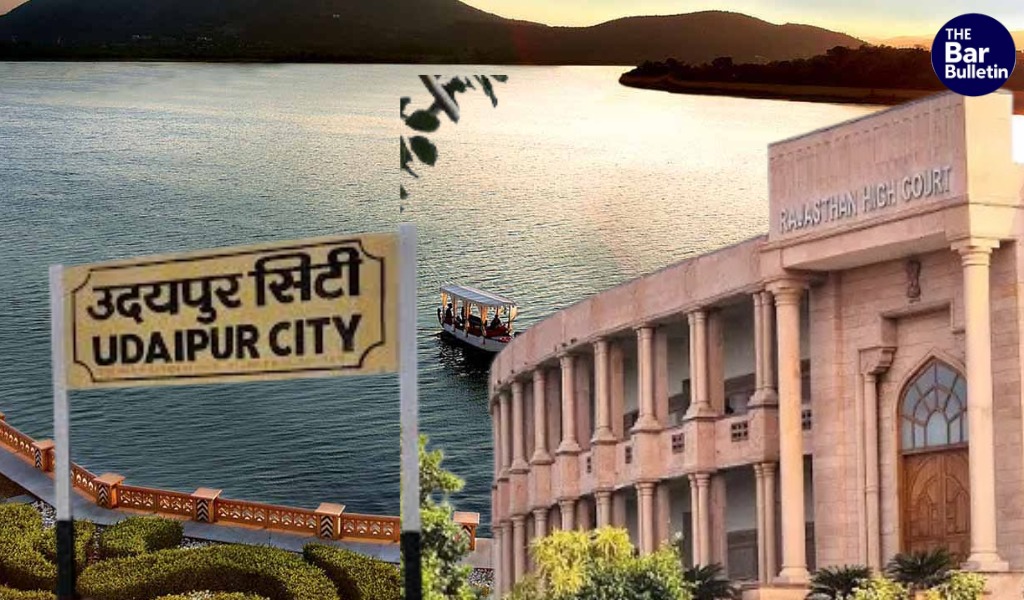

The Rajasthan High Court has initiated suo motu proceedings for the protection and conservation of lakes and water bodies in Udaipur, observing that the city’s lakes are not merely water bodies but a “living natural and cultural heritage” that shape its history, economy and ecological balance.
A Division Bench of Justice Pushpendra Singh Bhati and Justice Rekha Borana registered a suo motu Public Interest Litigation after examining a series of newspaper reports published in the Udaipur edition of Rajasthan Patrika, which highlighted concerns regarding encroachments, unresolved disputes over lake boundaries, degradation of water bodies, structural deficiencies in canal infrastructure and developmental activities near ecologically sensitive lake areas.
Opening its order with a reference to poet JaiKrishn Chaudhry ‘Habeeb’s celebrated nazm on Udaipur, the Court remarked:
“
“The lakes of Udaipur are not mere water bodies but constitute a living natural and cultural heritage that has shaped the history, economy and collective consciousness of the region for centuries. These water bodies not only form an integral part of the city’s environmental and cultural heritage but also perform critical functions relating to groundwater recharge, water security, biodiversity conservation, flood moderation, climate resilience and maintenance of ecological balance…”
Referring to the constitutional framework governing environmental protection, the Bench noted that Article 21 encompasses the right to a clean and healthy environment, while Articles 48A and 51A(g) impose duties upon the State and citizens to protect natural resources. It further observed:
“
“The Public Trust Doctrine mandates that natural resources of vital public importance are held by the State as a trust, for the benefit of the public and the future generations, and cannot be permitted to suffer degradation through inaction or unsustainable use.”
The Court observed that preservation of lakes is essential not only for environmental sustainability but also for safeguarding the constitutional right of present and future generations to a clean and healthy environment. The Bench noted that Udaipur’s identity, economy, tourism potential and ecological stability are substantially dependent upon its interconnected system of lakes, feeder channels, canals and catchment areas. It cautioned that:
“
“Disturbance in any one component of this interconnected hydrological system is likely to have cascading effects on the ecological integrity and sustainability of the entire lake network.”
The proceedings were triggered by three reports published on May 25, May 29 and May 31, 2026.
- One report raised concerns regarding uncertainty over the boundaries and extent of Roop Sagar Lake despite prolonged administrative proceedings.
- Another highlighted recurring failures in portions of the Madar Canal despite repeated repairs, posing risks of accidents and flooding during the monsoon season.
- A third report referred to proposed development activities near Fateh Sagar Lake and raised concerns regarding balancing urban development with ecological preservation.
According to the Court, these reports collectively pointed to broader issues involving protection of lakes and water bodies, preservation of catchment areas, prevention of encroachments, maintenance of water infrastructure, regulation of developmental activities and conservation of the ecological character of urban water bodies.
The Court observed that increasing urbanisation, unregulated development, encroachments, pollution, sewage discharge, alteration of natural drainage channels and inadequate maintenance of water infrastructure have emerged as significant challenges affecting water bodies across the country, particularly in water-stressed regions.
The Court identified the following eight key aspects requiring consideration and action:
- Identification, mapping, demarcation and protection of lakes, water bodies, canals, feeder channels and catchment areas situated within Udaipur.
- Assessment of the present status, ecological condition and conservation measures relating to major lakes and water bodies, including Pichola, Fateh Sagar, Swaroop Sagar, Rang Sagar, Roop Sagar, Doodh Talai, Goverdhan Sagar, Badi Lake, Udai Sagar, Madar Lake and other connected water systems.
- Evaluation of measures taken to prevent encroachments, illegal constructions, pollution, sewage discharge and waste dumping affecting lakes and water bodies.
- Examination of the legality and environmental impact of developmental and commercial activities undertaken or proposed near ecologically sensitive lake areas.
- Review of the condition, maintenance and structural integrity of canal infrastructure and associated water management systems.
- Assessment of the impact of degradation of lakes and water bodies on biodiversity conservation, groundwater recharge, water security, ecological balance and environmental sustainability.
- Formulation and implementation of short-term, medium-term and long-term measures for the protection, restoration and sustainable management of lakes and water bodies in Udaipur.
- Need for an immediate and coordinated response from authorities, particularly regarding:
- Identification and demarcation of lakes and water bodies;
- Prevention of encroachments;
- Protection of catchment areas;
- Regulation of environmentally sensitive activities;
- Maintenance of canal infrastructure;
- Prevention of pollution; and
- Conservation and restoration of ecologically significant water resources to safeguard their environmental functions and ecological integrity.
Finding that the issues warranted immediate judicial scrutiny, the Court directed registration of a suo motu PIL titled In Re: Protection and Conservation of Lakes and Water Bodies in Udaipur. Notices were issued to the State Government, Rajasthan State Pollution Control Board, Udaipur Development Authority, Municipal Corporation, Water Resources Department and other authorities.
The Court directed all respondents to file detailed status reports addressing the condition of major lakes including Pichola, Fateh Sagar, Swaroop Sagar, Rang Sagar, Roop Sagar, Doodh Talai, Goverdhan Sagar, Badi Lake, Udai Sagar and the Madar lake system. The reports are to cover issues such as encroachments, water quality, biodiversity, sewage discharge, conservation measures, boundary demarcation, environmental safeguards and developmental activities. Authorities have also been asked to submit a comprehensive short-term, medium-term and long-term action plan for the protection and restoration of Udaipur’s lake ecosystem.
As an interim measure, the Court directed that no further encroachment, reclamation, filling, dumping, construction activity or alteration of the physical boundaries of any identified lake, water body, canal, feeder channel or catchment area shall be permitted except in accordance with law. It also ordered inspections, water quality assessments and ecological evaluations of major lakes and directed maintenance of status quo regarding their existing physical extent and character until further orders.
The matter has been listed for further hearing on July 13, 2026.