
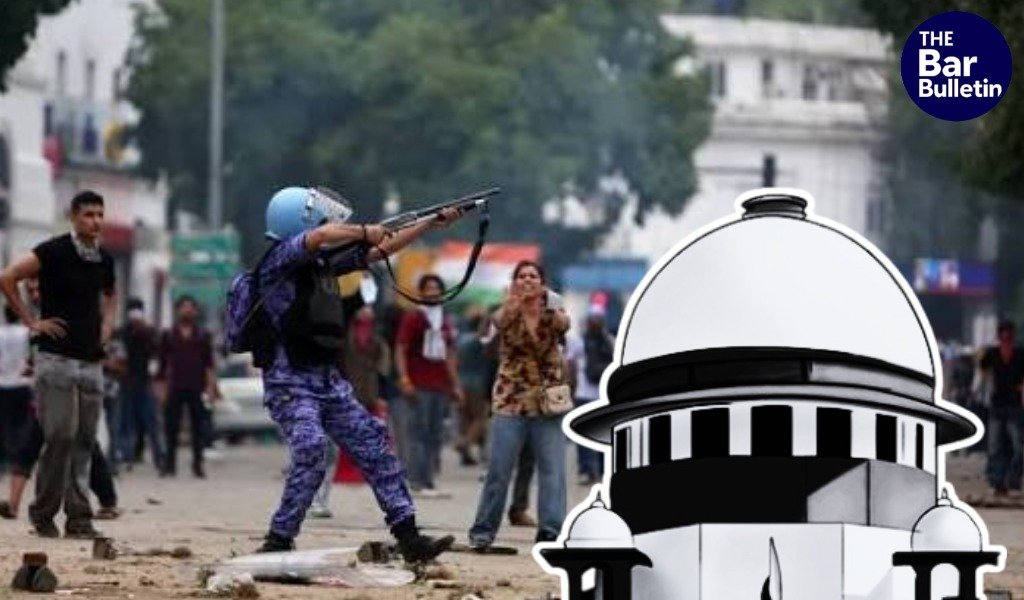

The Supreme Court on Thursday examined issues surrounding the alleged use of metallic pellet guns during the July 20 protests, observing that while it was open to examining the legality of such weapons, the petitioners would first have to specifically challenge the rule or regulation permitting their use rather than seek a broad prohibition.
The observations came during the hearing of a PIL filed by Ex-IPS Yashovardhan Azad, where the petitioners alleged that two young protesters suffered serious injuries after being struck by metallic pellets during the protest and sought directions, among other reliefs, against the use of such ammunition in crowd-control operations.
At the outset, Senior Advocate Vrinda Grover for the petitioners submitted that under the standard operating procedure (SOP) governing crowd control, law enforcement is required to follow a graded response beginning with declaring an unlawful assembly and issuing warnings before escalating force. Counsel argued that while police regulations permit pellet guns only in exceptional circumstances, the Bureau of Police Research and Development (BPRD) documents relied upon by the petitioners did not contemplate the use of metallic pellets. It was further submitted that metallic pellets had been recovered from the bodies of two young protesters injured during the July 20 demonstrations.
The Bench of Chief Justice Surya Kant, Justice Joymalya Bagchi and Justice V Mohana, however, questioned the manner in which the relief had been framed, observing that the petitioners’ prayer was “very vague.” It remarked that if the objective was to phase out pellet guns or prohibit metallic pellets, the challenge would necessarily have to be directed against the specific statutory provision, standing order or regulation authorising their use.
In a significant exchange, the Bench observed:
“
“We are not averse to examining the use of pellets, but in a particular incident, when you say that at no stage a metallic pellet can be used, you must demonstrate before us that this is a permissive use as per the rules governing the graded response to force… If you want to phase out pellet guns, then you have to challenge that very regulation. Which kind of assembly and what kind of force? What is the choice of weapon will be determined by the principles of reasonableness, necessity and proportionality. The nature of the crowd will determine the use of the weapon also… We are not saying whether it should be in the armoury…”
Accepting the Court’s concerns, counsel for the petitioners submitted that the challenge would be confined to the use of metallic pellets and stated that despite efforts, no Delhi Police standing order expressly permitting the use of pellet guns had been found in the public domain. Counsel requested the Union Government to place any such regulation on record if it existed and indicated that the petition would be amended accordingly.
During the hearing, the Bench also questioned why operational advisories governing police action were not publicly accessible, observing that such advisories ought to be uploaded as they are essential for police administration. The petitioners submitted that in the absence of any publicly available standing order authorising metallic pellets, they had relied upon BPRD documents.
The Solicitor General Tushar Meta submitted that while non-violent protest is a constitutional right, law enforcement agencies must also be equipped to deal with situations where otherwise peaceful demonstrations are hijacked or turn violent. He argued that such situations require a graded response by the police depending on the circumstances at the spot. To this, Justice Joymalya Bagchi said that adequately equipping police personnel with protective gear would give them the confidence to exercise greater restraint before reacting to violence
Referring to the injuries sustained by the petitioners, counsel submitted that one protester narrowly escaped losing his eyesight after a metallic pellet struck near his eye, while another continued to have pellets embedded in his body. The petitioners sought comprehensive medical treatment, release of medical records and interim compensation for the physical and mental trauma allegedly suffered. The Bench indicated that necessary medical treatment should be ensured.
The petitioners also requested preservation of additional evidence, including RAF duty logs, weapon and ammunition registers and deployment records relating to the July 20 protests. Referring to earlier preservation orders passed by the Supreme Court and the Delhi High Court, counsel submitted that these specific records had not been expressly included. The Bench responded that whatever was required for an effective investigation would be preserved, while the petitioner stated that the prayers would be suitably amended once the relevant standing order was produced.