
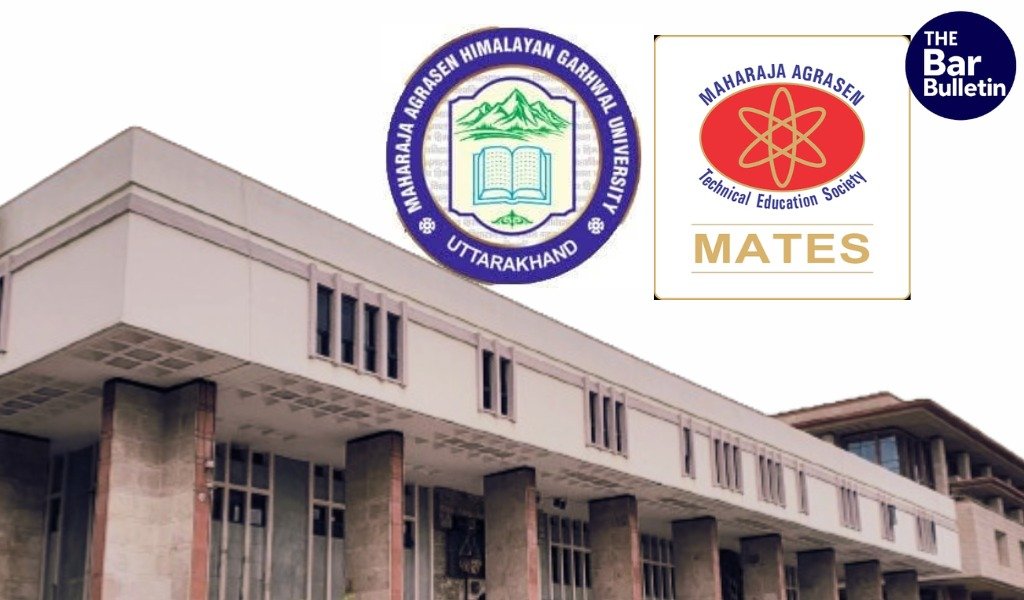

In a significant interim ruling, the Delhi High Court has injuncted Maharaja Agrasen Himalayan Garhwal University from using the name “Maharaja Agrasen” in its trademark, holding that the dominant element of a composite mark is entitled to standalone protection and that a party cannot resile from a concession made on the court record without seeking formal recall of the order. The Court has restrained the Defendant from using the impugned mark “Maharaja Agrasen Himalayan Garhwal University” and its corresponding logo, which is deceptively similar to the Plaintiff’s marks, and/or the name “Maharaja Agrasen” in any manner whatsoever, till the next date of hearing. The Defendant was, however, granted liberty to use the impugned logo without the name “Maharaja Agrasen.”
The Court found that the Defendant had mala fidely and dishonestly adopted the impugned mark subsuming the words MAHARAJA AGRASEN in entirety, despite being aware of the Plaintiff’s immense goodwill and reputation and the number of institutions run by the Plaintiff under the Maharaja Agrasen family of marks. The dishonest intention was fortified by the fact that the mark was adopted for an educational university rendering identical services, so as to present a narrative of commercial nexus or association with the Plaintiff, and that too in the aftermath of a judicial order restraining the Defendant from using its earlier name Himalayan Garhwal University.
Also Read Raising Questions in Legislative Assembly Is a Legislative Act, Not Amenable to Writ: MP High Court
A Single Judge Bench of Justice Jyoti Singh observed that the Plaintiff is a registered society with a long-standing commitment to quality education across multiple disciplines, with esteemed entities such as P.C. Jewellers, Microtek International Ltd., and Zee News associated as trustees. The Court noted the Plaintiff’s extensive academic footprint, spanning from the establishment of MAIT in 1999 to the establishment of MAU in 2013 and further expansion through various departments and institutions, all operating under the MAHARAJA AGRASEN family of marks. The Court recorded that the Plaintiff had secured 16 trademark registrations, both word and acronym marks as well as device marks, with MAHARAJA AGRASEN as an essential, inseparable, and dominant feature.
On the legal framework, the Court observed that while determining infringement of a trademark, rival composite marks must be considered in their entirety rather than dissecting them into component parts. However, the Court noted the evolution of the “dominant mark test,” holding that while a mark is to be considered as a whole, it is permissible to accord more or less importance or dominance to a particular portion or element of a composite mark. The principle of anti-dissection and identification of the dominant mark are not antithetical but rather complement each other. The Court further reiterated that while Section 17 of the Trade Marks Act, 1999 restricts exclusive rights to a trademark as a whole, courts may still identify dominant or essential features to assess the likelihood of confusion.
Applying the dominant mark test to the present case, the Court observed that MAHARAJA AGRASEN is the dominant part of the Plaintiff’s logo mark, which captures attention in the first instance, and the Defendant has copied the name in its entirety as part of its logo. The Court noted that owing to the deceptive similarity of the rival marks, there is every likelihood of confusion among members of the public, particularly since both the Plaintiff and the Defendant are rendering identical services, imparting education at the university level. The Court reiterated that in the field of education, the element of confusion should not only be reduced but completely eliminated in the larger interest of students and parents, even if that means outweighing the commercial interests of the rival parties.
The Court rejected the Defendant’s argument that mere commonality of the name MAHARAJA AGRASEN was not enough to pass a restraint order. The Court made a critical observation regarding the Defendant’s conduct during the proceedings. The Court noted that the Defendant had taken a position on May 08, 2025 that it had no association with the Plaintiff and did not wish to continue using the mark MAHARAJA AGRASEN, and on that basis, the Defendant had successfully stalled the passing of an interim injunction for over a year. When the matter was listed on July 07, 2026, the Defendant took a completely contradictory stand that no such statement was made. The Court held that this belated shift of stand cannot be accepted, noting that no application had been filed by the Defendant seeking recall, review, or modification of the order dated May 08, 2025 on the ground that the Defendant did not make such a statement.
Briefly, the Plaintiff, Maharaja Agrasen Technical Educational Society (MATES), is a registered charitable society established on July 02, 1998, dedicated to promoting quality education across multiple disciplines including Technology, Management, Law, Pharmacy, and Health Services. Over the years, the Plaintiff has established several premier institutions under the MAHARAJA AGRASEN umbrella, including the Maharaja Agrasen Institute of Technology (MAIT) in 1999, the Maharaja Agrasen Institute of Management Studies (MAIMS) in 2003, the Department of Law in 2017, and the Department of Computer Applications in 2024. In 2013, the Plaintiff also established Maharaja Agrasen University (MAU) in Solan, Himachal Pradesh, which was inaugurated by the then President of India and is recognised by the UGC and AICTE. The Plaintiff holds 16 trademark registrations covering word marks, acronyms, and device marks, all featuring MAHARAJA AGRASEN as an essential, inseparable, and dominant component.
In February 2025, the Plaintiff discovered that the Defendant was unauthorisedly using the name MAHARAJA AGRASEN as part of its university’s name, Maharaja Agrasen Himalayan Garhwal University (MAHGU), located at District Pauri Garhwal, Uttarakhand, despite having no association with the Plaintiff. Upon further enquiry, it was revealed that the Defendant was originally known as Himalayan Garhwal University, but following a trademark dispute with Himalayan University, the District Judge of Arunachal Pradesh had directed the Defendant to change its name. Instead of adopting a completely distinct and independent name, the Defendant deliberately incorporated the name MAHARAJA AGRASEN in its entirety into its new name and logo mark. The Plaintiff alleged that this was a calculated and mala fide attempt to ride on the Plaintiff’s immense goodwill and reputation in the education sector, and to cause confusion and deception among students, parents, and the general public by misleading them into believing that the Defendant’s university was affiliated with or associated with the Plaintiff.
A significant Google search screenshot was placed on record demonstrating that a search for “Maharaja Agrasen University” prominently displayed the Defendant’s institution as “Maharaja Agrasen University Uttarakhand” in the primary search results, while the Plaintiff’s universities were pushed to the second place, further evidencing the likelihood of confusion. The Plaintiff also brought to the Court’s attention that on May 08, 2025, the Defendant had made a statement before the Court that it was not associated with the Plaintiff in any manner whatsoever and that it did not wish to continue using the mark MAHARAJA AGRASEN. On this basis, the parties were referred to mediation before the Delhi High Court Mediation and Conciliation Centre, and interim relief was deferred. However, the Defendant neither seriously attempted to settle the disputes nor stopped using the impugned mark.
