
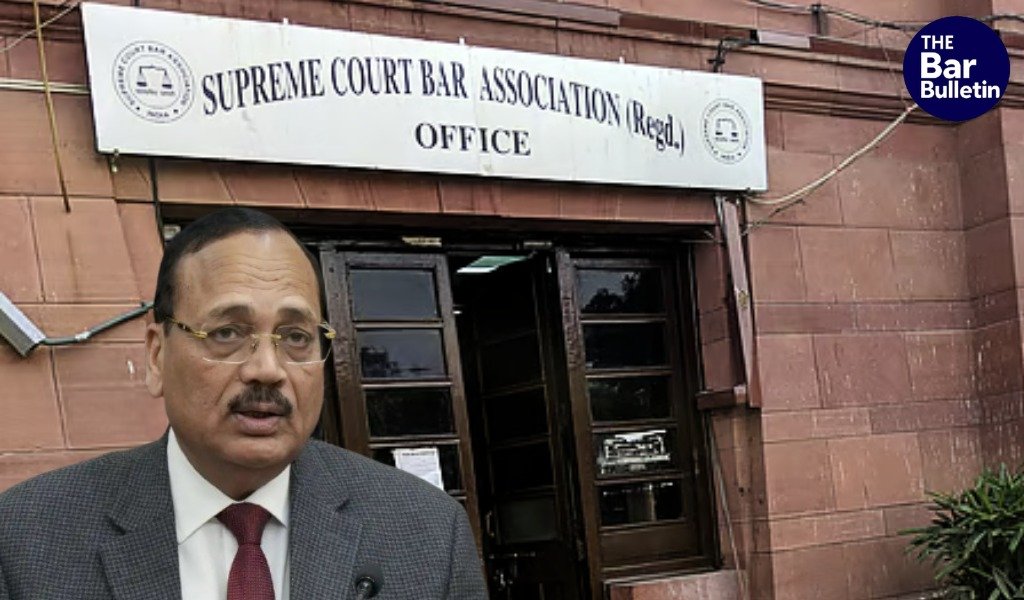

Chief Justice of India, Justice Surya Kant on stated that Thursday that the mechanism providing representation to women in the Supreme Court Bar Association (SCBA) was a judicially evolved measure and not a statutory reservation, observing that it had been introduced with the Bar’s consensus and that any further reforms must continue to be pursued through cooperation.
Responding to the submissions, the Chief Justice clarified that there was no statutory or constitutional framework providing for reservation within the SCBA.
“
“There is no reservation (for women in Bar) provided in any law or any regulations or by-laws. It was a Court creation, broadly, with the consent of all the members. We are not using the word ‘reservation’. You must be aware of it. Last time also we said we are using the word ‘representation’ for women. As we have succeeded, we have succeeded in providing representation to women very proudly on a pan-India basis throughout the country only because of the support, full cooperation, and consent of all these members of the Bar.
Without their consent, suppose they oppose, if somebody starts arguing, under what order you are reserving? Under what order are you providing representation? Because there is no constitution, there are no by-laws, there are no regulations. Everything has to go stepwise, and with persuasion, good cooperation, with consent. So that environment needs to be created.”
The observation came during hearing of a batch of applications in the long-pending proceedings concerning reforms in the Supreme Court Bar Association (SCBA), with the hearing witnessing sharp exchanges over election-related issues, voting rights, and women’s representation in the Association’s governing body.
At the outset, the Bench of Chief Justice Chief Justice Surya Kant and Justice KV Vishwanathan sought to restore order in the courtroom after multiple members attempted to address the Court simultaneously. Expressing displeasure over the conduct during the hearing, the Court stated that if proceedings continued in such a manner, it would have no option but to transfer the matter elsewhere.
During the hearing, interveners argued that every member of the SCBA should enjoy an equal right to vote and contest elections. One of the interveners submitted that the Association’s affairs ought to be governed by its General Body and alleged that the institution had effectively been “hijacked by a few people.” The Bench acknowledged the concern, observing that while several orders had already been passed in the matter, “ultimately the power of the general body has to be restored.”
The Court then considered applications seeking greater representation of women in the SCBA’s office-bearer posts and Executive Committee. Counsel appearing for the applicants relied upon the Court’s earlier order dated May 2, 2024, contending that the rotational reservation of office-bearer posts should not remain confined to a limited number of positions and sought earmarking of additional posts for women.
Responding to the submissions, the Bench clarified that there was no statutory provision, by-law or regulation providing for such reservation and that the mechanism had been evolved by the Court with the consent and cooperation of members of the Bar. The Court also clarified that it preferred using the expression “representation” rather than “reservation.”