
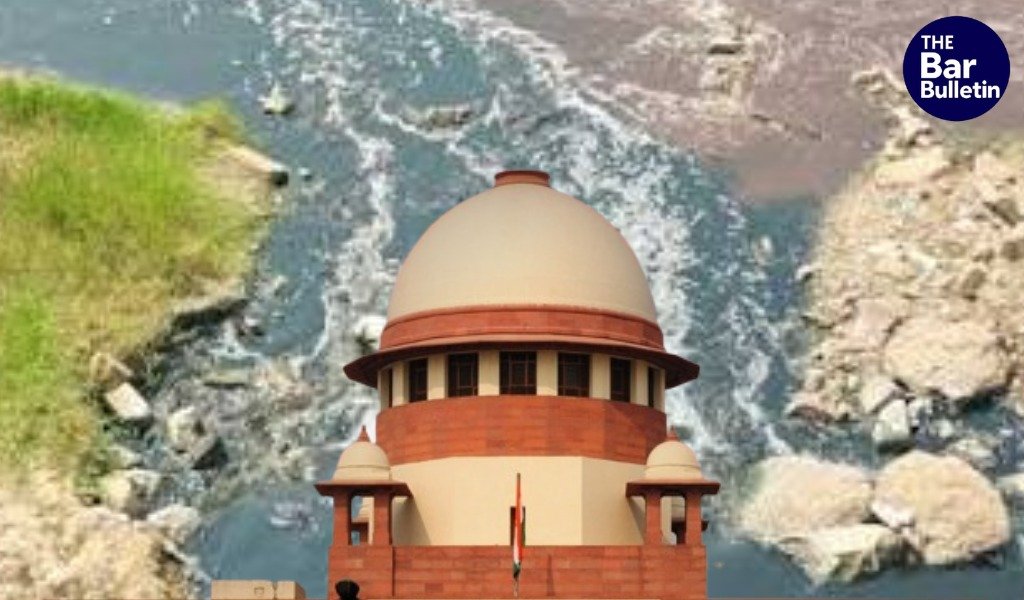

The Supreme Court on Monday directed that no construction or development activity of any nature shall be permitted within 100 metres from the edge of the Jojari River, as an interim measure to protect the riverine ecosystem amid continuing ecological degradation.
The direction was passed in a Suo Motu Writ Petition in which the Court has been monitoring the contamination and degradation of the Jojari River ecosystem. The proceedings are being heard by a Bench of Justices Vikram Nath and Sandeep Mehta.
The Court noted the “serious extent of ecological degradation and the widespread destruction” of the riverine ecosystem and said that an interim, definite and measurable area of protection was necessary while the scientific exercise for determining and demarcating the High Flood Line and ecological buffer zones is pending. The Court directed:
“
“Having regard to the serious extent of ecological degradation and the widespread destruction of this ecosystem, which has been noticed and highlighted by this Court in its preceding orders passed since September 2025, we are of the considered view that it is necessary to put in place an interim definite and measurable area of protection, so as to adequately safeguard the riverine ecosystem during the pendency of the scientific exercise for determination and demarcation of the high flood line and the requisite ecological buffer zones. Hence, we hereby direct that no construction or development activity of any nature whatsoever shall be permitted within a distance of 100 metres from the edge of the river in accordance with the aforesaid guidelines.”
As an additional safeguard, the Court also prohibited hazardous industries or activities capable of causing pollution, contamination or other damage to the riverine ecosystem within 500 metres on either side of the existing flood line, wherever the flood line has been identified, or the present flow path of the river.
The restriction will operate until completion of the scientific exercise for determining and demarcating the High Flood Line and the requisite ecological buffer zones.
The Court also addressed concerns regarding the functioning of the High-Level Ecosystem Oversight Committee and an Integrated Coordination Group constituted by the government. It noted that several senior government functionaries were members of both bodies, resulting in an overlap that could create practical difficulties in the independent discharge of their respective functions.
The Bench clarified that the Integrated Coordination Group was only an internal government arrangement for coordinating the exercise and does not impinge upon the domain of the Committee.
However, given the overlap, the Court empowered the Chairperson of the Committee, in his individual capacity, to issue appropriate directions and instructions whenever necessary to ensure the effective and expeditious implementation of the Court’s directions and the Committee’s mandate.
The Court further directed that its earlier directions empowering the Committee to take necessary action and pass requisite orders would continue to operate. The Bench also recorded that it had assigned a project to the National Law University as part of the ongoing exercise and had issued necessary directions regarding the release of the Malhotra Accumulated Water.
The matter has been directed to be listed again on September 22, 2026. During the hearing, the Court also indicated that a similar exercise could be considered for Jodhpur if an appropriate application is filed.
The Supreme Court had taken suo motu cognizance of the Jojari River pollution issue in September 2025 after a documentary highlighting the condition of the river drew the Court’s attention. Subsequent proceedings have involved examination of ecological degradation, industrial pollution, untreated effluents, groundwater contamination, riverbed and floodplain encroachments and deficiencies in identifying High Flood Lines and buffer zones.
Appearances
Petitioner: Mr. Saurabh Rajpal, AOR M/S. Aura & Co., AOR Mr. Shiv Mangal Sharma, A.A.G. Mr. Nikhil Jain, AOR Ms. Divya Jain, Adv. Ms. Arveen Sekhon, Adv. Mr. Pawan Kumar Saxena, Adv. Mr. Charan D, Adv. Mr. Ankit Bhatnagar, Adv. Mr. Rajiv Agnihotri, Adv. Mr. Dhruv Shankar Mishra, AOR
Respondents: Mr. K. Paari Vendhan, AOR Mr. Rishabh Sancheti, Adv. Ms. Padma Priya, Adv. Mr. Digvijay Singh, Adv. Mr. Nishant Kumar, Adv. Mr. Aquib Ali Khan, Adv. Ms. Poornima Gupta, Adv. Mr. Dhaval Gaur, Adv. Mr. Siddharth Praveen Acharya, AOR Mr. Milind Kumar, AOR Ms. Archna Pathak Dave, A.S.G. Mr. Gurmeet Singh Makker, AOR Ms. Harshita Choubey, Adv. Mr. Aditya Dixit, Adv. Mr. Udit Dediya, Adv. Mr. Varun Chugh, Adv. Mr. Rohan Gupta, Adv. Mr. Avijit Roy, AOR Mr. Vinay Kothari, Adv. Mr. Mehul Kothari, Adv. Ms. Mahima Pandey, Adv. Mr. Alabhya Dhamija, AOR Mr. Surya Pratap Tyagi, Adv. Mr. S.v Raju, A.S.G. Mr. Shiv Mangal Sharma, A.A.G. Mr. Saurabh Rajpal, AOR Ms. Arushi Rathore, Adv. Mrs. Archana Pathak Dave, A.S.G. Mr. Sudarshan Lamba, AOR Ms. Harshita Choubey, Adv. Mr. Aditya Shankar Dixit, Adv. Mr. Udit Dedhiya, Adv. Mr. Varun Chug, Adv. Mr. Azmat Hayat Amanullah, AOR Mr. Arpit Gupta, AOR Mr. Chandrika Prasad Mishra, AOR Mr. Nishant Awana, AOR Ms. Rini Badoni, Adv. Mr. Gs Awana, Adv. Mr. Mayank Chaudhary, Adv. M/s Nma Law Chambers, Adv. Mr. K. Paari Vendhan, AOR Mr. Rishabh Sancheti, Adv. Ms. Padma Priya, Adv. Mr. Digvijay Singh, Adv. Mr. Nishant Kumar, Adv. Mr. Aquib Ali Khan, Adv. Ms. Poornima Gupta, Adv. Mr. Dhaval Gaur, Adv. Mr. Ketan Gaur, Adv. Mr. Neil Chatterjee, Adv. Mr. Abhinav Srivastav, Adv. Mr. Utsav Saxena, Adv. Ms. Ria Bansal, Adv. M/S. Trilegal Advocates On Record, AOR Mr. Sarvesh Bisaria, Adv. Mr. Prakash Chandra Sharma, Adv. Mr. Nishant Bhardwaj, AOR Mr. S.V. Raju, A.S.G. Mr. Shiv Mangal Sharma, A.A.G. Mr. Saurabh Rajpal, AOR Ms. Arushi Rathore, Adv. Mr. Siddharth Praveen Acharya, AOR Ms. Sapna Bharadwaj, Adv. Mr. Bhuvnesh Vyas, Adv. Mr./Ms. Princess Singh, Adv. Mr. Raghunatha Sethupathy B, AOR