
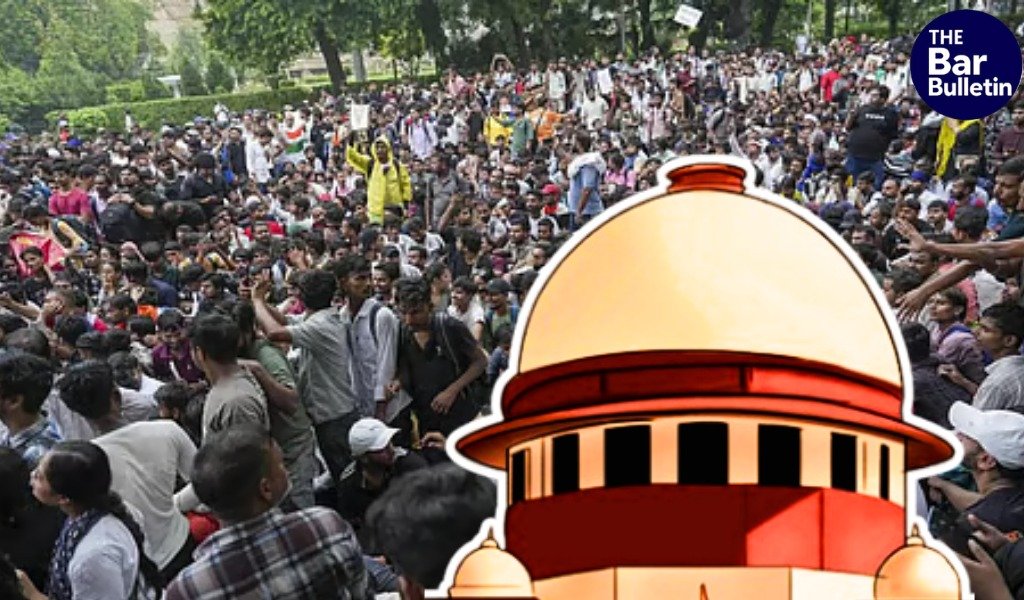

The Supreme Court on Friday directed that there shall be no complete prohibition on the movement of metro trains and other trains in Delhi ahead of the October 10 protest, after expressing concern over restrictions that could inconvenience ordinary citizens. The Court asked the authorities to allow services to operate in an appropriately regulated manner, ensure wide publicity of transport arrangements and publish information about alternative routes.
A bench of Chief Justice of India Surya Kant and Justices Joymalya Bagchi and V. Mohana was hearing submissions concerning restrictions imposed ahead of the planned protest, including the closure of metro station gates and the cancellation of certain trains. The protest has been linked to demands concerning Chief Election Commissioner Gyanesh Kumar.
The Court emphasised the distinction between regulating public transport and shutting it down altogether, observing that the restrictions must be proportionate to the apprehended law-and-order situation.
“
“Having been suggested from our side that there is a distinction between a complete prohibition and regulation of the movement of metro and other trains, the learned Solicitor General has fairly agreed to impress upon the authorities to reconsider the prohibition and allow the movement of metro trains and other trains in an appropriately regulated manner, so that no inconvenience is caused to the citizens, proportionate to the apprehension, keeping in mind the principles of proportionality,” the Court recorded in its order.
“In terms of that assurance, we make it clear that there shall be no complete prohibition on the movement of metro trains. It shall be taken into consideration that these matters fall within the domain of governance. We direct that due publicity be given with respect to the movement of metro trains,” it added.
The Court further directed that information about regulated services be widely publicised, including through newspapers and online websites, and that alternative routes be indicated to prevent hardship to commuters.
Closure of 57 metro stations, cancellation of trains
During the hearing, senior advocates Gopal Sankarnarayanan, Kapil Sibal and N Hariharan argued that the restrictions extended beyond the protest organisers and were affecting the wider public, including people who depended on public transport to travel within Delhi and the National Capital Region.
Counsel referred to notices concerning the closure of metro stations and the cancellation of trains arriving at New Delhi and Hazrat Nizamuddin railway stations during specified hours on October 10. They argued that cancelling trains at their originating stations could prevent passengers travelling from other parts of the country from reaching Delhi, even if they had no connection with the protest.
One lawyer submitted that there could be no justification for cancelling all trains entering Delhi merely because some people intended to protest. Referring to the reported closure of 57 metro stations, counsel argued that millions of people in the NCR relied on the metro and that the restrictions would affect commuters who were not participating in the demonstration.
The lawyers also questioned the impact of barricading and road restrictions, arguing that the availability of private vehicles would not resolve the problem if people were prevented from travelling between different parts of the city.
They highlighted the difficulties that the measures could cause for lawyers, court staff, workers and other people who needed to commute for their daily activities. Counsel stressed that not everyone owned a car or had access to private transport and that public transport was an essential facility for ordinary residents.
One lawyer also referred to the cancellation of trains arriving from Kerala, submitting that trains scheduled to reach Delhi during the restricted hours would be affected. Counsel argued that the measures could prevent people travelling for reasons unrelated to the protest from reaching their destination.
Petitioners allege wider restrictions on movement and public activity
The lawyers raised concerns about a range of additional measures allegedly being taken ahead of the protest. These included the deployment of 221 companies of Central Armed Police Forces, involving approximately 23,000 personnel, preparations for detention centres, checking at Delhi’s borders, restrictions on hotel bookings and reported advisories concerning public gatherings.
Counsel also referred to alleged restrictions affecting fresh bookings at OYO hotels, possible internet curbs, requirements for media personnel to carry identification and advisories asking people not to participate in what were described as unnecessary protests.
They alleged that police personnel had visited mosques and warned people against participating in demonstrations. They also claimed that young women had been removed from trains on the suspicion that they were travelling to attend the protest.
On the allegation concerning visits to mosques, the bench said it could not comment on the police action without hearing the authorities concerned. The Court nevertheless emphasised that citizens should not be unduly harassed and that restrictions imposed to regulate a protest must be justified by the public-order concerns involved.
Right to protest must be exercised in accordance with law, Court observes
It was argued that an entire city could not be shut down because the authorities anticipated a protest, and submitted that restrictions affecting public transport and access to essential facilities were disproportionate to the situation.
The bench, however, pointed out that the right to assemble and associate must be exercised in accordance with the law. It observed that organisers were required to seek permission from the authorities and could approach the courts if permission was refused or the authorities failed to act.
The Court noted that a protest held without the requisite permission would not be in accordance with the law and could expose participants to prosecution, while clarifying that this did not mean that citizens had no right to protest.
The bench also sought information about the organisers and the expected number of participants, indicating that authorities could calibrate security arrangements if they knew how many people were likely to assemble. It suggested that details concerning the proposed gathering, including the expected number of participants and responsible persons who would oversee it, could help avoid restrictions imposed across a broad area without sufficient tailoring.
The bench also took note of the urgency arising from the fact that the protest was scheduled for the following day. It discussed the possibility of the concerned parties returning to the Court with further information, while noting that a challenge to the refusal of permission to hold a protest was a separate issue.
Solicitor General Tushar Mehta defended the security measures, stating that an earlier protest permitted for one day had continued for 17 days, allegedly violating prescribed conditions. He referred to an attempted march near Parliament and alleged that over 200 police personnel and some private individuals were injured, with women police officers also attacked.
Mehta said the State had a duty to protect public safety and clarified that the alleged internet restrictions were limited to a four-kilometre radius around Rashtrapati Bhavan and Raisina Road. He submitted that the measures could be modified depending on the situation, while the bench focused on the impact of transport restrictions on ordinary commuters.
The Court stressed that security measures must be proportionate, cautioning against blanket restrictions that unnecessarily disrupt public movement. To illustrate, CJI said one can’t use “hammer to kill a fly.”The bench also emphasised protecting commuters, including women, children, senior citizens and patients, and suggested providing clear information on barricades, accessible roads and alternative routes.
The Supreme Court said reducing metro frequency amounts to regulation, while shutting services altogether constitutes prohibition, and urged authorities to allow regulated metro and train operations instead of a complete shutdown. Recording the Solicitor General’s assurance to reconsider the restrictions, the Court directed wide publicity of transport arrangements, including through newspapers and websites, and the indication of alternative routes. It clarified that the directions do not amount to micromanagement and that restrictions must remain proportionate to the security concerns.