

In a case where the Successful Resolution Applicant (SRA) was the very erstwhile promoter who accepted the Operational Creditor’s (OC) claim at 0.72% in the resolution plan, the Supreme Court has held that the ‘clean slate’ principle applies against the SRA, while permitting the OC to raise its counterclaim solely for the purpose of set-off without any affirmative recovery.
The Apex Court explained that the ‘clean slate’ principle under Section 31(1) of the IBC, now reinforced by the insertion of Section 31(6) w.e.f. May 26, 2026, extinguishes all claims against the Corporate Debtor (CD) prior to approval of the resolution plan, and this principle applies equally against the Successful Resolution Applicant (SRA), including where the SRA is the very erstwhile promoter who returned to management as an MSME.
The Court clarified that the SRA is entitled to pursue the dues of the CD against its debtors in arbitration even after conclusion of CIRP, since the arbitration agreement is a separate and independent contract that survives under the doctrine of separability, and the RP’s failure to raise a counterclaim during CIRP does not disable the SRA from realizing the CD’s dues.
The OC is entitled to raise a counterclaim in the arbitration solely for the purpose of set-off against any amount found due by the OC to the SRA, but the OC cannot claim any independent or affirmative recovery on such counterclaim, since its claim stands extinguished as against the CD and the SRA under the ‘clean slate’ principle, added the Court.
Briefly, the Modern Asset (the appellant) and KNK Construction Private Limited (the respondent) entered into a contract dated July 09, 2018, for civil and structural work in the construction of an office building, with a total contract value of Rs. 133.68 Crores. The contract contained an arbitration clause for resolution of disputes. The appellant paid the mobilisation advance, and the respondent furnished a bank guarantee of Rs. 1.56 crores towards successful completion of the work. The work commenced on June 01, 2018, the timeline was extended once till Dec 31, 2019, and 95% of the work was completed.
The appellant then threatened termination if the defects pointed out were not rectified within 14 days without just cause. The appellant stood by its termination notice and the subsequent termination effected on Feb 25, 2020, by which time the respondent had already been admitted into CIRP on Dec 11, 2019. After admission into CIRP, the respondent applied to be registered as a small enterprise with the Ministry of MSME.
The appellant approached the Resolution Professional (RP) with a claim of Rs. 12.26 crores, of which only 0.72% was admitted after a major haircut in the resolution plan submitted by the erstwhile promoter, on the strength of the Corporate Debtor (CD) being an MSME under Section 240A(1) of the IBC. The appellant’s claim was allowed only to the extent of Rs. 8.82 lakhs with interest. The NCLT approved the resolution plan, and the erstwhile promoters of the CD came back into the management as the Successful Resolution Applicant (SRA).
Subsequently, the appellant lodged an FIR against the Directors of the respondent under Sections 420, 468, 471 of the IPC, alleging that the respondent had furnished a work completion certificate on the letterhead of the appellant with a forged signature to the Karnataka State Road Transport Corporation. As a counterblast, the respondent invoked arbitration and also filed a complaint alleging misappropriation, which was later quashed by the High Court. Payment under the resolution plan commenced on June 15, 2023 and stood fully satisfied.
On June 20, 2023, the respondent filed an application under Section 11 of the Arbitration and Conciliation Act before the High Court of Karnataka seeking arbitration of amounts allegedly payable to the respondent arising from the very same contract on which the appellant had raised a claim before the RP and received a paltry amount after a major haircut. The High Court appointed an Arbitrator but directed the parties to first approach the Karnataka Mediation Centre, and on failure of mediation, the Director of the Mediation Centre was to inform the Director, Bengaluru International Arbitration and Conciliation Centre.
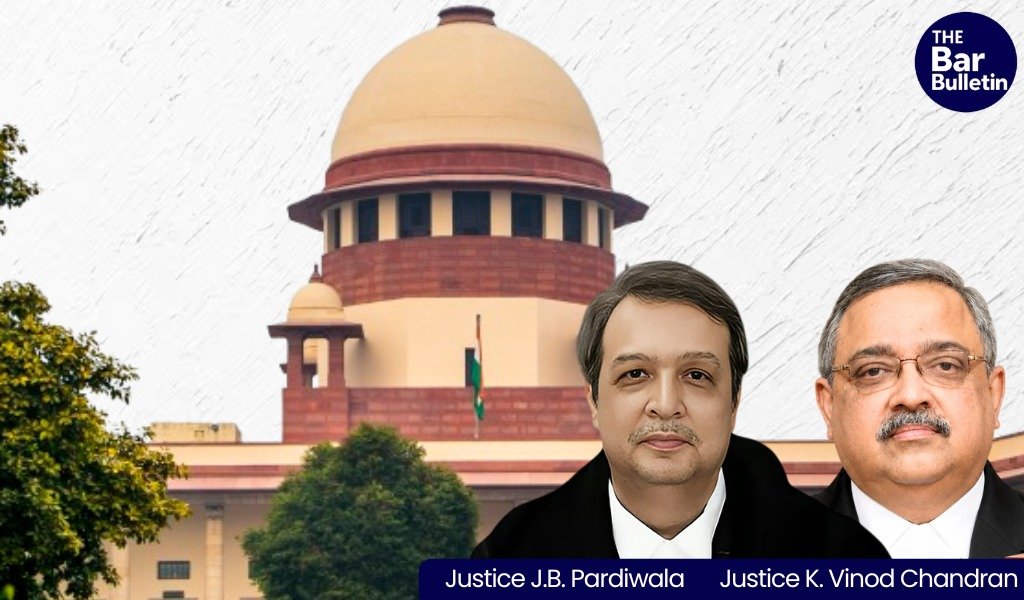
A Two-Judge Bench comprising Justice J.B. Pardiwala and Justice K. Vinod Chandran observed that the scope of Section 11 of the Arbitration and Conciliation Act is confined to the prima facie existence of an arbitration agreement, as laid down in SBI General Insurance v. Krish Spinning [(2024) 12 SCC 1] and In Re: Interplay between Arbitration Agreements under the Arbitration and Conciliation Act 1996 and the Indian Stamp Act, 1899 [(2024) 6 SCC 1]. Section 31 of the IBC does not extinguish the arbitration agreement or the claim of the respondent against the appellant, since the arbitration agreement is a separate and independent contract. After CIRP is admitted, the erstwhile Directors of the CD have no role to play, and the RP’s failure to raise a counterclaim cannot disable the SRA from realizing the dues of the CD, which is also permissible under Section 31.
Relying on Swiss Ribbons Pvt Ltd. v. Union of India [(2019) 3 SCC 17], the Court noted that the RP does not carry out an adjudication of the claim raised by the OC and it is only an administrative measure. Section 30(2) enables the resolution plan to provide for payment of amounts to OCs, which is not less than what they would be entitled to in a liquidation. The insertion of Section 31(6) w.e.f. May 26, 2026, clarifies the ‘clean slate’ principle, and all claims against the CD prior to the approval of the resolution plan would stand extinguished, with the clarificatory amendment enabling retrospective effect. Relying on Ghanshyam Mishra & Sons (P) Ltd. v. Edelweiss Asset Reconstruction Co. Ltd. [(2021) 9 SCC 657], the Court observed that there is complete extinguishment of the claim of an OC after participating in the CIRP and raising a claim which has been allowed to the extent permissible in a liquidation process, with the resolution plan approved by the NCLT.
The Court further observed that limitation is to be computed excluding the date on which the CIRP commenced and the date on which the NCLT approved the resolution plan, and that an SRA can pursue the claims of the CD in arbitration even after conclusion of CIRP, with limitation being extended by exclusion of the moratorium period under Section 14, by Section 60(6). The High Court had framed six questions and answered them, holding that Clause 19.13 constitutes a valid arbitration agreement surviving termination of the contract under the doctrine of separability; that Section 11(6-A) contemplates only a prima facie examination; that extinguishment of claims under Section 31(1) operates as against the CD and not against the SRA’s claims; that questions of extinguishment, waiver, or estoppel are for the Arbitral Tribunal; that the doctrine of competence-competence mandates leaving substantive objections to the Tribunal; and that live and subsisting arbitral disputes survive warranting appointment of an Arbitrator.
The Court also traced the IBC framework, noting that after admission of an application under Sections 7/9/10, a moratorium is declared under Section 14, a public announcement is made under Section 15, an IRP is appointed under Section 16, and the CoC is constituted under Section 21. The IRP is duty bound to collect all information of the assets, finances, and operations of the CD under Section 18, and the RP prepares an Information Memorandum under Section 29, which should contain the entire financial position of the CD, including disputes by or against the CD. The Court placed heavy reliance on Ujaas Energy Ltd. v. West Bengal Power Development Corporation Ltd. [2026 SCC OnLine SC 453], where despite the respondent having raised a counterclaim in arbitration initiated by the RP, the respondent did not pursue it before the RP, and the RP failed to make it part of the resolution plan.
