
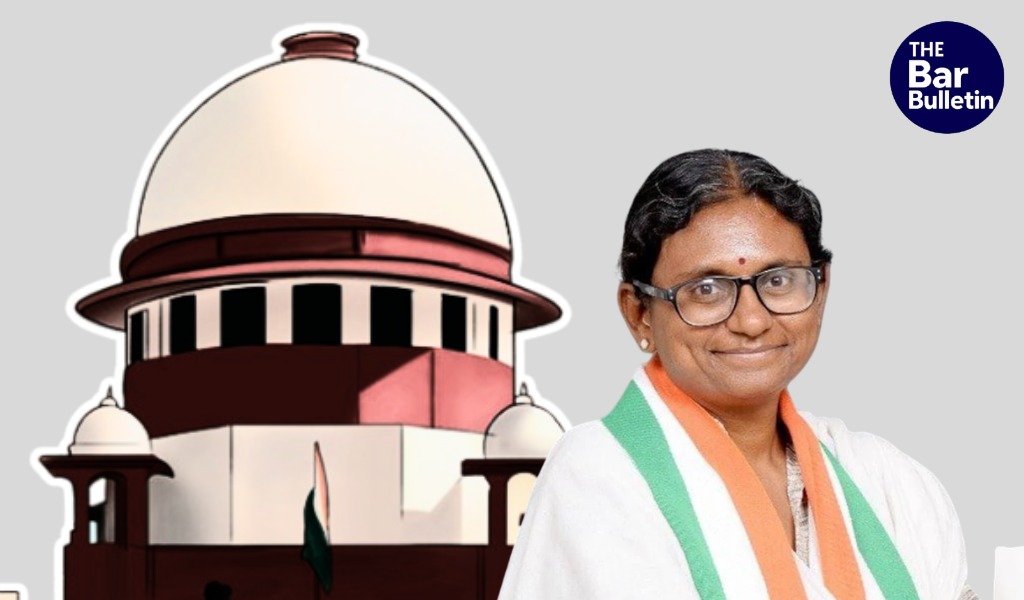

The Supreme Court on Friday dismissed a writ petition filed under Article 32 by Congress leader Meenakshi Natarajan challenging the rejection of her nomination papers, holding that election-related disputes of this nature must ordinarily be addressed through an election petition and not by invoking the Court’s writ jurisdiction.
Appearing for the petitioner, Senior Advocate Abhishek Manu Singhvi argued that the Returning Officer had wrongly rejected Natarajan’s nomination on the ground that she failed to disclose a pending criminal case in Form 26. He contended that the complaint relied upon by the Returning Officer did not even pertain to allegations against Natarajan, but merely referred to her role as an AICC in-charge who allegedly failed to take disciplinary action against another individual accused of misconduct.
Mr Singhvi submitted that the Returning Officer’s decision was arbitrary and contrary to the statutory disclosure requirements. According to him, there was no valid order taking cognizance against the petitioner, and the rejection of her nomination had effectively denied her the opportunity to contest the election. Relying on decisions including Mohinder Singh Gill v. Chief Election Commissioner and Election Commission of India v. Ashok Kumar, he argued that judicial intervention is permissible where it facilitates the smooth conduct of elections rather than obstructing them. He urged the Court to set aside the Returning Officer’s order, contending that such intervention would merely restore the petitioner’s right to participate in the electoral process.
Opposing the plea, Senior Advocate Mukul Rohatagi, Senior Advocate Dama Seshadri Naidu for ECI and SG Tushar Mehta for the State of Madhya Pradesh, appearing for the respondents and intervenors, questioned the maintainability of the petition itself. They argued that the right to contest elections is a statutory right and not a fundamental right, and therefore a petition under Article 32 was not maintainable. They further relied on the settled line of precedents beginning with N.P. Ponnuswami v. Returning Officer to submit that disputes concerning rejection of nomination papers can only be raised through an election petition after the election process is complete.
The Court accepted the preliminary objection regarding maintainability. Referring to the constitutional scheme under Article 329(b) and the consistent jurisprudence of the Court, it held that permitting judicial interference at the nomination stage would undermine the statutory election dispute resolution mechanism. The Bench of Justice Prashant Kumar Mishra and Justice Atul S Chandurkar observed that carving out exceptions for allegedly “glaring” or “manifest” cases would amount to introducing distinctions not contemplated by Article 329.
Declining to entertain the petition under Article 32, the Court dismissed the matter while clarifying that its observations regarding the rejection of the nomination were only for the purpose of deciding the writ petition. It further observed that nothing in its order would prejudice any election petition that may be filed before the appropriate High Court.
The petition was accordingly dismissed.
Appearances
For Petitioner- Senior Advocate Dr Abhishek Manu Singhvi For ECI- Senior Advocate Dama Seshadri Naidu For other Respondents- Senior Advocate Mukul Rohatagi For Intervenor: State of Madhya Pradesh- SG Tushar Mehta