
The Supreme Court has granted complete relief to the widow of a posthumous Shaurya Chakra awardee by directing the Union of India to extend the benefit of Extraordinary Pension from the date of her husband’s death, holding that families of soldiers who make the supreme sacrifice should not be compelled to approach courts for benefits that ought to have been granted by the authorities in the first place. Exercising its powers under Article 142 of the Constitution, the Court directed payment of a consolidated sum of ₹10 lakh to the appellant.
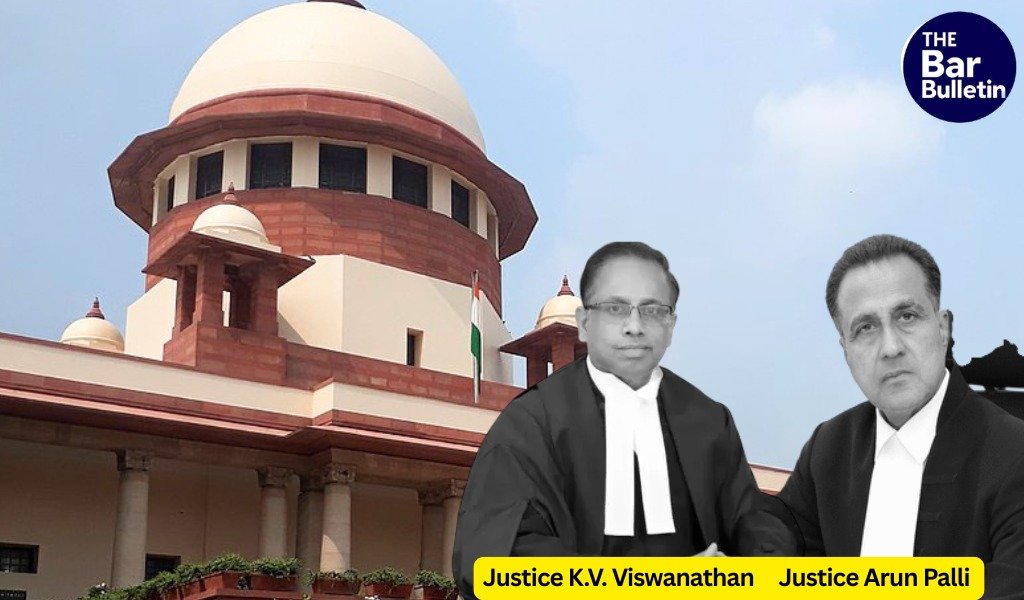
A Bench of Justice K.V. Viswanathan and Justice Arun Palli was hearing an appeal filed by wife whose husband, was serving as an Overseer with the General Reserve Engineering Force (GREF). While supervising the construction of a strategically important road along the Sino-Indian border in July 2000, he sacrificed his life after warning fellow workers and attempting to save both personnel and equipment from a rolling boulder. In recognition of his bravery, he was posthumously awarded the Shaurya Chakra in 2001.
The appellant had sought Special Family Pension under the CCS (Extraordinary Pension) Rules, 1939. Her claim was rejected on the ground that compensation under the Workmen’s Compensation Act, 1923 had already been paid. The Punjab and Haryana High Court subsequently held that the case fell under Category ‘C’ of the Extraordinary Pension Scheme but restricted arrears to three years preceding the filing of the writ petition, relying on a statement made by her counsel.
Before the Supreme Court, the Bench agreed with the High Court’s classification of the case under Category ‘C’, but questioned the restriction on arrears. The Court observed that the deceased had made the “supreme sacrifice” in the discharge of duty and that such cases are not ones where widows or family members should have to litigate to secure their lawful entitlements. It further observed that the delay in approaching the Court should not stand in the way of rendering justice.
The Court also recorded its appreciation for Attorney General R. Venkataramani, noting that he had responded positively to the Court’s concerns and that the concerned department had acted promptly. It was informed that the authorities had already released ₹14.28 lakh pursuant to the High Court’s judgment, processed the appellant’s Extraordinary Pension and released ₹4.12 lakh towards arrears. The Attorney General further submitted that the amount payable for the period from 13 July 2000 to 12 July 2015 worked out to ₹6.62 lakh, which, with interest, would be approximately ₹8.32 lakh.
Taking into account that the appellant had earlier received compensation under the Workmen’s Compensation Act and had already refunded the principal amount, the Supreme Court held that a consolidated payment of ₹10 lakh for the period from 13 July 2000 to 12 July 2015 would serve the ends of justice. The Court clarified that this direction was being issued in exercise of its powers under Article 142, having regard to the peculiar facts of the case.
The Bench emphasised that it was extending the benefit from the date of the soldier’s death, notwithstanding the concession recorded before the High Court, observing that Mohan Singh had laid down his life in the line of duty and had been decorated with the Shaurya Chakra, India’s third-highest peacetime gallantry award. Accordingly, the Court modified the High Court’s judgment and directed the Union of India to release ₹10 lakh within four weeks, disposing of the appeal.
