
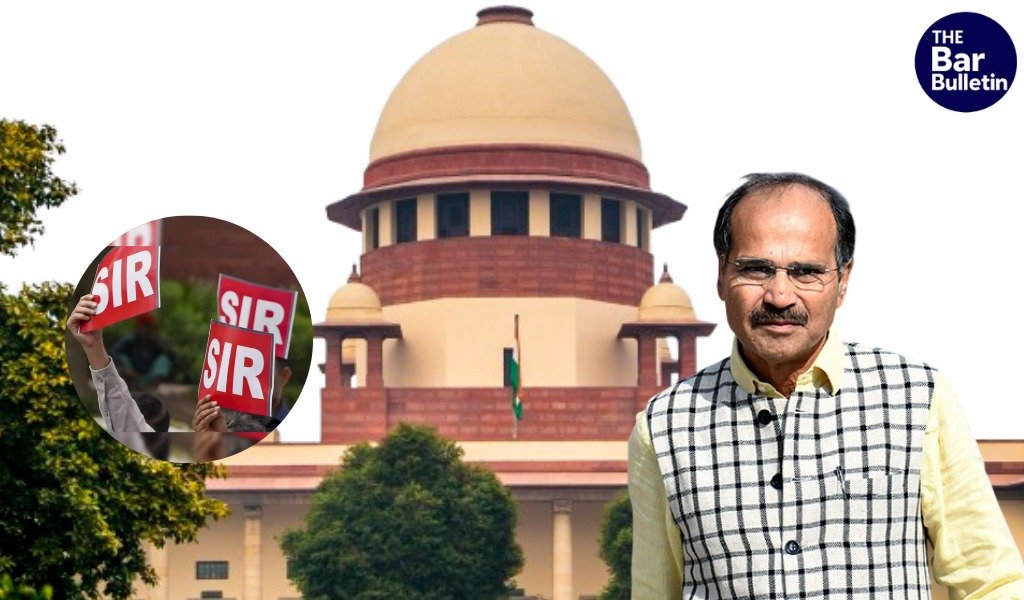

The Supreme Court on Tuesday sought detailed data on the functioning and disposal of appeals by tribunals constituted in West Bengal in connection with electoral roll deletions during the SIR process, stressing that the mere existence of an appellate mechanism would not satisfy a litigant unless the proceedings result in timely adjudication.
A Bench of Chief Justice Surya Kant, Justice Joymalya Bagchi and Justice V Mohana issued notice in Public Interest Litigation (PIL) filed by Congress leader Adhir Ranjan Chowdhury’s PIL against the Election Commission of India, seeking details regarding the number of tribunals, their working hours, the number of appeals disposed of and the time taken for disposal.
The Bench said its immediate concern was to assess the performance and output of the tribunals, particularly since considerable time had already elapsed. The Court emphasised that it was not concerned at this stage with whether the appeals were ultimately allowed or dismissed, but with the quantum of disposal and whether the tribunal mechanism was functioning effectively.
“
“We need to see their performance or output. Performance, nothing else. And if the performance appears to be wanting, with regard to the volume and the tenure time taken, then to request you to revisit and restructure the architecture of disposal…We are not concerned with the disposal or the result itself. We got it. But the quantum of disposal. The output….When it comes to adjudication, I don’t think we have anything. You may not address us. But we, the creators of these tribunals, we also need to see how we can ensure the outcome of the due process….Just to file an appeal does not satisfy a litigant.
The Bench sought comprehensive information on the functioning of the tribunals, including their number, working hours and disposal figures, so that it could assess what would constitute a reasonable timeline for deciding the appeals. The bench remarked: “We want to see ourselves. How many tribunals? What are the working hours? How much is the disposal? And what should be a possible timeline?”
Also Read ECI Can Deploy Government Teachers for SIR Duty, But Must Ensure They Are Not Overburdened: Delhi HC
On the consequences of delays in deciding electoral roll appeals, counsel referred to instances where deletion from the electoral roll was allegedly followed by denial of social benefits, including ration. The Bench cautioned counsel against expanding the scope of the present proceedings to issues concerning the denial of welfare benefits. It observed that if the State had independently used deletion from an electoral roll to deny a social benefit, that would give rise to a separate cause of action which could be pursued before the High Court.
“
“Whether the State of West Bengal chooses to use a deletion from an electoral roll to deny social benefit or not, that is an independent cause of action. That should go to the High Court…So far as the tribunals are concerned, where there is an initial deletion and a direction is given for appellate tribunals to look into the correctness of that decision, we need to see to it that the outcomes come quickly.”
Concerns were also raised about whether inadequate infrastructure or geographical accessibility could be contributing to delays, including difficulties faced by persons from remote villages in travelling to Kolkata.
The Court indicated that it would examine the issue after receiving the necessary information from the authorities and feedback from the Election Commission. The matter is listed for August 25, 2026.