
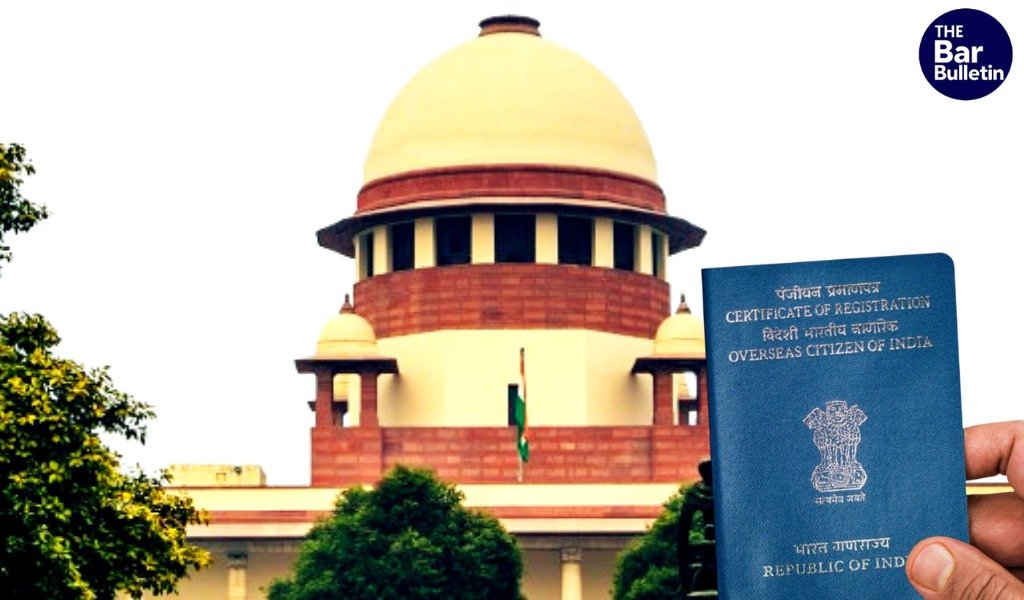
The Supreme Court on Tuesday issued notice on a plea filed by Khalid Jahangir Qazi, an 82-year-old US-based medical professor and Overseas Citizen of India (OCI) cardholder, challenging the denial of interim relief permitting him to enter India amid an ongoing dispute over the cancellation of his OCI card and his alleged blacklisting by the Union Government.
Qazi told the Supreme Court that the Delhi High Court’s interim order had required him to demonstrate an exceptionally strong case for interim relief, but argued that the High Court had relied upon an earlier order passed before he ultimately succeeded before the Single Judge.
He submitted that the earlier interim proceedings could not be used against him after the Single Judge had subsequently ruled in his favour. According to Qazi, the Single Judge had set aside the action taken against him concerning his OCI card and blacklisting.
The controversy dates back to 2022, when the Indian authorities issued a show-cause notice alleging that Qazi was involved in “anti-India activities”. His OCI card was subsequently cancelled in May 2023 on allegations including activities considered prejudicial to India’s sovereignty, integrity and security. The Delhi High Court, however, in November 2024, set aside the cancellation and blacklisting orders, finding serious procedural deficiencies and violation of principles of natural justice.
The High Court had noted that the allegations in the show-cause notice were broad and lacked sufficient particulars. It observed that the notice vaguely alleged that Qazi’s actions were “anti-India” and adverse to the sovereignty and integrity of India without furnishing specific details or evidence enabling him to effectively respond.
Qazi told the Supreme Court that he is 82 years old, a professor and has travelled to India more than 20 times. He submitted that he had even visited India while the writ proceedings were pending, between August and October, without any adverse incident being reported.
“
“I am a professor. I am 82 years old. I am not only a well-known academic, I am 82 years old. I have come to India about 20-plus times. While my writ was pending, I visited India, my Lord, from 3rd of August to the 10th of October. Nothing was found against me. It is not, my Lord, that I am some kind of an activist who will, my Lord, create all kinds of problems for the nation outside India.”
He further submitted that he had elderly sisters in India and wanted to visit the country for family weddings. He offered to give an undertaking that he would not engage in any political activity during his stay.
The petitioner also challenged the attempt to treat him as an ordinary foreigner despite his continuing OCI status. He argued that the Supreme Court has recognised OCI status as occupying a position between full citizenship and that of a foreigner.
His counsel relied upon the Supreme Court’s decision in Anushka Rengunthwar v. Union of India, submitting that OCI status constitutes a form of “midway” or intermediate status in the absence of dual citizenship. The petitioner argued that if the Government intended to remove the statutory protection attached to his OCI status, it had to follow the specific procedure prescribed under Section 7D of the Citizenship Act.
He submitted that the first cancellation of his OCI card had already been set aside because he was not given the required opportunity of hearing, but the Government was now relying upon substantially the same allegations to restrict his entry into India.
The dispute stems from the Delhi High Court’s November 2024 judgment, which set aside both the cancellation of Qazi’s OCI card and the blacklisting action. The Union Government challenged that judgment before a Division Bench, while Qazi also filed proceedings in relation to his continuing inability to enter India.
The Delhi High Court Division Bench subsequently declined interim permission for Qazi to travel to India for family weddings, holding that the question of his entitlement to interim relief involved issues requiring consideration in the pending appeals. The Supreme Court had earlier directed the High Court to consider his request for interim relief expeditiously.
Before the Supreme Court, Qazi sought permission to remain in India until October and assured the Court that he would not participate in political activities.
“
“All I am requesting is to permit me to stay till October. I will give an undertaking if at all it is necessary, my Lord, that I will not indulge in any political activity. I have never indulged, my Lord.”
The Supreme Court has now issued notice on his plea. The Matter is listed for September 07, 2026.