
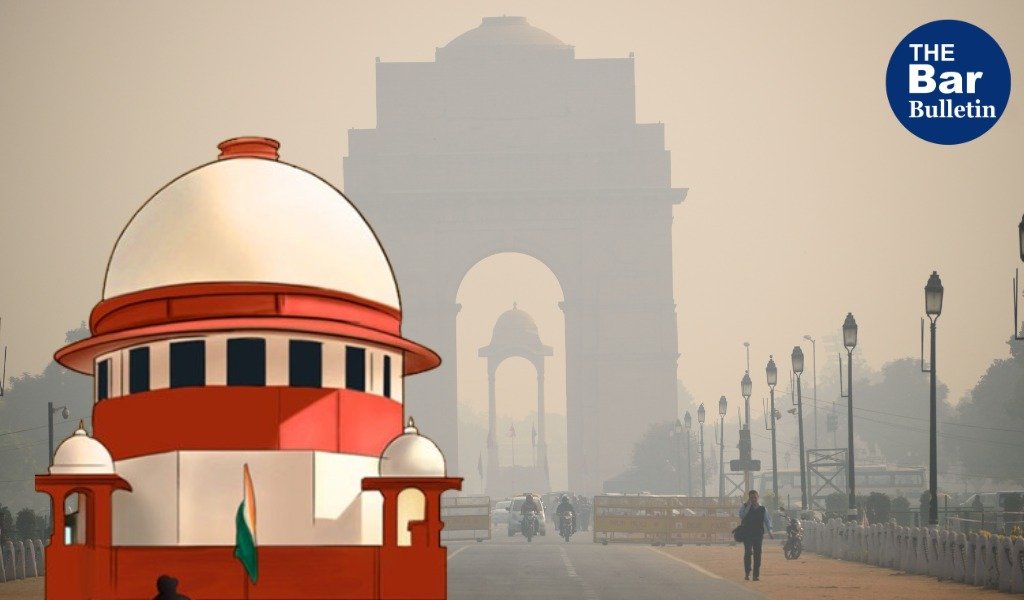
The Supreme Court on Monday pulled up the neighbouring States of Haryana, Punjab, Uttar Pradesh and Rajasthan for their passive participation in efforts to curb air pollution in the National Capital Region (NCR), asking them to take greater responsibility and ensure the presence of their respective Advocate Generals during the proceedings.
Hearing the suo motu case concerning air pollution in the NCR, the Bench of Chief Justice Surya Kant, Justice Joymalya Bagchi and Justice V Mohana stressed that the responsibility of tackling pollution cannot rest with Delhi alone and that neighbouring States must actively contribute to the process. During the hearing, the Court asked why the States were not participating more actively and remarked:
“
“What is most important is that why the neighbouring states are very passively participating in this process? Why they are not actively involved? So let the Advocate General of Haryana, Punjab, UP and Rajasthan to remain present….You people always remain like backbenchers. Why don’t you all take responsibility? Tell your Advocate General to be here.”
The Court asked the respective Advocate Generals to remain present and directed all the States to file status reports detailing the steps taken by them to reduce pollution in the NCR region.
The Bench also questioned the States about the steps taken by them, observing that the responsibility to curb pollution in the NCR required coordinated action. It asked the States to place their respective Advocate Generals before the Court so that they could explain the measures undertaken. The Court further discussed extending BS-VI compliance requirements beyond Delhi to the entire NCR, observing that such a measure could significantly contribute to reducing pollution.
Also Read: Vehicular Pollution as Major Contributor to Delhi’s Air Crisis: Supreme Court
Court explores long-term plan to restrict commercial vehicles entering Delhi
During the hearing, the Bench also explored whether commercial vehicles could eventually be prevented from entering Delhi, while ensuring that the city’s requirements for essential commodities were not affected. The Court acknowledged that Delhi depends on neighbouring States for vegetables, food and other daily necessities. It therefore suggested developing an alternative mechanism, including warehousing and stocking facilities near the borders, with cleaner vehicles transporting goods into the city. CJI observed:
“
“How to ensure that commercial vehicles don’t enter Delhi at all? But it does not mean that Delhi people don’t require… They have a lot of necessities. They require vegetables, they need food, they need other day-to-day items, daily items. So everything will have to be made available. So what can be the alternate? Can there be something that at the border itself you have some warehousing, stocking there… other battery-operated vehicles or non-polluting vehicles to bring them inside the city? This kind of arrangement may not be possible this year, may not be possible next year. But why not to have this within five years? Why not have it within five years? To ensure that not a single commercial vehicle enters Delhi.”
The Court also questioned why restrictions imposed on vehicles registered in Delhi should not apply equally to vehicles from neighbouring States.
“
“If you have some curb here for Delhi vehicles, why it should not be applied to the neighbouring states also? Because what is the use? What is the effectivity? If you have a particular type of vehicle only in Delhi, at the other you are allowed to have completely [all types of vehicles], the same thing will happen.”
At the same time, the Bench cautioned against imposing an immediate blanket ban, noting that it could have far-reaching consequences. It also recalled that vehicles carrying essential commodities had earlier been exempted from Environmental Compensation Charges (ECC).
During the hearing, counsel submitted that the increase in ECC had resulted in a reduction in the number of commercial vehicles entering Delhi from neighbouring States. The Bench asked the States, the Municipal Corporation of Delhi and the Delhi administration to work on a joint proposal outlining alternatives to regulate commercial vehicle movement without disrupting the supply of essential goods.
CAQM expert report to be considered by States
Additional Advocate General Aishwarya Bhatti submitted CAQM-appointed expert committee report identifying the causes behind the deterioration in air quality in Delhi-NCR. The Amicus Curiae suggested that the report be circulated to all States and that they be directed to submit their responses, along with a response from the CAQM.
The Amicus further sought permission for the CAQM to assist the Amicus Curiae on technical issues in the proceedings, stating that expert inputs were necessary to verify the opinions placed before the Court.
The Court directed the States to respond to the CAQM report and the relevant earlier orders. In its subsequent order dated November 6, 2026, the Supreme Court granted the States two weeks to place their submissions on record, including the steps taken, their responses to suggestions made by the CAQM and the Amici, and further measures they independently propose.