
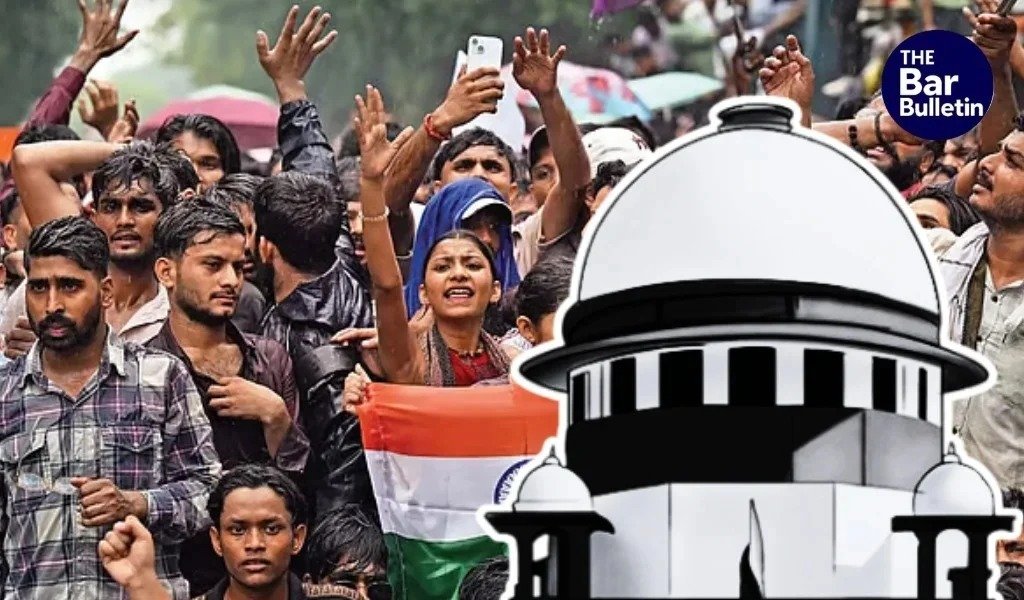

The Supreme Court has declined an application seeking reconstitution of the High-Powered Enquiry Committee (HPEC) constituted to examine issues arising from the protest-related incidents, observing that the challenge to the Committee’s composition was based on conjecture and preconceived notions even before its enquiry had commenced.
A Bench comprising the Chief Justice of India, Justice Joymalya Bagchi and Justice V. Mohana was hearing a batch of connected petitions in connection with NEET students’ protest at Jantar Mantar.
The plea for reconstitution was made after parties filed several affidavits and applications pursuant to the Court’s detailed August 18 order constituting the HPEC. The Court noted that a large number of contentions and suggestions had been placed before it during the proceedings. The Bench, however, refused to alter the Committee’s constitution, observing:
“
“Having perused the contents of the aforesaid application, we are constrained to observe, with some measure of disquiet, that aspersions have been cast upon the HPEC in a manner that is both premature and precipitate. In the circumstances, we are not inclined to effect any alteration in the constitution of the Committee, particularly where the prayer for such reconstitution proceeds on nothing more than conjecture and preconceived notions, articulated even before the HPEC has embarked upon its enquiry.”
The Court further said that the request for reconstitution proceeded on “nothing more than conjecture and preconceived notions”, even before the Committee had started its enquiry. It emphasised that the HPEC had been constituted to assist the Court with fairness, transparency and a dispassionate approach, and was not intended to espouse the cause of either side.
While retaining the existing composition, the Court issued further directions concerning the Committee’s functioning. It asked the HPEC to first proceed with its enquiry into issues including the use of pellet guns, targeted violence and harassment of female protestors, and excessive violence and destruction of property allegedly occasioned on either side.
The Court also reiterated that broader constitutional questions arising from the proceedings would be considered by it at the appropriate stage. The Bench directed the HPEC to ensure protection of vulnerable witnesses and persons who may come forward to place their accounts before the Committee. Their identities are to be kept confidential. The Court further stated: “It goes without saying that utmost confidentiality shall be maintained in respect of any statements given or evidence submitted by such vulnerable witnesses to the HPEC.”
The Court permitted the HPEC to consider creating a separate online portal to facilitate the submission of documents and evidence by such witnesses and other stakeholders. The Court also clarified that the nodal counsel appointed under its earlier order would primarily assist the Court and provide logistical support, and their role should not be construed as constituting a channel of communication between the HPEC, the Court and the parties.
The Court appointed Dr. Monika Gusain, Senior Advocate, along with C. Solomon, AOR, as Amici Curiae to assist the Court as representatives of the HPEC and to act as independent arbiters between the parties. The Bench also requested the HPEC to appoint a Member Secretary at the earliest and directed the Registry to provide the nodal counsel with the paperbooks and other relevant material.
The HPEC has been requested to submit its first report at the earliest. The connected matters have been listed for further consideration on October 9, 2026.
In a connected petition, the Court was also informed about alleged threats to a 14-year-old female protestor and her family. The petitioners alleged that no action had been taken against those allegedly responsible for the threats. The Supreme Court consequently directed the Delhi Police to assess the threat perception, provide necessary protection to the child and her family, and expeditiously investigate the alleged threats and harassment. A status report has been sought before the next hearing.
