
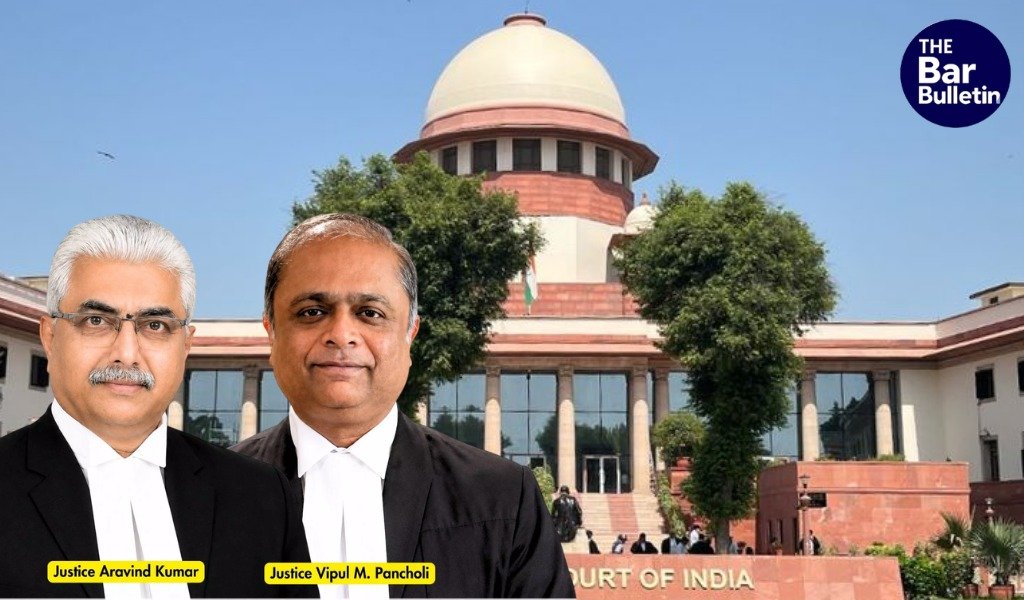

The Supreme Court has clarified that under the RPF Act and Rules, the Assistant Security Officer is a competent appointing and removing authority for Rakshaks, and the doctrine of ‘subordinate authority’ under Article 311(1) applies only where the removing officer is demonstrably lower in rank than the actual appointor. The Court further clarified that Rule 43 read with Schedule II of the RPF Rules, 1959 confers upon the Assistant Security Officer the power to impose the penalty of removal upon Senior Rakshaks and Rakshaks, and where the removing authority is of the same rank as the appointing authority, Article 311(1) of the Constitution is not attracted.
The Court said that the Call Letter dated May 03, 1979, issued by the Commandant was only a communication requiring selected candidates to report for initial training and did not constitute the operative appointment order, since the proposed appointment was expressly conditional upon successful completion of training. Further, the Battalion Order dated Dec 04, 1979, issued by the Assistant Commandant operated simultaneously as the appointment order and the posting order, and was the operative document by which the respondent was appointed as a regular Rakshak.
Under Section 6 of the Railway Protection Force Act, 1957 read with the proviso, the power of appointment does not rest exclusively with the Chief Security Officer and may be exercised by other superior officers as specified, and Rule 20 read with Schedule I of the RPF Rules, 1959 expressly confers the power to appoint Rakshaks upon the Assistant Security Officer, added the Court, while explaining that a departmental enquiry cannot be held to be vitiated merely because it proceeded ex parte where the delinquent employee had acknowledged receipt of the charge-sheet, was informed of the date of enquiry, and was afforded an opportunity to participate in the proceedings.
A Two-Judge Bench comprising Justice Vipul M. Pancholi and Justice Aravind Kumar observed that the Call Letter dated May 03, 1979, was not an unconditional appointment order but merely a communication requiring the selected candidates to report for and undergo the prescribed initial training, with the appointment being expressly conditional upon successful completion of such training. The Court noted that the Battalion Order dated Dec 04, 1979, issued by the Assistant Commandant, was the operative appointment order, which simultaneously recorded the appointment of the respondent as a Rakshak and his posting to the 7th Battalion.
The Court further observed that under Section 6 of the Railway Protection Force Act, 1957, although the power of appointment generally rests with the Chief Security Officer, the proviso expressly contemplates that such power may also be exercised by other superior officers as may be specified. Rule 20 read with Schedule I of the Railway Protection Force Rules, 1959 expressly confers upon the Assistant Security Officer the power to appoint Senior Rakshaks and Rakshaks. Similarly, Rule 43 read with Schedule II confers upon the Assistant Security Officer the power to impose the penalty of removal upon Senior Rakshaks and Rakshaks.
The Court also observed that Section 9 of the RPF Act makes the exercise of disciplinary power subject to Article 311 of the Constitution and the Rules. The Court further noted that the Adjutant, I.J. Singh, who passed the order of removal dated March 18, 1983, was of the same rank as the Assistant Commandant/Assistant Security Officer who had made the appointment, and the respondent had not placed anything on record to establish that the Adjutant was subordinate in rank to the Assistant Commandant.
On the question of natural justice, the Court observed that the respondent had acknowledged receipt of the charge-sheet, was informed of the date of enquiry, and was afforded an opportunity to participate in the disciplinary proceedings, and therefore, the enquiry could not be held to be vitiated merely because it proceeded ex parte.
Also read SC: Contractual Bar Can Oust Arbitrator’s Power to Award Pre-Reference Interest
Briefly, the respondent was appointed as a ‘Rakshak’ in the Railway Protection Special Force (RPSF), 2nd Battalion, Gorakhpur. He was initially issued a Call Letter dated May 03, 1979, by the Commandant requiring him to report for initial training, with the appointment being expressly conditional upon successful completion of such training. Upon successful completion of training, Battalion Order dated Dec 04, 1979, was issued by the Assistant Commandant, formally appointing the respondent as a Rakshak with effect from Dec 04, 1979 and posting him to the 7th Battalion.
While in service, the respondent was granted leave from May 09, 1982, to May 26, 1982, but failed to resume duty on May 27, 1982, and remained unauthorisedly absent for 72 days. Consequently, a charge-sheet dated Oct 01, 1982, was issued under Rule 44 of the Railway Protection Force Rules, 1959. The Enquiry Officer proceeded ex parte on Jan 01, 1983, after the respondent failed to appear, and a Show Cause Notice dated Feb 26, 1983, was issued proposing removal from service.
The Adjutant, I.J. Singh, thereafter, passed the order of removal dated March 18, 1983. The respondent’s departmental appeal was rejected on Nov 07, 1984. The respondent then instituted a civil suit, which was dismissed by the Trial Court. The First Appellate Court allowed the appeal on Dec 07, 1990, holding that the removal violated Article 311(1) of the Constitution since the Commandant was the appointing authority and the Adjutant was subordinate to him. The High Court of Allahabad affirmed the First Appellate Court’s view.
