
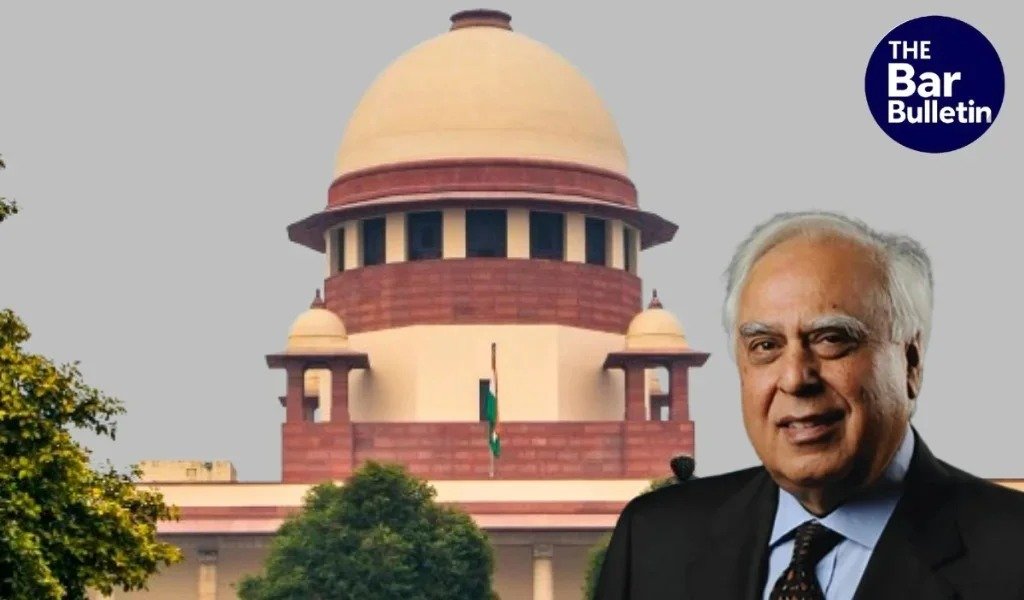
Senior Advocate Kapil Sibal, appearing for the Uddhav Thackeray faction in the Shiv Sena split matter, continued his submissions before the Supreme Court challenging the Speaker’s decision to recognise the Eknath Shinde faction as the real political party and to uphold the appointment of Shinde as leader and Bharat Gogawale as whip.
He submitted that the Tenth Schedule draws a clear distinction between a political party and its legislative party, and the Speaker could not treat a majority of MLAs as constituting the political party itself. He argued that the Speaker’s approach effectively undermined the anti-defection framework by allowing legislators to rely on a political party to win elections and subsequently detach themselves from that party.
“
“To hold that it is the legislative party which appoints the whip would be to sever the figurative umbilical cord which connects a member of the House to the political party. It would mean that legislators could rely on the political party for the purposes of setting them up for election, that their campaign would be based on the strengths and weaknesses of the political party and its promises and policies, that they could appeal to the voters on the basis of their affiliation with the party, but that they can later disconnect themselves entirely from that very party and be able to function as a group of MLAs which no longer owes even a hint of allegiance to the political party.”
He submitted that this was precisely the outcome the Tenth Schedule was intended to prevent. According to him, a legislature party is only a temporary group of elected legislators, whereas the political party is a permanent organisation registered with the Election Commission and existing beyond the life of a particular legislative assembly.
“
“A political party is a permanent body, registered with the Election Commission in terms of 29A. It may or may not contest elections, or even when it contests, it may not return any successful candidates. On the other hand, a legislature party is merely the group of legislators who at a particular time comprise the successful candidates belonging to the political party. Thus, by its very nature, a legislature party is temporary, and its existence is coterminous with the term of that House…If a majority group of legislators are held to represent the political party itself, the actual permanent organization outside the House would lose all significance… This would place the political party and its workers and supporters at the mercy of the machinations of opportunistic legislators, an outcome that the Tenth Schedule is designed to prevent and punish.”
Sibal further argued that the Speaker could not arrive at findings contrary to those already recorded by the Constitution Bench in Subhash Desai v. Principal Secretary, Governor of Maharashtra concerning the rival resolutions of June 21, 2022.
He submitted that the Constitution Bench had upheld the Deputy Speaker’s recognition of the resolution communicated by Uddhav Thackeray replacing Eknath Shinde as legislative party leader, while finding the Speaker’s subsequent recognition of the Shinde faction’s resolution invalid.
Mr Sibal contended that the Speaker’s conclusion that the Shinde faction constituted the political party was therefore “in the teeth” of the Constitution Bench’s categorical findings and liable to be set aside. Mr Sibal also argued that the respondents could not use their numerical majority in the legislature as an indirect substitute for the split defence, which was removed from the Tenth Schedule.
“
“If you allow this to happen, you will bring back split to the back door… A group of legislators, howsoever large in number, is bound to follow the directions of its political party, else they will be subject to disqualification, barring the limited exception of merger.”
He submitted that the legislature party has only limited relevance under the Tenth Schedule, principally in the context of the merger defence under Paragraph 4, which, according to him, was not available to the respondents in the present case.
Another major challenge concerned the Speaker’s decision to examine the 1999 Shiv Sena Constitution and use it to question the legitimacy of the 2018 leadership structure. Sibal argued that this inquiry itself was beyond the Speaker’s jurisdiction under Paragraph 6 of the Tenth Schedule.
He contended that allowing legislators to challenge the leadership under which they had contested elections would create a situation where MLAs could first obtain the benefit of the party’s identity and symbol and subsequently reject its leadership.
Mr Sibal also attacked the Speaker’s reasoning concerning the continued existence of the rival faction, comparing it to an unauthorised construction that cannot acquire legitimacy merely through the passage of time.
“
“The irony is, you base your legitimacy on an illegitimate act. And that illegitimacy continues for years. And then you will ultimately say to the court, now that it has continued for years, give me legitimacy. It’s like an unauthorized construction on government land. You construct, the government does nothing about it. Then at some point in time says this is government land, you say, but I have been there for a long time.”
Mr Sibal thereafter said he would proceed on the basis of undisputed facts rather than disputed documents. He pointed to the June 21 resolution by the rebel MLAs seeking to change the whip and reaffirm Shinde as legislative party leader, its communication to the Governor, their refusal to attend the June 22 meeting called by Sunil Prabhu, and their subsequent conduct.
He argued that these acts, viewed together, were sufficient to attract disqualification under Paragraph 2(1)(b) of the Tenth Schedule. He also relied on the respondents’ refusal to attend the legislative party meeting called by Sunil Prabhu, arguing that their assertion that Prabhu had no authority because they had appointed their own whip was itself material showing their rejection of the political party’s authority.
Sibal Seeks Freezing Of Shiv Sena Name And Election Symbol
Towards the conclusion of his submissions, Sibal also addressed the dispute over the Shiv Sena name and election symbol, arguing that the Shinde faction should not be allowed to retain the benefit of the symbol if its claim arose from conduct amounting to defection. He submitted that the symbol should instead be frozen, rather than allowing either faction to benefit from the disputed circumstances.
“
“The name belongs to Thackeray. The faction of Shinde cannot have the symbol. And the fact that they have enjoyed the benefit of that symbol is not a case of fait accompli. It’s a case of illegitimate use of a symbol. It should be frozen. He can’t have it. I can’t have it. It has to be frozen.”