
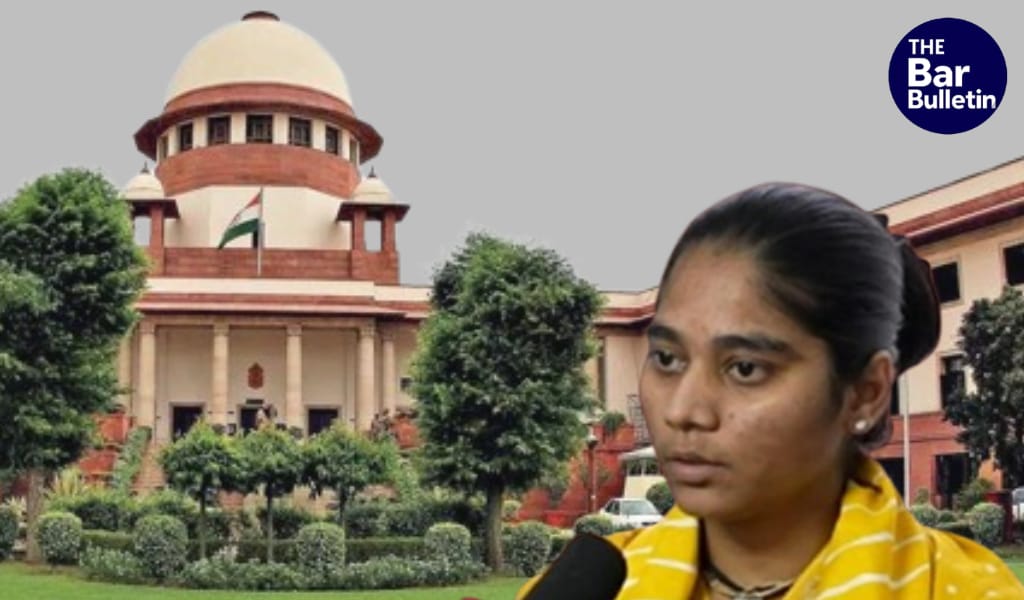

The Supreme Court on Thursday said it would examine whether an accused must necessarily be furnished written grounds of arrest, while hearing the State of Meghalaya’s challenge to the bail granted to Sonam Raghuvanshi, an accused in the Raja Raghuvanshi murder case.
Appearing for the State, Solicitor General Tushar Mehta submitted that the High Court had granted bail solely on the ground that written grounds of arrest had not been supplied. He argued that the remand order itself recorded that the accused was aware of the grounds of arrest and that written grounds had, in fact, been furnished, the only defect being a typographical error mentioning a non-existent statutory provision.
“
“So far as the supply of written grounds is concerned, now it is supplied. The only objection was that instead of Section 103, (BNS) by mistake Section 403, which does not exist, is mentioned. The grounds are supplied… The only mistake is a typographical error.”
The Bench of Justices Manoj Misra and Shree Chandrashekhar observed that the controversy raised an important legal issue in view of the apparent divergence between the Supreme Court’s decisions in Pankaj Bansal v. Union of India, (2024) 7 SCC 576 which held that grounds of arrest must be communicated in writing, and Vihaan Kumar v. State of Haryana, (2025) 5 SCC 799 which held that there is no mandatory requirement of written communication of grounds of arrest. The Bench noted that it would consider whether the issue warrants reference to a larger Bench.
“
“We will consider this matter at length. Submit written submissions. We will decide whether this matter also requires to be referred to a larger Bench or not, because the problem is that there are two judgments… Paragraph 45 requires communication of grounds in writing. Then there is another judgment… and then there is another judgment which says there is no requirement for grounds in writing. This is the conflict which is arising from the various coordinate Bench judgments.”
When the Solicitor General sought to demonstrate that the written grounds had been supplied and that the incorrect statutory provision was merely a clerical error, the Court remarked that it would first decide whether the ground on which bail was granted was legally sustainable. It observed that if the challenge to the bail order succeeded on that issue, the bail order would not survive; if not, the Court would then examine the other grounds.
Taking note of the seriousness of the allegations, the Court deferred the matter for further hearing on Tuesday, observing:
“
“There is some urgency, but because this is a very, very serious offence… List on Tuesday.”
Pending further consideration, the Court directed that the petitioner shall continue to abide by the conditions of the impugned bail order. The Court also directed the State to place on record photocopies of the documents relied upon to show that the written grounds of arrest had been furnished to the accused, observing that it would examine the issue in detail at the next hearing.
Appearances
For Petitioner: Mr. Tushar Mehta, Solicitor General Mr. Amit Kumar, Advocate General Mr. Avijit Mani Tripathi, AOR Ms. Vishakha, Adv. Ms. Arushi Malik, Adv. Mr. Luv Kumar, Adv. Mr. Himanshu Sehrawat, Adv.
For Respondent: Mr. Abhay Singh, AOR Mr. Zenith Chhablani, Adv. Mr. Jishnu Adhikari, Adv.
Also Read:Honeymoon Murder Case: Meghalaya High Court Upholds Bail Granted to Sonam Raghuvanshi