
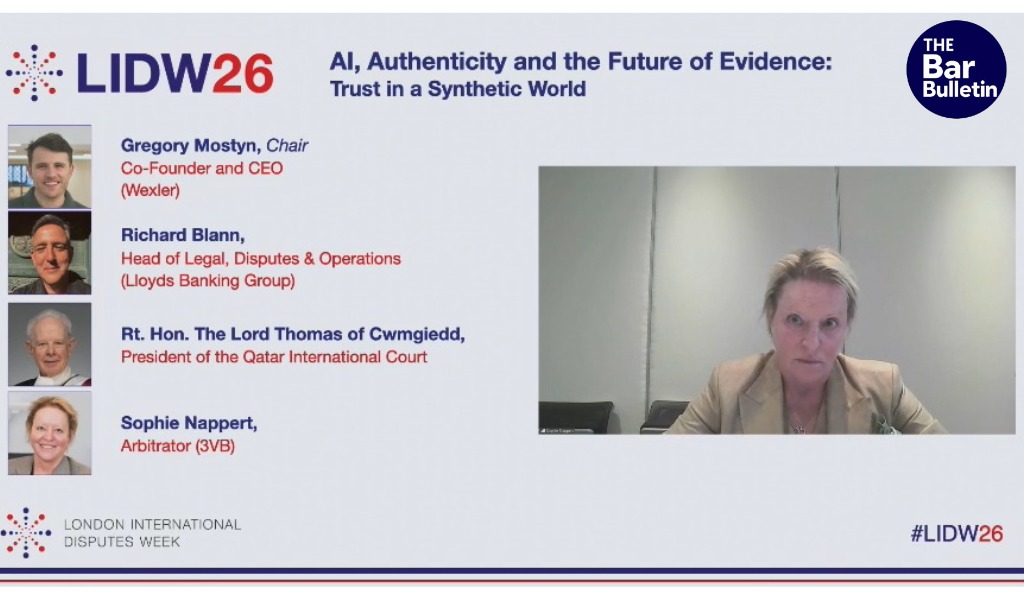

At London International Disputes Week (LIDW) 2026, a panel discussion on the theme “AI, Authenticity and the Future of Evidence: Trust in a Synthetic World” examined how courts and arbitral tribunals can preserve confidence in evidence amid the rapid advancement of artificial intelligence. The panel featured
- Mr. Gregory Mostyn, Co-Founder and CEO of Wexler
- Mr. Richard Blann, Head of Legal, Disputes & Operations at Lloyds Banking Group,
- Ms. Sophie Nappert, Arbitrator at 3VB, and
- Lord Thomas of Cwmgiedd, President of the Qatar International Court.

The discussion explored the challenges posed by AI-generated litigation, deepfakes, synthetic evidence, privilege, disclosure obligations and evidentiary reliability, while also examining whether existing procedural frameworks are equipped to address rapidly evolving technologies. The panellists discussed how courts and arbitral tribunals should assess authenticity in an age of AI-generated content, whether legal institutions are adapting quickly enough to technological change, the continuing importance of human judgement in dispute resolution, and the implications of AI for legal practice, access to justice and the future administration of justice itself.
Is AI Making It Too Easy to Bring Claims?

Opening the discussion, Mr. Gregory Mostyn observed that artificial intelligence is fundamentally altering the economics of dispute resolution by dramatically reducing the cost of generating claims, submissions and legal analysis. While AI may improve access to justice, he questioned whether it was also making it easier to bring large volumes of claims irrespective of their merits, leaving courts, tribunals and defendants to grapple with the resulting burdens.
Mr. Mostyn further suggested that AI would not reduce the need for lawyers but would instead reshape the nature of legal work. “I speak to partners and GCs all the time. And I do think there’s going to be a lot of legal work ahead ushering in this era responsibly, the framework for AI in the law, disputes generated from AI, from the application of AI, the geopolitical framework that Sean was discussing. I think it’s going to be a different type of work potentially, but there’s going to be a lot of law ahead,” he remarked, before inviting the panellists to consider how legal systems should respond to these developments.
Responding first, Mr. Richard Blann observed that corporations are already encountering large volumes of AI-generated complaints and claim documents. He said:
“People [are] using AI tools to generate thousands of pages of complaints or claim documents, whether litigants in person or backed by claims management companies, law firms, whatever. Whereas on the recipient side, the corporate still has to go through the exercise of examining the claim, assessing the merits and responding to it.”
Mr. Blann cautioned that while AI dramatically lowers the cost of producing claims, the burden of reviewing and responding to those claims remains largely unchanged for defendants.
Lord Thomas agreed that the issue posed significant challenges but distinguished between claims advanced by lawyers and those brought by litigants in person. While professional and ethical obligations provide safeguards in lawyer-led litigation, he noted that AI-generated claims by self-represented litigants may create new pressures on courts and dispute resolution systems.
Ms. Sophie Nappert added that AI is increasingly being used by smaller companies and parties who cannot afford extensive legal representation, particularly in arbitration. While this can improve access to dispute resolution, it also creates new procedural challenges for tribunals.
Are Tribunals Facing an Avalanche of AI-Generated Material?

Mr. Mostyn then questioned the impact of AI on the volume of information presented in disputes. Ms. Nappert highlighted the difficulties faced by arbitrators who must evaluate large quantities of AI-generated submissions and arguments. She said:
“I think as far as arbitration tribunals are concerned this presents procedural and due process challenges that are new and that are very real.”
She explained that arbitrators are increasingly required to distinguish persuasive and relevant material from what she described as an “avalanche of rhetoric” generated by AI systems.
Lord Thomas compared the current moment to the emergence of email evidence several decades ago. Although email dramatically increased the volume of potentially relevant documents, courts ultimately adapted through procedural innovation. He said:
“We managed to solve that by innovation and change. And I’ve got no doubt we will have to do the same.”
How Should Courts Respond to Deepfakes and Synthetic Evidence?
One of the central questions posed by Mr. Mostyn concerned the growing threat of fabricated evidence generated through AI.
Lord Thomas highlighted that procedural rules governing evidence would require significant modernisation to address deepfakes and synthetic content. He said:
“The Criminal Procedure Rules Committee, and no doubt the Civil Procedure Rules Committee, will have to modernise the rules about the admissibility of evidence to make certain that the accuracy of what is being put before a court is properly authenticated.”
He further stressed that courts cannot accept AI-generated material without understanding how it was produced.

Looking ahead, Lord Thomas expressed confidence that courts and tribunals would adapt to these challenges in much the same way they had responded to previous technological shifts. While acknowledging that the pace and scale of change brought about by AI is unprecedented, he emphasised that the fundamental principles governing the assessment of evidence remain unchanged. Lord Thomas also underscored the broader importance of courts and arbitral tribunals in preserving confidence in the rule of law amid technological disruption, observing that stable legal institutions remain essential to prosperity and social stability. He urged legal systems to be bold in embracing change while ensuring that technological innovation does not undermine the integrity of the justice system.
Do Existing Rules of Privilege Still Work?
Mr. Mostyn next asked how privilege doctrines should apply in a world where individuals increasingly communicate with AI systems. Mr. Blann noted that organisations are already grappling with the consequences of employees using AI tools in ways that create potentially discoverable records. Mr. Richard Blann expanded on the practical challenges organisations face in managing employee use of AI tools. He said:
“The use of AI tools mean people are engaging with something they think they can talk to and creating records. So there are all sorts of interesting privilege questions there, because if you’re talking to ChatGPT, are you talking to a third party? If you’re talking to your own AI tool, are you talking to a third party? How do you deal with all of those issues?”
 Mr. Blann added that organisations are increasingly being required to establish safeguards and educate employees on the responsible use of AI tools. According to him, businesses are still trying to determine how best to implement appropriate controls while ensuring that employees can benefit from the technology without inadvertently creating legal risks. He noted that companies across sectors are actively grappling with these issues as AI becomes more deeply integrated into day-to-day operations.
The panellists agreed that courts and legislatures are only beginning to confront these issues and that significant uncertainty remains.
Can Institutions Keep Pace with AI?
The discussion then shifted to whether legal institutions are adapting quickly enough to technological change. It was asked whether courts, legislatures and arbitral institutions were responding at an adequate pace, Mr. Blann replied candidly: “Is it fast enough? No.”
Ms. Nappert observed that technological innovation inevitably outpaces institutional reform, meaning courts, legislatures and arbitral institutions are often forced to react after new technologies have already become widespread. Lord Thomas emphasised the need for international cooperation, warning that AI-related abuses emerging in one jurisdiction would quickly spread to others. He said:
“We need to pool knowledge and develop as best we can rules, procedures, and intelligence, to deal with any abuse that AI can cause. Abuse can occur anywhere.”
He added that just as legal practice has become increasingly international, responses to AI-related threats must also be developed collaboratively across jurisdictions.
Will AI Change the Way Evidence Is Assessed?
Looking ahead, Mr. Mostyn asked whether AI-generated expert reports and AI-analysed evidence would become accepted features of dispute resolution. Lord Thomas suggested that while technology would transform the way evidence is generated and presented, the core judicial inquiry would remain unchanged.
“We’ve lived through great changes before. Although the change this time is vastly more complicated….Is it reliable? Is it relevant? And what weight can I attach to it? I’d be very surprised if we departed from that fundamental approach.”
Ms. Nappert agreed that human judgement would remain indispensable. “The last kilometre must remain human. It is absolutely important that throughout all of this, we have to advocate the place of the human in the game,” she said.
Mr. Blann similarly emphasised the continuing importance of human judgement but raised concerns about how future lawyers would acquire the experience necessary to exercise that judgement if many traditional training tasks become automated.
Advice to the Young Lawyers
Towards the end of the discussion, Mr. Mostyn asked each panellist what advice they would offer to junior lawyers entering practice during the AI era. Lord Thomas encouraged young lawyers to embrace AI while remaining cautious about its limitations. He said:
“Use AI because it’s good for your own work. Don’t trust it. Always look at it again.”
He recalled a recent case before the Qatar International Court in which AI-generated authorities cited by a party did not exist, underscoring the need for independent verification. Ms. Nappert urged young lawyers to focus on the human aspects of legal practice. She said:
“I would say to the young lawyers who are lucky enough to be ushered into this groundbreaking era … focus on the human side of being a lawyer.”
According to her, AI will free lawyers from routine tasks, allowing them to concentrate on advocacy, judgement and client relationships.
Can AI Improve Access to Justice?
The panel concluded with a discussion on AI’s potential benefits. Asked by Mr. Mostyn to identify the most positive contribution AI could make to the rule of law, Lord Thomas pointed to access to justice. “It is AI [that] gives the litigant in person a huge advantage,” he said.
Mr. Blann agreed that AI-powered dispute resolution systems could reduce burdens on courts and provide more accessible remedies for individuals deterred by the costs and complexity of traditional litigation. Ms. Nappert highlighted the success of online dispute resolution platforms and suggested that AI could play a significant role in resolving lower-value disputes more efficiently.
The discussion concluded with broad agreement that while artificial intelligence poses significant challenges for authenticity, privilege and evidentiary reliability, it also offers opportunities to improve access to justice and modernise dispute resolution. The central challenge for courts, arbitrators and practitioners, the panellists suggested, will be ensuring that trust, transparency and human judgement remain at the heart of the justice system in an increasingly synthetic world.