
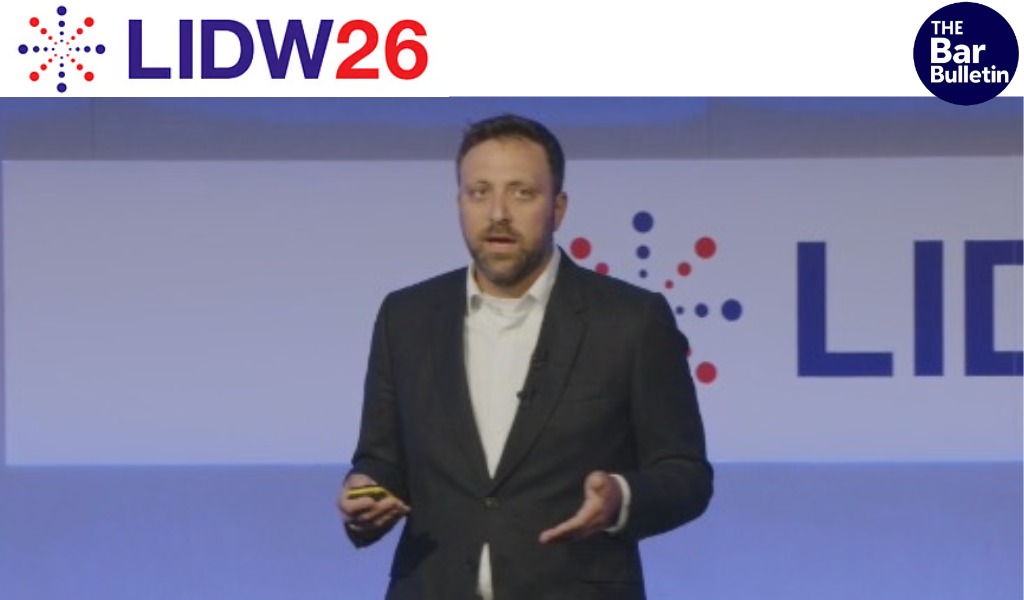

Speaking at London International Disputes Week (LIDW) 2026, Sean West, Co-Founder of The Unruly Corporation and Hence Technologies, stated that the world is experiencing an “international rule of law recession” marked by the erosion of global institutions, the rise of lawfare, rapid advances in artificial intelligence and increasing state intervention in commerce.
Delivering the keynote address at (LIDW) 2026, Mr West highlighted that businesses and lawyers are navigating a world where the assumptions that underpinned globalisation are rapidly eroding. Drawing from his book Unruly: Fighting Back When Politics, AI and Law Upend the Rules of Business, he outlined how disputes are increasingly being shaped by forces that originate outside traditional legal frameworks.
“The world is filled with norms that are being upended, rules that are being unsettled. Not just because of the volatility, but because literally the rules that we’ve all cut our teeth with during the globalisation era are falling away,” he said.”
The ‘Unruly Triangle’: Where Politics, Law and Technology Collide
Sean West focused on what he called “Unruly Triangle”, the simultaneous disruption of geopolitics, law and technology. While each of these developments individually creates uncertainty, their interaction produces entirely new forms of risk.
According to him, businesses are no longer dealing with isolated regulatory changes or geopolitical tensions. Instead, they face overlapping and mutually reinforcing disruptions that reshape commercial relationships, state behaviour and legal obligations. He described this convergence as fundamentally different from previous periods of instability because it alters the architecture of the global economy itself.
“We would be lucky if the only thing we were dealing with was volatile geopolitics. In fact, we have volatile geopolitics at the same time that the role of law and the rule of law is changing and that we’re witnessing massive, extensive technological innovation.”
International Rule of Law Recession
Mr West stated that the world is witnessing what he termed an “international rule of law recession”, marked by the weakening of multilateral institutions and the increasing use of legal tools as instruments of geopolitical power.
“We’re living through what I call an international rule of law recession. I’ve been writing about this for a few years. If you look at the data on rule of law that the World Justice Project pulls together, more countries have had a decline in rule of law than an increase in rule of law for almost the entire last decade.”
He pointed to the growing use of sanctions, secondary sanctions and legal mechanisms to achieve strategic objectives that were once pursued through military or diplomatic means. In his view, countries are increasingly deploying law itself as a weapon.
“This is when sanctions and lawfare become favoured tools that are used instead of firing missiles,” he said.
West suggested that businesses are now exposed to legal consequences arising from geopolitical conflicts even when they are not directly involved. Secondary sanctions, export controls and politically motivated regulatory actions can ensnare companies operating across multiple jurisdictions.
He also warned that executive power is becoming increasingly concentrated across many countries, creating legal uncertainty and raising concerns about institutional resilience.
“We’re living through what I call an international rule of law recession. More countries have had a decline in rule of law than an increase in rule of law for almost the entire last decade.”
New Realities: Deepfakes, Surveillance and Artificial Politics
On “artificial politics risk”, the intersection of politics and technology, he stated that technology is fundamentally altering how societies determine truth and legitimacy. The proliferation of AI-generated content, he said, creates what scholars describe as the “liar’s dividend”, a phenomenon where even genuine evidence can be dismissed as fabricated.
“We get so surrounded by fake information, by these deepfakes, it creates what’s called the liar’s dividend where we start to think real things are fake.”
Mr West also highlighted the emergence of sophisticated surveillance technologies capable of monitoring individual behaviour, financial transactions and political activity at unprecedented scale. He warned that advances in AI are enabling governments to exercise far greater control over information and public discourse than ever before.
According to him, the challenge is compounded by regulators’ inability to keep pace with technological innovation. While some jurisdictions seek stringent regulation of AI, others adopt a far more permissive approach, creating conflicting compliance obligations for multinational businesses.
Despite the risks, Mr West emphasized that artificial intelligence could become one of the most powerful tools for expanding access to justice. He described how AI-powered legal systems are already capable of assessing claims, generating legal documents and helping individuals pursue disputes without traditional legal representation. He recounted his own experience of using an AI-generated legal claim to challenge an insurance company’s refusal to compensate him following an accident.
“The fact is more and more citizens are going to be equipped with this technology, and they’re going to be able to take their disputes directly to the businesses.”
He stated individuals who previously lacked the resources to pursue claims could soon possess sophisticated legal tools on their smartphones. At the same time, he cautioned that the democratization of legal technology will create entirely new challenges for courts, regulators and businesses.
Lawsuits as Cyber Attacks
He then predicted that AI could transform litigation into something resembling cyber warfare. He argued that generative AI is making legal action increasingly inexpensive, creating opportunities for mass claims to be filed at scale. In such a scenario, businesses may face thousands, or even hundreds of thousands, of automated claims generated by AI systems.
“This gives rise to a phenomenon where generative AI makes legal action effectively free.”
Mr West compared future litigation strategies to phishing attacks in cybersecurity. Just as malicious actors send millions of emails hoping a few will succeed, legal actors could flood corporations with vast numbers of low-cost claims.
“We’re going to be in a world where we’re actually going to see a huge amount of legal spam, of cases that are basically phishing, filing hundreds of thousands of claims against corporations to see what can actually penetrate them.”
He cited examples of mass arbitrations filed against major corporations, illustrating how procedural systems can be overwhelmed when claims are generated at scale.
Rise of the Robot Lobbyists
Mr West also described how AI is beginning to reshape public policy and political advocacy. He referred to instances where AI-generated submissions and automated public comments influenced regulatory decision-making processes. According to him, AI-powered lobbying tools now allow organizations to generate and submit large volumes of policy feedback with minimal human involvement.
The result is a world where governments may struggle to distinguish genuine public participation from algorithmically generated advocacy campaigns. Such developments, he suggested, blur the line between democratic engagement and technological manipulation, raising difficult questions for regulators and policymakers.
Is Geopolitics Foreseeable? Rethinking Force Majeure and Contractual Risk
Turning specifically to dispute resolution, Mr West stated that lawyers must reconsider traditional contractual doctrines in light of recurring geopolitical disruption. He questioned whether events such as tariffs, sanctions, conflicts and regulatory interventions can genuinely be treated as unforeseeable when they have become recurring features of the global landscape.
“We need to think about a world where geopolitics and turmoil is the drumbeat against which all of our contracts are being made.”
According to him, courts are increasingly reluctant to accept broad force majeure arguments where geopolitical developments could reasonably have been anticipated. As a result, businesses and lawyers may need to draft more specific contractual provisions addressing particular geopolitical risks rather than relying on generic force majeure clauses.
The State Is No Longer a Referee; It Is a Player
He shared concerns regarding the changing role of the state in commercial activity. Historically, governments functioned primarily as regulators, lawmakers and dispute resolution venues. Mr West stated that states are now increasingly active participants in economic transactions and strategic industries.
“The state is now at the table. For hundreds of years, contracts are a contract between two parties. But actually, the state is silently there now, not just as the referee, not just as the host or the venue, but actually as a player. And now you might say, well, the state’s always made regulation. They’ve always made taxes. They’ve always changed laws. And that’s true. But they’re now doing this not in a general way. They’re doing it in a specific way.”
He pointed to examples of governments directly influencing commercial decisions through export controls, industrial policies and strategic interventions. Unlike traditional regulation, these measures are often targeted at specific companies, industries or transactions. Moreover, such interventions can evolve rapidly, driven by political developments and public messaging.
“We’re in a world where the state is actually transacting and the state’s position is shifting at the speed of a tweet.”
The Multi-Forum Reality of Modern Disputes
Mr West concluded by highlighting the increasingly interconnected nature of disputes. A single government policy, regulatory measure or geopolitical event can simultaneously generate litigation, arbitration, insurance claims, trade disputes and regulatory investigations across multiple jurisdictions.
“We increasingly need to think about multi-forum strategies and sequencing.”
According to him, dispute lawyers can no longer optimize for a single proceeding. Instead, they must understand how claims and risks travel across legal systems and regulatory frameworks. As the boundaries between politics, law and technology continue to blur, West urged legal professionals to take an active role in preserving the institutions that underpin the rule of law.
“These institutions are eroding. That is a fact. It’s happening in front of us. But we all have many moves we can play if we want to see them persist.”
He left the audience with a question: “In an unruly world, what are you doing to sustain the infrastructure that you rely on?”