
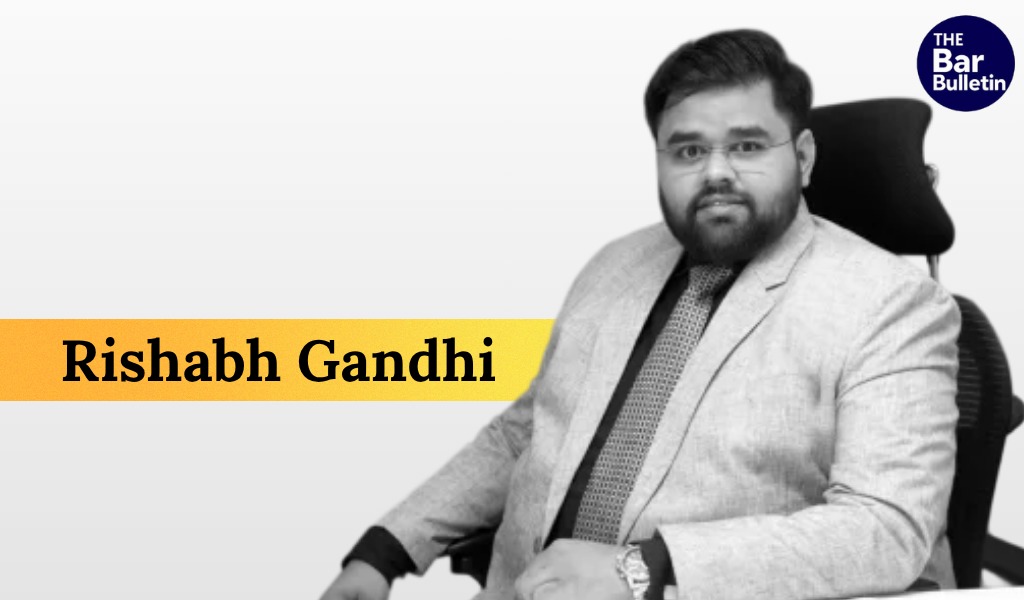

Dr. Rishabh Gandhi is an Advocate, Arbitrator, Mediator and former Trial Court Judge whose practice focuses on commercial disputes, arbitration and mediation in infrastructure, construction, real estate and regulatory matters. Alongside practice, Dr. Gandhi writes on arbitration reform, AI and law, end-of-life jurisprudence and constitutional questions. Recently awarded a Ph.D. in Law for research on religious death practices in Jainism, he continues to engage with the ethical and philosophical dimensions of law.
In this conversation with The Bar Bulletin, he reflects on his journey from the Bench to the Bar, the evolution of arbitration and mediation in India, the ethical use of AI, mentoring young lawyers, and the values that shape his approach to law and conflict resolution.
Q1. Take us back to the very beginning of your legal journey. What were the early influences that shaped the way you think about law and practice today?
Looking back, those early years shaped me in ways I still carry every day. Working at the Bombay High Court under Hon’ble Dr. D. Y. Chandrachud was not just about learning law. It taught me how to think. I saw, very closely, how complex issues can be broken down to first principles. That clarity stays with you. Even today, when I am stuck on a matter, I find myself going back to that way of thinking.
The early years of practice also gave me a strong foundation. Appearing before the Bombay High Court, trial courts, the NCLT, and in arbitration matters exposed me to different forums, different styles of advocacy, and different kinds of disputes. It taught me that law is not practised in one uniform way. The discipline required before a constitutional court is different from the immediacy of a trial court, and arbitration has its own rhythm of strategy, evidence, and commercial sense.
My time as a Trial Court Judge shaped me differently. There, law stops being abstract. You are not just dealing with files or arguments. You are dealing with people, families, emotions, and consequences that are very real. That experience humbles you. It makes you aware that every order affects someone’s life in a tangible way.
If I look back now, those years gave me clarity, a strong sense of fairness, and empathy. I do not see empathy as a weakness. I see it as a discipline. And that combination still guides how I practise law today.
Q2. Having served on the Bench early in your career, what drew you back to active practice, and what did that transition teach you?
Stepping away from the Bench was not an easy decision, and it was not something I had planned. It came from a mix of personal and practical reasons, including health, that I had to take seriously. At the same time, there was a strong pull back towards practice. I missed being in the middle of things, engaging directly with clients, shaping arguments, and building something through advocacy. Perhaps, in hindsight, I had entered the judiciary at a very early stage of my professional life. The experience was invaluable, but I also felt that there was a lot more I wanted to do in active practice. Returning to the Bar gave me that space.
Returning to practice after having served on the Bench changes you. You become far more conscious of time, of clarity, and of what actually assists a court or a tribunal. You also begin to see that fairness is not only about the final outcome. It is equally about the process that leads to it. That perspective has stayed with me. Whether I am appearing as counsel or working in arbitration or mediation, I carry both sides of that experience with me. It keeps me grounded. It reminds me that the role of a lawyer is not just to win, but to resolve disputes in a way that can withstand scrutiny and feels fair to those involved.
Q3. Once you returned to practice, you decided to build your dispute resolution and ADR firm. What led you to take that step, and what were the early realities of starting out?
After returning to the Bar, I felt a strong need to work in a way that reflected my own temperament and values. I wanted the freedom to decide how matters were handled, how advice was given, and how much time and care each case deserved. Starting an independent practice felt like the natural way to do that.
There was also a practical foundation. Some of the clients I had represented before joining the judiciary came back when I returned to practice. That trust meant a lot. Around the same time, the arbitration and mediation space was also growing, and I found myself increasingly drawn towards dispute resolution, commercial conflicts, and ADR work. But I did not want the firm to be narrow. I wanted to build a broader practice where litigation, arbitration, mediation, and advisory work could support each other. The early phase was demanding. There was uncertainty, long hours, and the constant pressure of making things work without the safety net of an established setup. Even when clients trusted you, you still had to prove yourself every day.
Over time, I realised that building a practice is not about quick growth. It is about consistency. You show up every day, do the work carefully, and stand by what you say. Slowly, that begins to compound. That is how the firm took shape.
Q4. You have sat as an arbitrator in both ad hoc and institutional arbitrations. How has that experience shaped your understanding of dispute resolution?
Sitting as an arbitrator really changes the way you look at disputes.
As counsel, you are obviously focused on your client’s case. You test the facts, build the argument, and try to present it in the strongest possible way. But when you sit as an arbitrator, you realise how important it is to step back and ask: what is the real controversy here? What actually needs to be decided? And has each side had a fair opportunity to put its case?
My time on the Bench helped me a lot here. It had already trained me to listen carefully, manage proceedings fairly, and separate noise from what is legally relevant. That discipline becomes very useful when you sit as an arbitrator. I have also realised that arbitration is not about how loudly something is argued. It is about clarity, credibility, preparation and the quality of assistance given to the tribunal. Sometimes a short, precise submission is far more useful than a long, aggressive one.
Working in both ad hoc and institutional arbitrations has taught me a lot. Institutional arbitration gives you structure, timelines and administrative support. Ad hoc arbitration gives you flexibility, but it also places greater responsibility on the tribunal to manage the process well. My association with institutions like CIArb helped me see arbitration as part of a larger professional discipline. It is not just about deciding disputes. It is about neutrality, ethics, procedure, efficiency and trust.At the end of the day, parties may not always be happy with the result. That is the nature of adjudication. But they should be able to say: we were heard, the process was fair, and the decision was reasoned. For me, that is the real test of arbitration.
Q5. You are also trained and empanelled as a mediator, including with DLSA Pune and through the Supreme Court Mediation and Conciliation Project Committee. How does mediation differ from arbitration in the way you approach conflict?
Mediation changes the entire lens. In arbitration, someone ultimately decides. In mediation, the mediator has to build trust so that both sides feel safe enough to move from positions to solutions. A mediation is only as good as the mediator’s ability to listen, understand the real interests, manage emotions, and keep the process fair. What I like about mediation is that it does not require one party to feel completely defeated. If handled well, both sides can walk away with something workable. That is why mediation, at its best, is not about compromise alone. It is about resolution with dignity.
Q6. Your practice spans sectors such as infrastructure, construction, real estate, pharma, IT, and FMCG. What common patterns have you seen across such different industries, and how do you adapt your legal strategy from one sector to another?
At first glance, these sectors look very different. Infrastructure often involves government contracts, tender conditions, delays, extensions of time, payments and public-sector decision-making. Construction disputes have their own rhythm, with site realities, certification issues, technical evidence and delay analysis. Real estate brings in buyers, developers, regulatory obligations and very human expectations. Pharma, IT and FMCG again operate with completely different pressures.
But once you go deeper, you start seeing common threads. Every client, no matter the sector, wants clarity, risk management and a solution that allows them to move forward with confidence. What changes is the texture. In pharma, compliance may dominate. In IT, speed and innovation matter. In FMCG, scale and distribution are critical. As a lawyer, you have to tune yourself to that rhythm. It is almost like switching channels. The fundamentals are the same, but the soundtrack is different.
The real challenge is adaptability, and that is something I enjoy. You cannot become complacent. You have to listen carefully, ask the right questions, understand the commercial pressure, and then apply legal principles with precision. Good lawyering is not about pretending to know every technical detail of an industry. It is about understanding enough to give advice that is legally sound, commercially sensible, and useful to the client.
Q7. As an arbitrator and mediator, what mindset shift is needed for ADR to become a real alternative to litigation in India?
The biggest shift has to be in how lawyers, clients and courts look at ADR. Too often, arbitration or mediation is treated as something to try after litigation becomes slow or expensive. That mindset has to change. ADR should not be the last resort. In many disputes, it should be the first serious option.
For lawyers, it means understanding that resolution is not always about defeating the other side. In mediation especially, success is when both parties walk away with something workable. For clients, it means trusting a process that may be less dramatic than court, but often more efficient, confidential and commercially sensible. Courts also have an important role. Early and meaningful referral to ADR can prevent many disputes from becoming unnecessarily bitter. If lawyers, clients and judges begin to see ADR as a primary path, not a compromise, India can make a real shift.
Q8. As India’s legal system evolves, especially in arbitration and ADR, what reforms or innovations are needed for India to become a global hub for dispute resolution?
India has the talent, the institutions and the commercial activity to become a serious dispute resolution hub. But talent alone is not enough. What parties look for is predictability, speed and trust.
The first issue is finality. If arbitral awards are interfered with too easily, or if judgments create uncertainty around the finality of awards, parties begin to wonder whether arbitration is really an alternative to litigation or just another step before litigation. That perception has to be addressed. Courts have an important supervisory role, but that role must remain within the discipline of the statute.
The second issue is delay. Arbitration cannot start resembling civil litigation. If pleadings, evidence, arguments and awards take years, the commercial purpose of arbitration is defeated. Arbitrators also have a responsibility here. Awards must be reasoned, clear and original. If awards appear mechanical or copy-pasted, the process loses credibility very quickly.
Third, we need consistent policy support. At times, government departments or public sector bodies have appeared hesitant about arbitration, and some policy signals have discouraged arbitration. That sends the wrong message. If India wants to be an arbitration-friendly jurisdiction, the State itself must show confidence in arbitration.
Technology can help. Digital filings, hybrid hearings, AI-assisted case management and better institutional administration can reduce time and cost. But technology is only a tool. The real reform is cultural: respect finality, enforce timelines, appoint credible arbitrators, write better awards and treat arbitration as a serious adjudicatory process. If we get these basics right, India does not have to imitate Singapore, London or Paris. It can build its own credible model of dispute resolution. India is moving in the right direction with institutions and training, but we still have a long way to go. We need a stronger culture of accountability, clearer standards, and a willingness among arbitrators to step aside when needed. At the end of the day, arbitration is built on trust. If we uphold ethics uncompromisingly, India won’t just be known for arbitration it will be respected for the quality and integrity of its arbitrators.
Q9. AI is already entering legal research, drafting, arbitration and mediation. What ethical challenges do you see, and how should lawyers, arbitrators and mediators respond?
AI in law is already here. So the real question is not whether lawyers should use it, but how responsibly they use it.
The first concern is hallucination. In law, a wrong case, a fabricated citation, or an invented proposition can cause real damage. The second concern is bias. If the material on which the system is trained is biased, the output may carry that bias, sometimes very quietly. The third is transparency. If a tool gives you an answer but you cannot trace the reasoning, you have to be careful before relying on it in court or arbitration. And finally, accountability. If something goes wrong, the lawyer cannot say, “the software did it.” Responsibility must remain with the human professional.
I do see value in AI. It can assist in research, chronology building, document review, drafting support, scheduling, translation and case management. In mediation, it may even help parties understand patterns in disputes or possible settlement ranges. All of this can save time and cost. But the line must be very clear. AI can assist the process. It cannot replace the human mind that decides, evaluates, listens or persuades. Arbitration requires judgment. Mediation requires empathy. Both require trust.
My view is simple: use AI, but do not surrender judgment to it. AI can sit at the table, but it should never sit on the chair.
Q10. In a profession driven by speed, results and commercial pressure, how do you keep ethics and values central to your practice?
Speed is important. Clients need timely answers, and lawyers cannot hide behind idealism. But speed without ethics is dangerous. A quick answer that is careless, unfair or misleading can do more harm than a delayed one.
For me, the anchor is consistency. Whether I am drafting, arguing, advising a client or sitting as an arbitrator, I ask myself a few basic questions: is this fair, is this honest, and can I stand by it later? That self-check matters.
Sometimes ethics means telling a client something they may not want to hear. Sometimes it means refusing a shortcut. It may slow you down for a moment, but in the long run it protects your credibility. I think values are not something separate from practice. They are the foundation of practice. Cases end, awards get challenged, deals close. What remains is reputation. And reputation is built not only by success, but by the way you conduct yourself while pursuing it.
Q11. You have taught law, mentored young lawyers and worked with interns over the years. What do you think young lawyers need most today: technical skill, values, or exposure?
They need all three, but not in the same order at every stage.
In the beginning, technical skill matters a lot. Young lawyers must learn how to read a file, draft clearly, research properly, understand procedure, and assist the court or tribunal. There is no substitute for that groundwork. But skill alone is not enough. Values decide how that skill is used. A bright lawyer without discipline, integrity or patience can become dangerous very quickly. The profession tests you constantly, especially when shortcuts are available. Exposure is equally important. Young lawyers should see courts, tribunals, client conferences, mediations, arbitrations and negotiations as early as possible. Law cannot be learnt only from books or PDFs. So, build skill, protect values, and seek exposure. That combination creates not just successful lawyers, but dependable professionals.
Q12. You have written widely on arbitration, end-of-life jurisprudence, Jainism, AI and law, and constitutional questions, and you are also working on a book. What role does writing play in your professional life?
Writing plays a very important role in my professional life because it forces clarity. In court or arbitration, sometimes you are reacting in the moment. But writing makes you slow down, organise your thoughts, test your assumptions, and ask whether an argument really holds together.
A lot of what I write comes from practice itself. Sometimes a matter raises a larger legal question. Sometimes a constitutional issue overlaps with technology, ethics, religion or commercial law. Writing gives me the space to explore those intersections more deeply.
I also enjoy the fact that writing allows legal conversations to go beyond courtrooms. An article may reach a young lawyer, a student, a businessperson, or even someone outside the legal profession entirely. That wider engagement matters to me.
And yes, I am also working on 2 books presently, one on arbitration and another relating to my doctoral research. It will take another year to complete. That process has been both demanding and rewarding because book writing requires a different level of discipline and depth. You cannot rely on surface-level understanding. It pushes you to study the law much more rigorously.
For me, writing is not separate from practice. It sharpens practice. It improves advocacy, deepens research, and keeps you intellectually honest.
Q13. You were recently awarded a Doctorate in Law for your work on freedom of religion and religious death practices in Jainism. What was the core focus of your doctoral research?
My doctoral research was titled Ethico-Legal Dimensions of Religious Death Practices in Jainism. At one level, it examined Sallekhanā, Santhārā and Samādhimaraṇa. At another level, it became a much deeper inquiry into law, religion, death, dignity, autonomy, faith, ethics, community, and constitutional limits. I approached the subject from multiple angles. It was not only a doctrinal or legal study. It also had ethical, sociological, psychological, ethnographic, bioethical, and philosophical dimensions. I conducted fieldwork across India, collected more than 4,000 questionnaire responses from Jain monks, nuns, scholars, practitioners and members of the Jain community, and interviewed more than 50 retired judges, lawyers, law teachers, professors, religious scholars and professionals. So the research was not only about what the law says, but also about how the practice is understood by those who live within that tradition and those who evaluate it from outside. The central question was delicate: how should constitutional law understand a religious practice that deals with the final stage of life, voluntary renunciation and spiritual discipline? Should it be viewed only through the lens of suicide, or should it also be examined through religious freedom, dignity, autonomy, conscience and safeguards?
I began with adverse hypotheses. I tested the strongest objections and questioned my own assumptions. That was important because a subject like this cannot be approached with predetermined conclusions. Ultimately, through doctrinal, legal, ethical and empirical research, I disproved my own hypotheses. The thesis does not argue for an unrestricted right to die. That distinction matters. It argues for a constitutionally sensitive, ethically informed, empirically supported and procedurally safeguarded understanding of a distinctive Jain religious practice. For me, the research changed something deeper. It did not merely produce a degree. It changed the way I understand law, faith, life and death.
Q14. You were recently recognised internationally through the Emerging Scholar Award at Sapienza University, Rome, and the Process Studies & South Asia Fellowship at the University of California, Irvine. How have these experiences shaped your research, and what connections do you see between Jain philosophy, Sallekhanā, law, ethics, and contemporary global thought?
Both experiences have been deeply meaningful, but in different ways.
The recognition at Sapienza University, Rome, was very special. To speak about Sallekhanā, a deeply Indian and Jain practice, in one of Europe’s oldest academic settings felt like a bridge between worlds. I remember thinking, here we are discussing an ancient Jain practice in a hall filled with scholars from across continents, and it resonated. That stayed with me. For me, the award was encouraging, but more than that, it gave me perspective. Questions about faith, law, dignity, death, autonomy, and tradition are not only Indian questions. They are global questions. Whether one looks at euthanasia in Europe, assisted dying in Canada, or Sallekhanā in India, the deeper question is similar: how does law respond to the most intimate choices human beings make?
The UCI Process Studies and South Asia Fellowship came at the right time for me. What I find exciting, and a little humbling, is that it allows me to look at Sallekhanā not only as a religious or legal question, but also through philosophy, especially process philosophy. I am now exploring ideas of becoming, completion, perishing, personhood, and liberation in conversation with Jain thought.
As a lawyer, I am trained to think in terms of rights, duties, evidence, and institutions. But when philosophers, anthropologists, and religious studies scholars look at the same practice, they ask different questions. That pushes me out of my comfort zone, in a good way. So both Rome and UCI have helped me see that work rooted in Jain tradition can still speak to global academic debates. It also brings responsibility. The more international the conversation becomes, the more careful one has to be with doctrine, language, and interpretation.
Q15. As someone deeply engaged with Jain philosophy and daily spiritual practice, does spirituality influence the way you approach law and conflict resolution?
Yes, it does. For me, spirituality is not separate from law. It quietly shapes the way I look at conflict.
Jain philosophy, especially the idea of anekāntavāda, teaches that reality is often many-sided. That has influenced me deeply. In a dispute, it is very easy to see only one side as right and the other as wrong. But many conflicts are really about competing truths, competing fears, and competing expectations. That perspective helps in law, arbitration and especially mediation.
Spirituality also teaches restraint. In this profession, one can easily get carried away by ego, aggression or the need to win every point. My daily practices, including visiting the temple and grounding myself in discipline, help me remain centred. They remind me that the goal is not always victory. Sometimes the real goal is balance, dignity and resolution.
So yes, spirituality is personal, but it also influences my professional life. It guides how I deal with clients, how I understand disputes, and how I try to resolve conflict.