
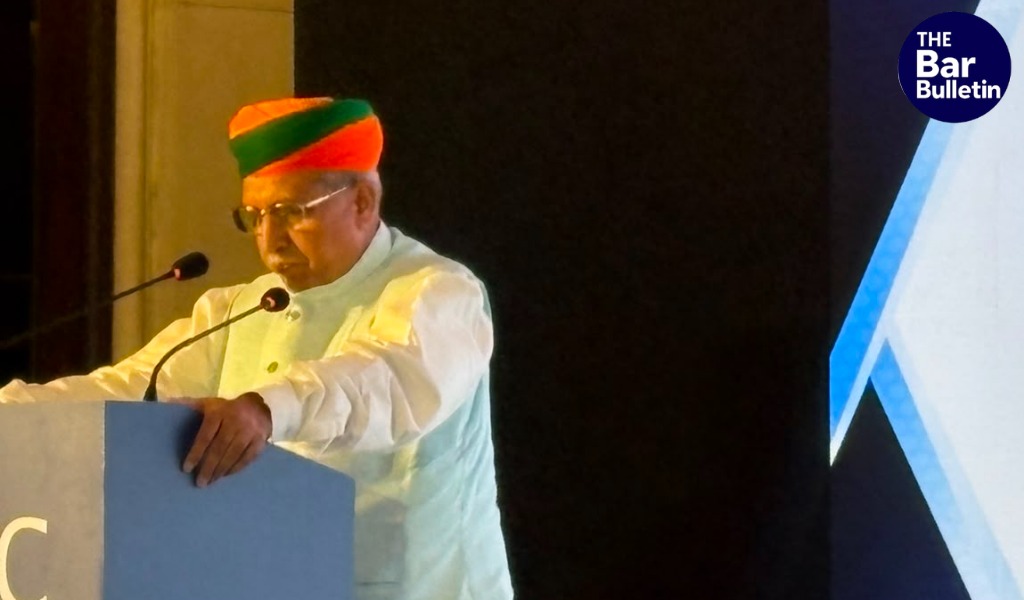

Speaking at the SIAC Annual India Conference 2026, Union Minister for Law and Justice Arjun Ram Meghwal on Saturday said that, with the 21st century widely recognised as the “century of Asia”, India and Singapore have a unique opportunity to shape the future of international arbitration and commercial dispute resolution. Calling for deeper cooperation between the two countries, he envisioned a model arbitration ecosystem founded on neutrality, commercial certainty, institutional excellence and innovation. The occasion also marked the official inauguration of the Singapore International Arbitration Centre’s (SIAC) Delhi Liaison Office by Meghwal and Singapore’s Minister for Law, Edwin Tong.
Shree Meghwal emphasised that this expansion reflects the global legal community’s surging confidence in India’s legal ecosystem and cements the nation’s rising status as a preferred destination for international commercial dispute resolution. Tracing the cultural roots of alternative dispute resolution in the subcontinent, the Law Minister reminded the audience that mediation and fair adjudication are embedded in India’s historical identity. He connected ancient governance to modern legal frameworks, illustrating a clear continuity of values.
“
“India’s engagement with arbitration is not merely a product of modern commercial law. It is deeply rooted in our civilisational ethos. The Mahabharata reminds us that Lord Krishna first sought dialogue and mediation before conflict. Kautilya’s Arthashastra recognised the importance of impartial adjudication for commerce, while our merchant guilds and the tradition of ‘Panch Parmeshwar’ developed trusted mechanisms for resolving disputes with fairness and consistency. In many ways, India’s journey from Panch Parmeshwar to modern international arbitration is the story of our nation’s evolution from traditional, community-based justice to a globally trusted, rule-based dispute resolution framework.”
The Law Minister highlighted that under the leadership of Prime Minister Narendra Modi, the government has executed aggressive, far-reaching legislative reforms to slash judicial intervention and elevate institutional arbitration. He pointed to successive amendments to the Arbitration and Conciliation Act in 2015, 2019, and 2021, alongside the Commercial Courts Amendment Act 2018, as structural pillars engineered to ensure the speedy disposal of high-value commercial disputes. Furthermore, he lauded the landmark Mediation Act 2023 for introducing a comprehensive framework that formally recognises mediated settlement agreements, providing corporate investors with total legal certainty.
He asserted that these legislative overhauls are perfectly synchronised with a progressive, pro-arbitration approach adopted by the Indian judiciary, which strictly respects party autonomy and enforces arbitral awards with minimal interference. He noted that as multinational corporations rapidly establish Global Capability Centres (GCCs) across India amid global geopolitical uncertainty, a bulletproof legal framework is a prerequisite for sustained investor confidence.
“
“We believe that in fast-growing economies, investor confidence depends not only on economic opportunities but also on legal certainty and the timely enforcement of commercial rights. The 21st century is widely acknowledged as the century of Asia, and within this Asian century, India and Singapore have a unique opportunity to shape the future of international arbitration and commercial dispute resolution. Both our countries are vibrant democracies sharing a firm belief in the rule of law. Together, we can present before the world a model arbitration ecosystem founded on certainty, institutional excellence, and innovation.”
The Law Minister concluded by highlighting the ongoing digital transformation of the Indian justice delivery system, driven by the expansion of the e-Courts Mission Mode Project. He noted that virtual hearings, e-filing, complete digitisation of court records, and AI-driven judicial initiatives are collectively building a transparent, accessible, and future-ready digital justice ecosystem.