
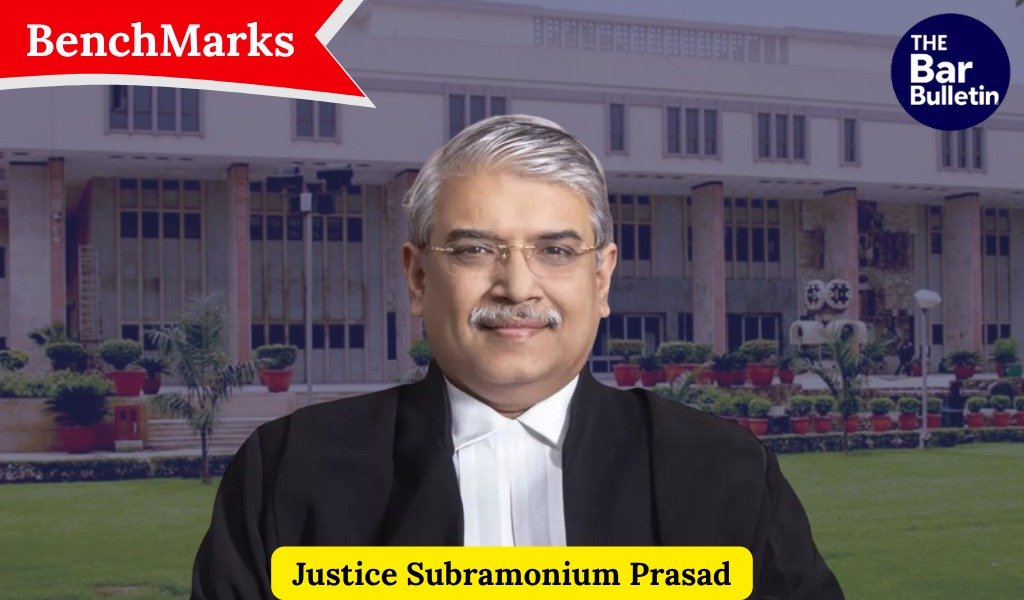
Justice Subramonium Prasad of the Delhi High Court has recently drawn attention for adjudicating two cases arising from protests in the national capital involving members of the Cockroach Janata Party (CJP) and the All India Students’ Association (AISA). In one, he heard a challenge by CJP leaders Saurav Das and Ashutosh Ranka to an order extending their judicial custody. In another, he dismissed AISA president Neha Bora’s challenge to a show-cause notice issued by a Special Executive Magistrate, asking her to explain why she should not furnish a bond to maintain peace during an inquiry. The cases have brought his judicial approach to preventive proceedings, public order and the scope of judicial review into focus.
The proceedings involving Saurav Das and Ashutosh Ranka came before Justice Subramonium Prasad on October 21, 2026, after the CJP leaders challenged an order extending their judicial custody in proceedings concerning an alleged violation of a peace bond. Justice Subramonium Prasad questioned the maintainability of their petition under Article 226 of the Constitution in view of the alternative statutory remedy available to them.
Two days later, Justice Subramonium Prasad delivered a judgment in Neha Bora v. State of NCT of Delhi, dismissing the AISA president’s challenge to a show-cause notice dated October 17, 2026, issued under Sections 126 and 130 of the Bharatiya Nagarik Suraksha Sanhita, 2023 (BNSS).
While these cases have drawn attention to questions surrounding peaceful protest, preventive proceedings and the scope of judicial review, they represent only a small part of Justice Prasad’s judicial work. Since joining the Madras High Court in 2018 and subsequently moving to the Delhi High Court in 2020, he has dealt with a wide range of disputes spanning criminal law, constitutional questions, commercial litigation, public authorities, the rights of individuals and several politically sensitive and high-profile cases that have attracted considerable public and media attention.
These include proceedings relating to former BJP MLA Kuldeep Singh Sengar in the Unnao rape case, the personality rights case of AAP leader Raghav Chadha, and cases arising from the 1984 anti-Sikh riots, placing his judicial work within a broader spectrum of contentious legal issues with significant political and public ramifications.
Early Life, Education and Practice
Justice Subramonium Prasad’s judicial career extends well beyond these recent matters. Before joining the Bench, he practised for decades before the Supreme Court and handled cases spanning constitutional law, criminal law, taxation, corporate and commercial disputes, election law, service law and inter-State river water disputes. His professional background placed him across several areas of litigation before his appointment as a judge.
Justice Prasad graduated with a B.Com. (Honours) degree from the University of Delhi and obtained his LL.B. from the university’s Campus Law Centre in 1990. He cleared the Advocate-on-Record examination in 1996 and subsequently began independent practice.
His work before the Supreme Court included representing the State of Tamil Nadu. He was appointed Standing Counsel for the State in 2003 and continued in that position until 2006. He also represented the custodian appointed under the Special Court (Trial of Offences Relating to Transactions in Securities) Act, 1992, in matters connected with the stock exchange scam of that year. In October 2012, he was appointed Additional Advocate General for Tamil Nadu before the Supreme Court. He was designated a Senior Advocate by the Supreme Court in April 2015.
After a career at the Bar spanning approximately 28 years, Justice Prasad was appointed an Additional Judge of the Madras High Court on June 4, 2018. His tenure there was followed by a transfer to the Delhi High Court, where he assumed office as an Additional Judge on March 13, 2020. He was confirmed as a permanent judge on March 17, 2020.
His professional experience before the Supreme Court and his subsequent judicial appointments have taken him through different branches of law, from commercial and tax disputes to criminal and constitutional questions.
Key Judgments & Orders of Justice Subramonium Prasad
1. 1984 Anti-Sikh Riots: Delhi High Court Orders Retrial
Justice Subramonium Prasad authored a judgment for a Division Bench of the Delhi High Court in a suo motu case (Court on Its Own Motion v. Dhanraj & Ors., CRL.REV.P. 245/2017) that raised serious concerns over investigative lapses and the handling of trials arising from the 1984 anti-Sikh riots. In the judgment delivered on August 11, 2025, the Bench, comprising Justice Prasad and Justice Harish Vaidyanathan Shankar, directed the trial court to make efforts to reconstruct records of three criminal cases in which the accused had been acquitted in 1986. The proceedings arose from complaints concerning the killings of Sikh men and the destruction of homes and a gurdwara in Delhi’s Raj Nagar area in the aftermath of former Prime Minister Indira Gandhi’s assassination.
The Court found prima facie deficiencies in the investigation and the manner in which the original trial proceedings had been conducted. The Bench also questioned how the cases had been concluded without a proper effort to ensure that material evidence was brought before the court. Emphasising the gravity of the alleged crimes and the failure of the criminal justice process to adequately address them, the Bench observed:
“
“The complaints disclose horrifying crimes against humanity. The complaints also point out that male members of one community were singled out for elimination. This suggests that these were no ordinary crimes, or ‘simple’ murders (if ever a murder could be termed as ‘simple’). Treated as individual cases, while the culprits got away scot free, everybody else, the police, the prosecutors, even the courts, appear to have failed the victims, and, most importantly society. Perhaps, had these terrible offences in 1984 been punished and the offenders brought to book, the history of crime in this country may have been different. We are of the view that if we fail to take action even now, we would be miserably failing in our constitutional duty as well as in discharging judicial function.”
As an immediate step, the High Court directed the jurisdictional trial court to make its best efforts to reconstruct the records, drawing on all possible sources. It called upon the CBI, Delhi Police, public prosecutors, counsel for the accused and counsel for the complainants to extend full cooperation, and directed the trial court to submit a detailed report on the reconstruction exercise.
2. Suspending the Sentence of Kuldeep Sengar in Unnao Rape Case
Justice Subramonium Prasad authored another judgment for a Division Bench of the Delhi High Court, comprising him and Justice Harish Vaidyanathan Shankar, on December 23, 2025, suspending the sentence of former Uttar Pradesh MLA Kuldeep Singh Sengar during the pendency of his criminal appeal in the Unnao rape case. The judgment was delivered in Kuldeep Singh Sengar v. Central Bureau of Investigation, CRL.A. 53/2020, on an application seeking suspension of sentence under Section 389(1) read with Section 482 of the Code of Criminal Procedure, 1973.
The Court prima facie held that Section 5(c) of the POCSO Act was not attracted for the purpose of suspension of sentence, questioning whether Sengar, as an MLA, qualified as a public servant. It noted that he had spent around seven years and five months in custody and suspended his sentence subject to conditions, including ₹15 lakh security, restrictions on approaching the survivor’s residence, passport surrender and weekly police reporting, while directing continued protection for the survivor.
Emphasising that concerns over the survivor’s safety should be addressed through protective measures, the Court observed:
“
“The Courts cannot keep a person in custody being apprehensive that the police/paramilitary may not do its job properly. Such an observation or such a thought process would undermine the laudable work of our police/paramilitary forces. The concerned DCP of the area where the Victim is currently residing, is directed to personally ensure and supervise the protection given to the Victim/Survivor during the pendency of the Appeal. The State is also providing for the accommodation of the Victim. The DCW is responsible to ensure that the Victim is provided with sufficient accommodation and such arrangement is directed to be continued till further orders. In any way, the appeal is in this Court and it is always open for the Victim to approach this Court, if required.”
3. Drawing the Line Between Political Criticism and Defamation: Raghav Chadha’s Personality Rights Case
Justice Subramonium Prasad has presided over proceedings in AAP-turned-BJP Rajya Sabha MP Raghav Chadha’s defamation and personality rights case [Raghav Chadha v. Ashok Kumar (John Doe) & Ors., CS(OS) 466/2026] against social media posts allegedly portraying him as having “sold himself for money” following his political shift from the Aam Aadmi Party to the BJP.
Initially, while considering whether to register the plaint as a suit, Justice Subramonium Prasad orally remarked that the posts appeared to criticise Raghav Chadha’s decision to shift political allegiance from the Aam Aadmi Party to the BJP, observing, “Unlike other judgments, here it’s just criticism taken on decisions taken by you in political arena… It is a comment by a person criticising a political decision. Your political decision is being criticised.the line between political criticism and defamation is quite thin”
It held that while the use of artificial intelligence to create deepfakes aimed at harming an individual’s dignity is unacceptable, politicians cannot seek to suppress satire or criticism merely because it is unpleasant. Refusing to grant a blanket injunction sought by Aam Aadmi Party-turned-BJP Rajya Sabha MP Raghav Chadha, the Court observed that public figures must not be “too thin-skinned” and must accept satire and criticism as an inevitable consequence of public life. Justice Prasad observed:
“
“this Court observes that humor about change in political party alliances, governance, policies, etc. are a part and parcel of politics. Any action by a politician belonging to any political party will, in most, if not all circumstances, invite criticism from, upset, or create turmoil amongst, the general public or members from rival political parties, which may at times be expressed in the form of satirical humor. However, that does not automatically make such content offensive or defamatory. At the cost of repetition, public figures assuming such positions of power must accept being at the receiving end of the satirical humor as a necessary and inevitable aspect of their profession, though unpleasant.”
4. Isha Foundation’s Defamation Suit Against Google and Nakkheeran
Justice Subramonium Prasad dealt with Isha Foundation’s ₹3 crore defamation case [Isha Foundation v. Google LLC & Ors., CS(OS) 957/2024] against Google LLC and Tamil media outlet Nakkheeran Publications, alleging that online articles and videos had damaged the reputation of the Foundation, its founder Sadhguru Jaggi Vasudev, and its followers. On March 19, 2026, the court dismissed Nakkheeran’s application seeking rejection of the plaint under Order VII Rule 11 CPC and directed the removal of the impugned content, finding a prima facie case for interim relief.
In a subsequent order dated July 28, 2026, Justice Prasad clarified and expanded the takedown directions to expressly cover 39 short videos and five English-language videos already referred to in the plaint. The Court held that these materials did not require separate adjudication because they fell within the scope of the earlier injunction proceedings.
5. School Uniform Subsidy: Judicial Review of Government Policy
In Justice For All v. State (NCT of Delhi), W.P.(C) 3684/2013, Justice Subramonium Prasad was also part of a Delhi High Court Bench along with then Chief Justice DK Upadhyay that considered a challenge concerning the government’s decision to provide school uniform assistance through direct benefit transfers instead of supplying uniforms in kind. The Government had sought modification of an earlier order dated April 13, 2023, citing practical difficulties in measuring students, procuring different fabrics, stitching uniforms according to individual measurements and ensuring timely distribution across schools with varying uniform designs. Accepting the Government’s explanation, the Bench held that the applicable rules mandated the provision of uniforms but did not require that they be supplied only in kind. The Court observed:
“
“Undoubtedly, it would be impossible to carry-out the exercise of taking measurements of every student, placing orders for different kinds of uniform cloth on the GeM portal, after procurement of the material getting the uniforms stitched as per the measurements and finally distributing the uniforms in schools before the commencement of a new session. In the opinion of this Court, the decision taken by the Government to provide for money to the students directly so that they can buy the uniforms would ensure that the uniforms are available to the students in time.”
The Bench further reiterated the limits of judicial review over executive policy, observing that courts should not interfere with government policy decisions unless they are grossly arbitrary or irrational.
6. Daiichi-Ranbaxy Dispute: Forensic Audit of Fortis Share Transactions
Another significant ruling by Justice Subramonium Prasad came in the long-running enforcement proceedings in Daiichi Sankyo Company Limited v. Malvinder Mohan Singh & Ors., concerning the enforcement of a foreign arbitral award against the former promoters of Ranbaxy. On August 31, 2026, Justice Prasad ordered a forensic audit into transactions involving Fortis Healthcare and its holding company to examine the movement and alleged dissipation of shares relevant to the award’s enforcement. Emphasising that court procedures must facilitate, rather than obstruct, justice, the Court observed:
“
“It is settled law that procedure is meant to advance the cause of justice and not to retard it. The Courts must be careful to ensure that the decrees are executed not only for the satisfaction of the Decree Holder, but to also hold the majesty of the Courts and administration of justice.”
Judicial Legacy and Contribution to Jurisprudence
As Justice Subramonium Prasad continues his tenure at the Delhi High Court, his judicial record will remain a reflection of the cases he has adjudicated, the legal principles he has applied, and his contribution to the development of jurisprudence. His judgments across diverse areas of law provide the basis for assessing his judicial approach and its significance in the broader legal landscape.