
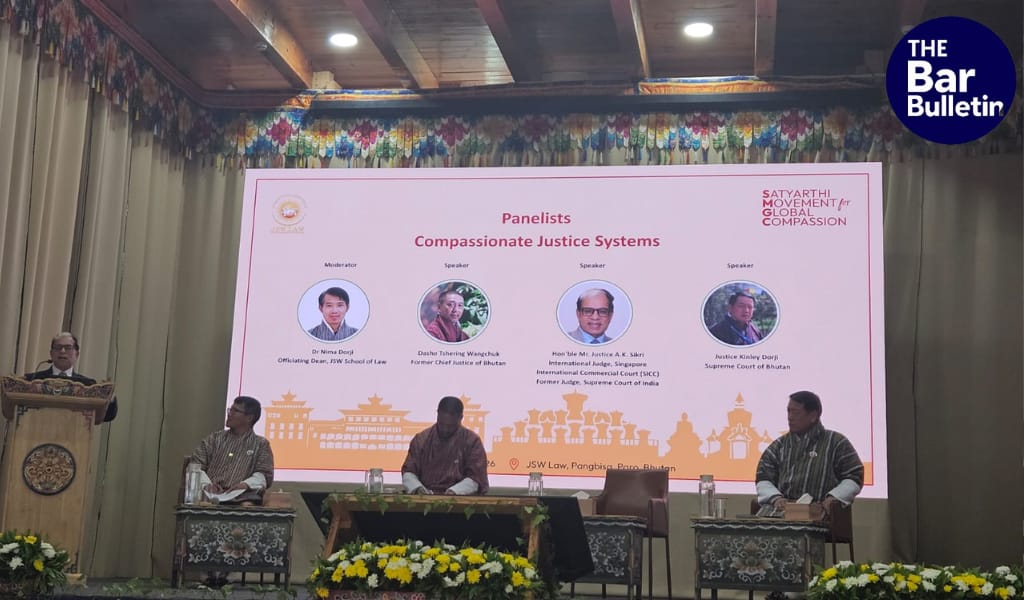

In a landmark step towards advancing compassion as a guiding principle for governance and global leadership, Bhutan became the first country to sign the Global Compassion Declaration (GCD) during the Bhutan Compassionate Leadership Forum (BCLF) held at the Jigme Singye Wangchuck School of Law (JSW Law) in Paro.
The one-day high-level forum, themed “Compassionate Leadership for Just Peace and Sustainable Futures,” was graced by Her Royal Highness Princess Sonam Dechan Wangchuck, Honourable Founding President of JSW Law. It brought together Nobel Peace Laureate Mr. Kailash Satyarthi, policymakers, jurists, business leaders, academics, students, and civil society representatives to deliberate on embedding compassion into leadership, governance, justice systems, and public policy.
Conceived as a global platform, the Forum addressed pressing challenges including conflict, inequality, ecological stress, democratic erosion, and declining public trust, while advocating compassion as a practical framework for institutional transformation and sustainable development.
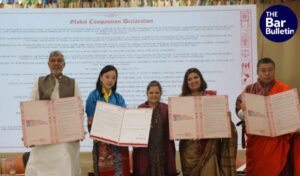
A defining moment of the event was the formal unveiling of the Global Compassion Declaration, signed by the Hon’ble Prime Minister of Bhutan, Dasho Tshering Tobgay, making Bhutan the first nation to endorse the Declaration. The ceremony was jointly led by Her Royal Highness Princess Sonam Dechan Wangchuck, Nobel Peace Laureate Mr. Kailash Satyarthi, Mrs. Sumedha Kailash, SMGC CEO Ms. Asmita Satyarthi, and Chief Justice of Bhutan Lyonpo Norbu Tshering.
Speaking at the ceremony, Her Royal Highness Princess Sonam Dechan Wangchuck said:
“
“This Declaration is an invitation: to place human dignity at the centre of our decisions, to recognize our shared responsibilities, and to reaffirm the values that make peaceful and just societies possible.”
Nobel Peace Laureate Mr. Kailash Satyarthi described the occasion as a historic milestone, stating:
“
“Bhutan, a nation that has redefined growth and development through its values-driven approach, was the most appropriate place to unveil the Global Compassion Declaration. This historic moment will be remembered as a milestone in humanity’s journey towards a more just, equal, peaceful, and sustainable world. I am also deeply encouraged by the leadership of His Majesty The Druk Gyalpo, Jigme Khesar Namgyel Wangchuck, whose compassion, humility, and graciousness embody the very spirit of the Declaration.”
The Global Compassion Declaration emerged from discussions held during the High-Level Roundtable on “Globalising Compassion” convened alongside the 80th Session of the United Nations General Assembly in 2025. It seeks to establish compassion as a shared moral and strategic framework guiding governments, businesses, legal institutions, educational bodies, media, faith organisations, and civil society in responding to interconnected global challenges.
Another major highlight of the Forum was the launch of the JSW–Satyarthi Compassionate Action Lab (JSW–SCAL), a collaborative initiative between JSW Law and the Satyarthi Movement for Global Compassion. Inspired by the vision of His Majesty the Fourth Druk Gyalpo and Mr. Satyarthi, the Lab will function as a centre for research, education, dialogue, and community engagement, rooted in Bhutan’s philosophy of Gross National Happiness and the framework of the Globalisation of Compassion™.
The partnership was further institutionalised through the signing of a Memorandum of Understanding (MoU) between JSW Law and the Satyarthi Movement for Global Compassion, promoting collaboration in education, research, professional exchange, and the development of compassionate leadership.
The Forum also featured a curated exhibition titled “Soft Power and Strong Leadership: The Great Fourth’s Global Legacy,” showcasing the visionary leadership of His Majesty the Fourth Druk Gyalpo and the enduring global relevance of Bhutan’s Gross National Happiness philosophy in shaping sustainable and compassionate governance.
Through keynote addresses and thematic dialogues spanning governance, business, and justice systems, participants highlighted that compassion is not merely a moral virtue but an essential leadership principle capable of strengthening institutions, restoring public trust, and advancing justice.
Concluding with a collective call to action, the Bhutan Compassionate Leadership Forum reaffirmed the need for sustained collaboration across sectors to translate compassion from aspiration into institutional practice. With Bhutan becoming the first nation to sign the Global Compassion Declaration, the Forum marked the beginning of a broader global movement dedicated to promoting human dignity, justice, equality, peace, and planetary well-being through compassionate leadership.
Speaking to The Bar Bulletin (TBB), Justice A.K. Sikri reflected on the significance of the Bhutan Compassionate Leadership Forum, drawing a contrast with the ongoing discussions at London International Disputes Week (LIDW).
“
“While LIDW in London is hosting high-level discussions on commercial arbitration, Bhutan hosted an engaging conversations on Compassionate Justice—a framework aimed at achieving prosperity for the marginalised and underprivileged and fostering peace in a world afflicted by conflict. The sessions, held at the Jigme Singye Wangchuck School of Law on 2 June in collaboration with the Kailash Satyarthi Foundation, were immensely meaningful.”