
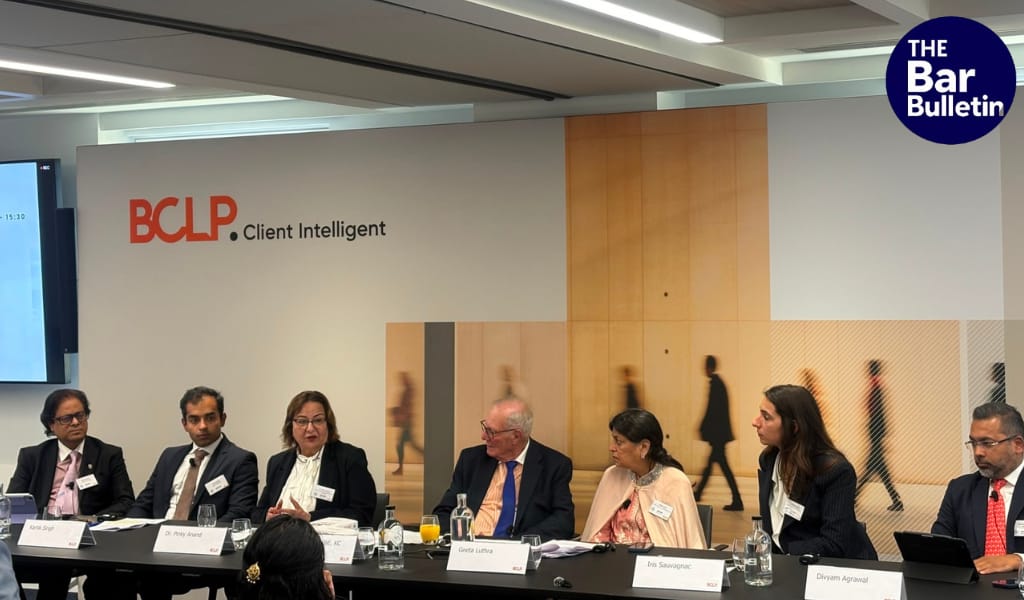

Leading legal minds from India and the United Kingdom came together for an insightful discussion on “Building the Legal Ecosystem for Viksit Bharat 2047: Governance, Inclusion & Institutional Innovation” during the “Two Nations, One Legal Future” conference held as part of London International Disputes Week (LIDW) organised by GCAI in association with BCLP.
Moderated by Nusrat Hassan, Managing Partner, Dentons Link Legal, the session explored the role of governance reforms, technology, alternative dispute resolution, and institutional innovation in shaping India’s legal ecosystem as the country progresses towards its vision of becoming a developed nation by 2047.
Opening the discussion, Dr. Pinky Anand, Senior Advocate and former Additional Solicitor General of India, highlighted that robust corporate governance and efficient dispute resolution are complementary pillars of economic growth. She highlighted India’s significant regulatory reforms, including the decriminalisation of several corporate offences and the Insolvency and Bankruptcy Code, while stressing that speed and certainty in dispute resolution remain critical for commercial confidence. She cautioned against arbitration becoming a mirror image of traditional litigation and advocated for streamlined procedures, greater use of mediation, and continued institutional reforms to enhance efficiency.
Offering an international perspective, Philip Wood, CBE KC, one of the world’s foremost authorities on international finance law, described legal systems as humanity’s most comprehensive codes of conduct that underpin democracy, commerce, and societal stability. Drawing upon comparative legal traditions across jurisdictions, he observed that a business-friendly legal framework must inspire confidence through clarity, predictability, and effective institutions. He praised India’s ongoing legal reforms and expressed optimism that the country’s commitment to strengthening its legal infrastructure would reinforce its emergence as a global legal and economic power.
Geeta Luthra, Senior Advocate and Vice-President of the Indian Council of Arbitration, addressed the transformative potential of technology in the justice delivery system. She credited judicial digitisation and virtual hearings with significantly improving access to justice while emphasising that technological advancement must remain inclusive. She pointed to translation initiatives and digital accessibility as crucial steps towards democratising legal services. At the same time, she cautioned against over-reliance on artificial intelligence, particularly in relation to electronic evidence and authenticity, stressing the need for strong safeguards, human oversight, and responsible regulation.
Speaking on the impact of artificial intelligence in international arbitration, Kartik Singh, Counsel, Baker McKenzie, observed that AI has already become an invaluable tool for document review, chronology preparation, and data analysis. However, he emphasised that concerns surrounding accuracy and hallucinations continue to require active human supervision. While AI can significantly improve efficiency and reduce administrative burdens, he noted that legal professionals will remain accountable for the integrity of legal work products, making human judgment indispensable in dispute resolution.
Responding to the discussion on AI, Dr. Pinky Anand reiterated that while technology can assist with administrative and procedural tasks, legal reasoning and adjudication ultimately depend on human intellect and experience. She observed that AI should function as an aid rather than a substitute for independent legal analysis, cautioning that excessive dependence could undermine the quality of legal decision-making.
Turning to investor-state dispute settlement, Iris Sauvagnac of Hogan Lovells International LLP advocated for greater integration of mediation into international investment disputes. She highlighted the 2022 ICSID Mediation Rules as a significant institutional development that offers states and investors a confidential and flexible mechanism for resolving disputes before lengthy arbitration proceedings. While acknowledging practical challenges such as political sensitivities and the need for greater mediation culture, she argued that mediation can substantially reduce costs, preserve relationships, and facilitate faster settlements. She also noted that India’s enactment of the Mediation Act, 2023 positions it favourably to become a global hub for consensual dispute resolution.
Divyam Agrawal, Partner at JSA, reflected on India’s ambition to emerge as a preferred arbitration destination. Referring to recent international surveys, he observed that India has made measurable progress in improving its arbitration ecosystem but stressed that further gains require consistency, clarity, and policy certainty. He pointed to the need for greater alignment between governmental policy and India’s pro-arbitration judicial approach, arguing that a coherent and supportive dispute resolution framework would significantly strengthen investor confidence and deepen commercial ties under initiatives such as the India-UK Free Trade Agreement.
The panel collectively concluded that achieving the vision of Viksit Bharat 2047 requires not only sustained economic reforms but also a legal ecosystem characterised by efficient dispute resolution, technological innovation, institutional integrity, and global competitiveness. As India and the United Kingdom deepen legal and commercial collaboration, the discussions reinforced the central role of modern legal institutions in driving inclusive and sustainable economic development.
Also Read ‘Mediation Is Not a New Concept in India’: Experts Debate Future of Commercial Dispute Resolution at LIDW26
‘Institutional Oversight Is Not Merely Desirable, It Is Necessary’: Global Arbitration Leaders Debate the Future of Institutional Arbitration at LIDW26
Also Read “Law Must Think Earlier About Emerging Risks”: Mark Evans on Disputes at the Frontiers at LIDW 2026
Also Read ‘India Has Travelled Far in Arbitration, But Is Still Short of the Destination’: Justice Chandrachud
Also Read How Much Time Will It Take? A Question Arbitration Can No Longer Avoid: Vyapak Desai at LIDW
Also Read Is AI Creating an Authenticity Crisis for the Justice System? Panel Discusses at LIDW 2026
Also Read ‘We Are Living Through an International Rule of Law Recession’: Sean West at LIDW 2026