
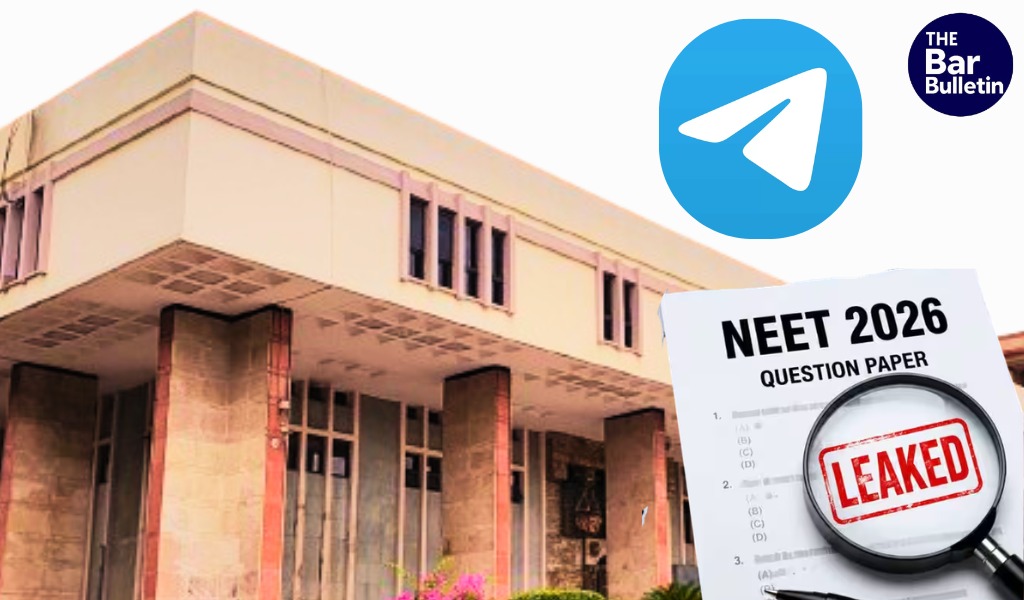

The Delhi High Court on Wednesday sought a response from the Union Government on a petition filed by messaging platform Telegram challenging a blocking order issued in connection with the circulation of NEET-UG 2026 paper leak-related content.
The matter was heard by Justice Tejas Karia, who directed the respondents to file their reply and listed the case for further hearing the following day at 2:30 PM. Explaining the government’s concerns regarding Telegram’s role in the alleged NEET-UG paper leak ecosystem, Solicitor General Tushar Mehta submitted that even after authorities identified and acted against certain channels, similar channels would reappear under different names. He submitted:
“
“There is some concept of a channel. One channel starts, which is prohibited by us. Another channel in a different name starts. What is being projected and circulated is that these are the questions. If you pay this much, I will give you five questions. A QR code is provided, payment is made, and you will receive the paper. This is continuous.”
On the other hand, appearing for Telegram, the counsel contended that the blocking order issued under Section 69A of the Information Technology Act and the relevant Blocking Rules was arbitrary, disproportionate and suffered from non-application of mind. He argued that the platform had been cooperating with authorities for weeks and had promptly acted on requests to remove channels and accounts allegedly involved in circulating fake or leaked examination material.
It was submitted that Telegram had received communications from the Ministry of Electronics and Information Technology and had taken down the identified channels within hours. According to him, the impugned order failed to consider the actions already taken by the platform and instead proceeded on the erroneous assumption that Telegram had not acted against the offending content.
Questioning the invocation of emergency powers, he argued that the authorities had been corresponding with Telegram since early June regarding the alleged misuse of certain channels. He contended that where specific accounts or content were alleged to be unlawful, the authorities could direct their removal, but a blanket action against the entire platform was excessive and beyond the scope of the statutory framework. It was submitted
“
“The statute permits the blocking of information or part thereof, not the entire platform. There may be some impermissible activities, but there are also entirely legitimate activities taking place on the platform. Blocking the whole platform because of certain offending channels is like throwing the baby out with the bathwater. Telegram serves millions of users for legitimate educational, business and communication purposes, and a blanket ban results in a serious infringement of their rights.”
The Union Government opposed the plea and sought time to place material on record. Appearing for the respondents, Solicitor General Tushar Mehta submitted that authorities had been dealing with complaints relating to the misuse of Telegram since May and substantial material existed to justify the action taken. He stated that the matter involved serious concerns and that the government would place relevant facts before the Court.
“
“I have seen the papers. My learned friend Mr. Sharma has seen the papers. The papers contain substantial material. This is not something that has happened overnight. We have been dealing with them since May. Complaints have been received since May. For some reasons, this platform is being used. Kindly imagine the situation that may arise. We are shattered. Imagine a situation where there is public unrest and this is going on rampantly for several weeks while we are in touch with them. If Your Lordship puts it tomorrow, there is something shocking which I am going to show to Your Lordships.
The Bench observed that these issues would require consideration after examining the government’s response.
Telegram sought interim protection against coercive action, contending that the blocking order and non-compliance could expose it to penal consequences. However, the Court declined to grant any interim stay at this stage. When Telegram requested that no coercive steps be taken until the next hearing, the Court observed that either the order could be stayed or it could continue to operate, and there was no intermediate arrangement.
The matter was directed to be listed at 2:30 PM tomorrow for further hearing after the filing of the government’s response.