
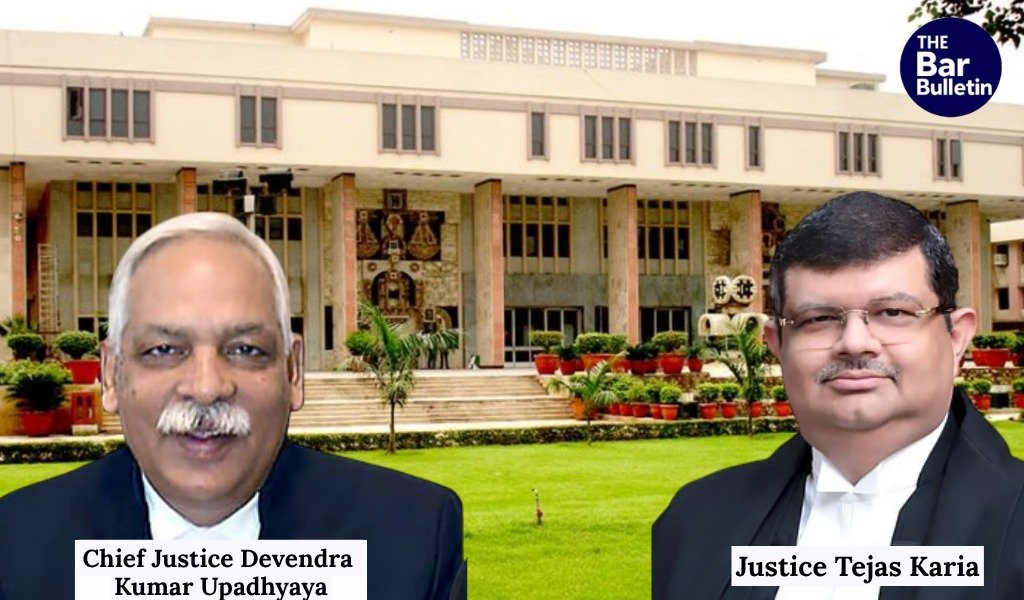

In an intra court appeal filed before the Delhi High Court against an order dated 27-07-2026 passed in the appellant’s writ petition whereby the Single Judge declined to permit respondents to permit the appellant to re-join and complete the training for the post of Executive Trainee (Mechanical), a Division Bench of Chief Justice Devendra Kumar Upadhyaya and Justice Tejas Karia dismissed the appeal but directed that the disengagement communication for the appellant would not carry the stigma of termination.
The appellant was a person with 100% hearing impairment who possessed a Disability Certificate dated 18-07-2016 issued by the Government of Maharashtra and a Unique Disability Card dated 08-03-2021 issued by the Government of India, both certifying his 100% hearing impairment. On 20-02-2026, the respondents issued an official recruitment advertisement for filling vacancies to the post of Executive Trainee (Mechanical) (E-2 Grade) through the Graduate Aptitude Test in Engineering (GATE) 2026 Examination, including vacancies reserved for Persons with Benchmark Disabilities (PwBD). Having completed his B. Tech. in Mechanical Engineering and having qualified the GATE-2026 Examination, the appellant applied for the post by submitting an online application form. The respondents shortlisted the appellant and issued an interview call letter dated 08-06-2026.
On 15-06-2026, the appellant submitted his application form for employment along with the requisite documents on respondent 2’s website. In the application form, for a question asking whether he had a previous criminal record, the appellant denied the same. By an email dated 08-07-2026, the respondents issued an offer letter of appointment to the appellant, directing him to report on 15-07-2026. Thereafter, the appellant filled the attestation form, wherein he accepted that he had a previous criminal record, while also submitting a disclosure affidavit about a First Information Report dated 21-08-2020, registered for offences punishable under Sections 324, 323, 504, 506 and 34 of the Indian Penal Code, 1860, based on complaints by distant relatives arising out of an ancestral family land dispute.
ALSO READ: Orissa HC Orders Release of Ex-MLA Bikram Panda, Holds Arrest Vitiated for BNSS Violations
The respondents questioned the denial by the appellant in the application form and did not permit him to participate in the training programme for the post, pending completion of his background verification. The appellant addressed an email to the respondents on the same date, stating that there were structural limitations in the application form and that he had no intention to suppress the pendency of the criminal cases, requesting that he be permitted to re-join the training. Thereafter, the appellant filed a writ petition, seeking a direction upon respondents 2 and 3 to permit him to immediately re-join and complete the training. The same was dismissed holding that the subsequent disclosures made in the attestation form as well as the affidavit could not cure the earlier false declaration furnished in the application form, and that the respondents’ decision could not be said to suffer from arbitrariness, perversity or any infirmity warranting interference under Article 226 of the Constitution of India. Aggrieved, the appellant preferred the present intra court appeal.
The issue for consideration in the present matter was whether the question in the application form was vague and ambiguous such that the appellant’s negative response could not amount to suppression or furnishing of false information, and whether the respondents’ action in preventing the appellant from participating in the training was arbitrary, mechanical and illegal.
The Court was unable to accept the appellant’s contention, finding that his submission proceeded on a dissection of the question. It was also held that the said question specifically required disclosure of whether any criminal/disciplinary/vigilance case was pending or had ever been instituted, and that the reference to the Public Service Commission, University or other educational authority related only to barring or disqualification from examinations, and could not be construed as limiting the disclosure requirement for pending criminal cases to such authorities alone. The Court found it to be evident that, at the time of submitting the application form, criminal proceedings arising out of the FIRs were admittedly pending against the appellant, rendering his negative response incorrect.
Further, it was held that the appellant had obtained the Affidavit on 15.06.2026 itself, yet did not submit it until after the offer of appointment had been issued and the Court found no merit in the submission that subsequent disclosure in the affidavit negated any suppression. The Court agreed with the Single Judge’s view that the legality of the respondents’ action had to be examined with reference to the declaration furnished in the application form and not disclosures made at a subsequent stage. However, it was noted that the withdrawal of the appointment offer by a communication dated 04-08-2026 may have a bearing on the appellant’s future candidature in any recruitment process.
Hence, the appeal was dismissed. However, the Court directed the communication dated 04-08-2026 to not be construed as termination of employment and to not carry any stigma of termination in view of the respondents’ submission that the communication dated 04-08-2026 was a disengagement letter rather than a termination letter and that the appellant would be entitled to apply to respondent 2 in the next recruitment cycle subject to full disclosures. It was also directed that any future candidature of the appellant before respondent 2 or any other employer or recruiting agency would be considered independently and on its own merits, in accordance with the terms and conditions governing the relevant recruitment process and the disclosures made therein.
