
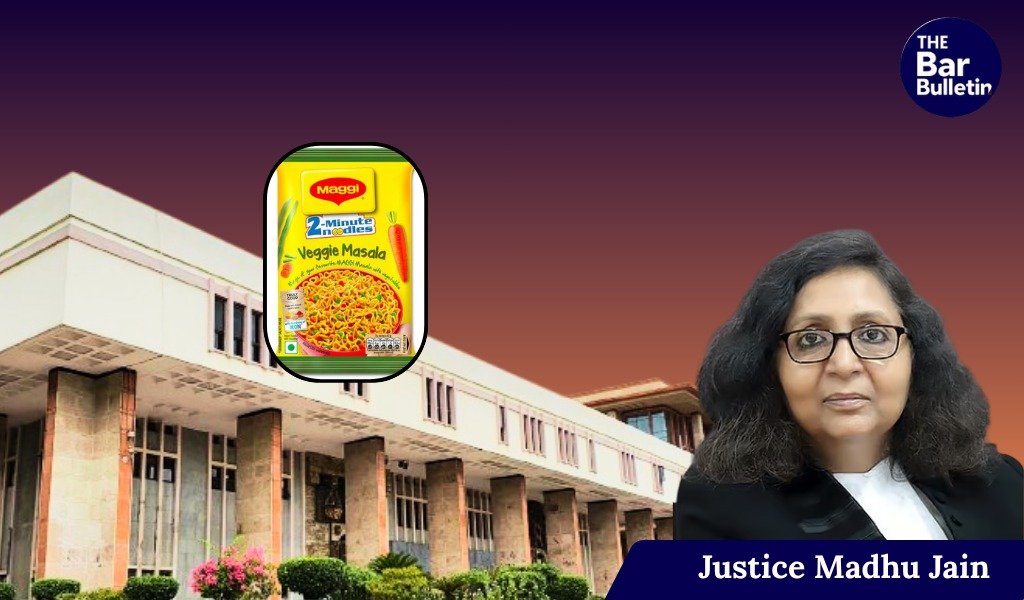

The Delhi High Court has held that where the sole foundation of a criminal prosecution under the Food Safety and Standards Act, 2006 (FSS Act) is a Food Analyst’s report, and that very report has been subsequently subjected to judicial scrutiny before constitutional courts resulting in fresh testing through a duly accredited and notified Referral Food Laboratory which found the product conforming to prescribed standards, continuation of the prosecution on the basis of the superseded and diluted earlier reports amounts to abuse of the process of law.
The High Court clarified that the evidentiary value of the original State laboratory reports necessarily stands diluted when the same scientific issue has been examined afresh under the supervision of the Supreme Court through a Referral Food Laboratory, and the prosecution cannot continue solely on the basis of such superseded reports when no independent evidence of adulteration exists apart from those reports.
A Single Judge Bench of Justice Madhu Jain noted that the prosecution in the present complaints was founded entirely upon the Food Analyst’s reports declaring the sampled product “unsafe” on account of alleged excess lead content, and these reports constituted the sole basis for institution of the complaints and the summoning orders. The Court observed that the controversy surrounding MAGGI Noodles did not remain confined to isolated prosecutions but became the subject matter of extensive judicial scrutiny before the Bombay High Court, which held that laboratories conducting analysis under the FSS Act must satisfy the twin statutory requirements of being NABL accredited as well as notified under Section 43, and consequently set aside the ban orders while directing fresh sampling and testing through duly accredited and notified laboratories.
The Court further observed that the Supreme Court thereafter directed that samples be tested through CSIR-CFTRI, Mysore, a Referral and notified laboratory, and by order dated Jan 13, 2016 specifically directed CFTRI to examine whether lead content and glutamic acid levels were within permissible parameters. The Supreme Court, while disposing of Civil Appeal No. 14539 of 2015 on Jan 03, 2019, observed that the CFTRI Report should constitute the basis of adjudication before the NCDRC and consciously chose not to substitute its own findings on scientific issues. The NCDRC proceedings thereafter culminated in dismissal of the complaint instituted by the Union of India after taking into consideration the CFTRI reports.
Also read Tehelka Editor-in-Chief Tarun Tejpal Sentenced to 10 Years’ Rigorous Imprisonment in 2013 Rape Case
The Court observed that these developments could not be viewed in isolation, as the complaints before it arose out of the very same nationwide sampling exercise of May 2015, with substantially identical allegations, analytical deficiencies and scientific issues, and the prosecution did not rely upon any independent evidence of adulteration apart from the Food Analyst’s reports generated during the original sampling exercise. The Court held that once the original analytical reports became the subject matter of judicial scrutiny and fresh testing was directed through a Referral Food Laboratory recognized under the statute, the evidentiary value of the earlier reports necessarily stood diluted, and the subsequent scientific evaluation undertaken under the supervision of the Supreme Court could not be ignored while examining whether continuation of the criminal proceedings would serve the ends of justice.
The Court rejected the State’s contention that the criminal complaints were independent proceedings that must proceed to trial, holding that where the very scientific foundation upon which the prosecution rests has undergone subsequent examination through a process supervised by the constitutional courts, the High Court cannot remain oblivious to those developments while exercising jurisdiction under Section 482 CrPC. The Court reiterated that continuation of prosecutions founded upon earlier State laboratory reports would amount to abuse of process once the issue regarding lead content stood examined through CFTRI reports obtained pursuant to the Supreme Court’s directions.
Briefly, during May 2015, Food Safety Officers of the Department of Food Safety, Government of NCT of Delhi, collected samples of MAGGI Noodles from different retail outlets in Delhi, including M/s Gupta Store in Gole Market, Connaught Place, and the establishment of accused Virender Narula. The samples were drawn following the procedure prescribed under the Food Safety and Standards Act, 2006, notices were issued, panchnamas were prepared, samples were divided into four counterparts, duly packed, sealed, labelled, and one counterpart was forwarded to the Food Analyst while the remaining were deposited with the Designated Officer.
Upon analysis, the Food Analyst by reports dated June 02, 2015 opined that the samples were “unsafe” within the meaning of the FSS Act on the ground that the lead content in the masala tastemaker exceeded the prescribed maximum limit of 2.5 ppm. In one complaint, the product was also alleged to be misbranded on account of the declaration “No Added MSG” on the label. Copies of the Food Analyst’s reports were forwarded to the respective Food Business Operators as well as to the manufacturer, M/s Nestlé India Limited, under Section 46(4) of the FSS Act. None of the accused exercised their right to seek referral analysis by the Referral Food Laboratory within the prescribed period.
The Designated Officer thereafter forwarded the case records to the Commissioner, Department of Food Safety, who accorded consent under Section 30(2)(e) of the FSS Act for institution of prosecution. Separate complaints were filed before the Trial Court alleging violations of Sections 20, 26 and 27 of the FSS Act, punishable under Section 59, which was dismissed.
