
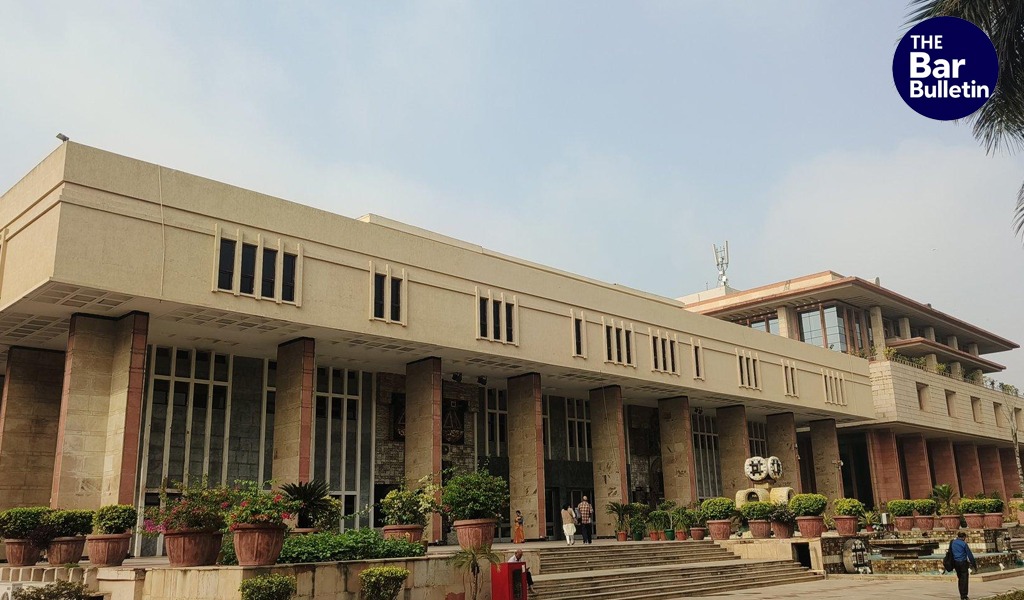

The Delhi High Court has set aside an order requiring two accused persons to obtain prior permission from the trial court before travelling abroad, holding that a Magistrate cannot introduce new bail conditions years after granting bail by describing them as a mere “clarification” of the original order.
Justice Anup Jairam Bhambhani allowed a writ petition challenging an order dated November 6, 2025 passed by the Chief Judicial Magistrate, Patiala House Courts, which had directed the petitioners to seek prior court permission before undertaking foreign travel. The High Court held that the condition did not form part of the original bail order and could not subsequently be inserted by the Magistrate.
The petitioners had been granted bail in March 2021 in a criminal case arising from allegations under Sections 420 and 120B of the Indian Penal Code. More than three years later, on an application moved by the complainant expressing apprehension that the accused might abscond, the Magistrate imposed a condition requiring prior permission before travelling abroad. That order was subsequently set aside in revision proceedings and remanded for fresh consideration.
Following remand, the Magistrate again directed the accused to seek prior permission before foreign travel, characterising the direction as a clarification of the original bail order. Challenging this action, the petitioners argued that the Magistrate lacked jurisdiction to review or modify the bail conditions originally imposed.
Agreeing with the petitioners, the High Court observed that the original bail order did not contain any restriction on foreign travel. The Court held that introducing such a requirement years later amounted to adding a fresh bail condition and not clarifying an existing one. It noted that an order can only clarify an ambiguity or imprecision in an earlier order and cannot be used as a vehicle to introduce an entirely new condition.
The Court reiterated that Section 362 of the Code of Criminal Procedure bars criminal courts from altering or reviewing final orders except for correcting clerical or arithmetical errors. It held that the Magistrate’s attempt to impose travel restrictions constituted a review or modification of the original bail order and was therefore impermissible.
Justice Bhambhani further observed that once the Sessions Court had set aside the earlier order imposing travel restrictions, the Magistrate could not effectively restore the same condition through a purported clarification. Such an exercise, the Court held, circumvented the revisional court’s order and rendered the remand meaningless.
The High Court also emphasised that under Section 439(1)(b) CrPC, the power to modify bail conditions imposed by a Magistrate is vested in the Sessions Court and the High Court. A Magistrate does not possess parallel powers to alter conditions after bail has been granted. Accordingly, the impugned order was held to be without jurisdiction and non est in law.
While noting that the petitioners had travelled abroad multiple times without obtaining permission during the subsistence of the impugned order, the Court condoned the infraction. It observed that the petitioners had consistently returned to India, complied with court proceedings, and maintained a satisfactory record of appearance either personally, through video conferencing, or through counsel. Since the order imposing the restriction was itself jurisdictionally flawed, the Court found that no punitive action was warranted.
Setting aside the impugned order, the Court directed that the petitioners would continue to remain bound only by the conditions contained in the original bail order of March 23, 2021, without any requirement to seek prior permission before travelling abroad. However, as a measure of atonement for the technical violation of the Magistrate’s order, the Court directed each petitioner to pay costs of ₹2 lakh to Friendicoes SECA within two weeks.
