

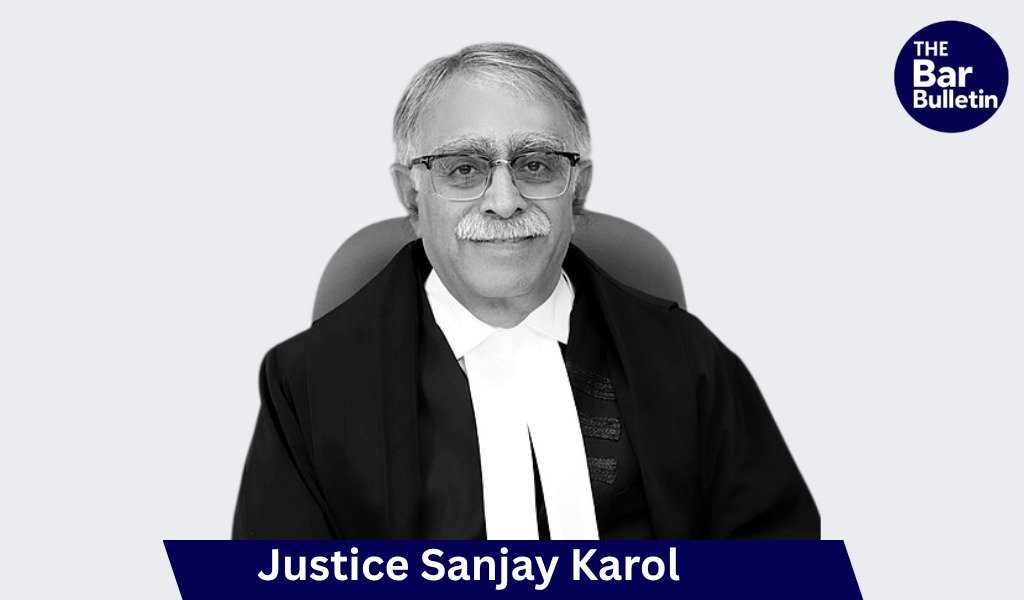
Judging, at its core, requires understanding the case fully, not just the law that governs it, but the human situation that produced it. Justice Sanjay Karol, who retired from the Supreme Court of India on 22 August 2026, did this as a matter of principle. Many of his judgments are known for opening not with dry recitals of fact but with a fuller telling of the human story. It was his way of insisting that a case was, before anything else, a set of people whose circumstances deserve to be understood before they are decided. We write this, between the two of us, as members of the younger Bar who appeared before him and perceived his understanding of what it means to be holding the case papers in his courtroom.
Judging without being judgmental
In Justice Karol’s court empathy was never a consequence of being judgmental about the parties. He judged the case. He did not judge the client, and he did not judge the lawyer. The choices a client made, the reasons a person found themselves before the Court, remained theirs to own or defend, understood in full but not excused or condemned in advance. His attempts to strongly wrestle with the prejudice resulting from the client’s choices and to keep the same out of judicial decision making was something that was quite apparent in many of the cases. The arguments a lawyer built around those choices remained the lawyer’s craft, to be tested on their own merits and not necessarily influenced by the designation of the lawyer. He frequently appointed young (and often briefless lawyers) as amicus curiae, and it gave each one of them a confidence and above all conviction that they too are equal contributors in this noble profession.
Dignity as Common Thread in His Judgments
If one reads enough of Justice Karol’s judgments together, across subject and even fora, a single thread emerges: dignity. Thus, what Justice Karol’s empathy secured was essentially dignity owed to the person at the central of the dispute, which at its core is the constitutional value. We outline a few of his judgments rendered whilst at Supreme Court, and in that we have attempted to focus on judgments that are very meaningful but have received less than usual attention.
● Regarding the use of the split multiplier in calculation of compensation in MACT cases, Justice Karol held that “retirement from service is not ‘out of the ordinary’, ‘exceptional’ and ‘cogent’ for the same to qualify” as a reason to apply split multiplier. While doing so, he clarified the law different understood across 10 High Courts in 34 judgments cited in his judgment which also he completes in bare 22 paragraphs (Preetha Krishnan v. United India Insurance Co. Ltd., 2025 SCC OnLine SC 2365). This focuses on dignity as it eased the agony of the family that faced reduction in the compensation owed to the families of the deceased, on the reasoning that a person’s income would have fallen once they reached superannuation, splitting the multiplier into a higher pre-retirement figure and a discounted post-retirement one. Retirement, he wrote, is merely the natural progression of a working life, and cannot be treated as a negative factor against a person who has died or been permanently disabled
● Regarding passive membership of a banned organization, the concept of dignity inheres in his separate supplementing opinion on Section 10 of the Unlawful Activities (Prevention) Act, in which he declined to equate mere passive membership of a banned organisation with criminal culpability, insisting that suspicion is not guilt and that liberty survives until the State proves otherwise. (Arup Bhuyan v. State of Assam, (2023) 8 SCC 745). He notes:
“
“…The vast, varied and scholarly jurisprudence developed by this Court has been in view of these clauses within Article 19. Now, at this juncture, seven decades thence, in my view a stand of whichever court, cannot be allowed to stand if it is in ignorance of the constitutional provisions…”
● The thread of dignity runs through Indrakunwar v. State of Chhattisgarh (2023 SCC OnLine SC 1364), where a life sentence confirmed without recorded reasons was set aside and the convict acquitted, and in which he held that the duty to disclose cannot override the right to privacy without cause. Notably, he observed, “Such a view being taken, i.e., thrusting upon a woman the guilt of having killed a child without any proper evidence, simply because she was living alone in the village, thereby connecting with one another two unrelated aspects; reinforces the cultural stereotypes and gendered identities which this Court has explicitly warned against.”
● Similar expression is evident from Rajeev Kumar Upadhyay v. Srikant Upadhyay, 2024 INSC 1008 in which he wrote that any act, by the State or by another person, which undermines a person’s dignity, imperils the very human rights the Constitution exists to secure. Justice Karol reminder that “It is a well-acknowledged fact that the States and the Union Government are the biggest litigators before the High Courts and this Court. Numerous cases are filed by State parties everyday. There may be various reasons as to why the States choose to litigate various issues and topics before the Court, but the overarching purpose of any action of the State should be the welfare of the people.” Specifically in relation to dignity, he held “what can be gathered from reference to the above judgments is that dignity is an invaluable aspect of Indian Constitutional jurisprudence, and there exists a duty upon the State to take all action to protect the same.”
● Fuleshwar Gope v. Union of India (2024 SCC OnLine SC 2610) was a UAPA case where Justice Karol, writing for the Court, upheld the NIA’s jurisdiction and the validity of the prosecution sanction against Gope and permitted the accused to raise a challenge to invalid prosecution at the outset rather than to suffer the trial. This judgment again shows empathy towards the accused and does not dismiss his grievance merely because he is accused of an offence under UAPA. The court did not accede to the default prosecutorial setting to delay challenges to validity and open the gates to ensure that the dignity of the accused is not compromised in a ‘process is punishment’ methodology.
● In the homemaker-compensation judgment, Shishu Pal @ Shish Ram & ors. vs Surjeet & Ors. (2026 INSC 634), he and Justice N. Kotiswar Singh rejected the long-standing assumption that a homemaker is a dependent rather than a contributor, fixing a notional monthly income for unpaid domestic work and calling homemakers, in the Court’s own words, ‘nation-builders.’ The case deserves its due acknowledgement here as well.
A Courtroom for Learning and Standing Up
Justice Karol was a judge who took the trouble to understand a matter’s human situation before deciding it. He had no reason to make a hearing intimidating for its own sake, and his courtroom was not. Junior counsel appeared before him knowing that they would be heard properly on the merits of what they said, not measured against their seniority or their polish. That, in turn, made his courtroom a place many of us sought out to learn in; not because he lectured, but because an ordinary exchange conducted taught those watching as much as it resolves the case at hand.
In his speech in the ceremonial bench, Justice Karol offered, in his own words, a distilled version of the same commitment. He told the young lawyers to be alive to the Constitution rather than merely cite it. He highlighted that “standing up” was itself a judicial virtue and not merely a private conviction, and reflected on his understanding of dharma.
In his court room, he often reminded the counsel appearing for the State Government, about the limits of persuasion in matters touching liberty and the point at which the opposition to a matter concerning liberty must cease. This clearly conveyed that the dharma of the State Counsel is not winning; but to reinvigorate the faith of a common (wo)man in the rule of law and the Constitution. In his court one did see that there is much merit in erring on the side of liberty.
What We Carry Forward
On the occasion of his retirement, we want to name plainly what we, as members of the younger Bar, are left holding. Justice Karol showed us that a judge can imagine a case with measured empathy. He showed us, in his own conduct toward us, what it looks like to treat the Constitution’s values as something one serves rather than something one merely applies. He showed what it means to practice dignity and fraternity as members of the Bar. The tradition he began of entrusting young members of the Bar with the responsibility of serving as Amicus Curiae deserves to be carried forward.
*Talha Abdul Rahman, Advocate on Record
**Sudhanshu Tewari, Advocate, Supreme Court of India