
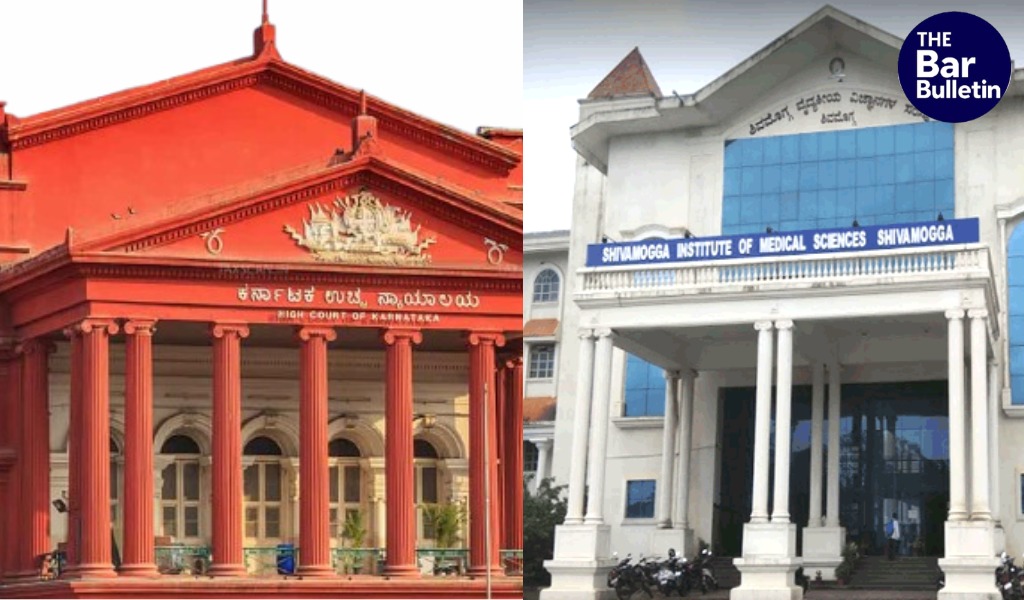
The Karnataka High Court on Monday came down heavily on the Karnataka Government and the Shimoga Institute of Medical Sciences (SIMS) over the revocation of the suspension of an Associate Professor accused in two separate incidents of sexual harassment, questioning the decision to reinstate him despite the findings of the Internal Complaints Committee (ICC) and his previous misconduct.
Hearing appeals arising out of the controversy, a Division Bench of Justice D.K. Singh and Justice T.M. Nadaf expressed strong disapproval of the conduct of senior officials, including Mohammad Mohsin, Additional Chief Secretary, Medical Education Department, and Dr. Virupakshapa, Director of SIMS, who had recommended withdrawal of Dr. Hebbar’s suspension.
During the hearing, the Bench observed that the authorities appeared to have prioritised administrative considerations over the safety and dignity of women students. Questioning the decision to revoke the suspension, the Court remarked that ‘this is a wolf sitting in the institute’, adding that neither patients, teachers nor students were safe if such an individual continued in the institution.
The Court also criticised the Director for recommending reinstatement despite being aware of the allegations, the ICC findings, and the doctor’s previous misconduct. The Bench noted that the Director’s report praised Dr. Hebbar but failed to mention the serious allegations against him, observing that responsibility for the situation had to be shared by senior officials, including the Additional Chief Secretary.
In one of the strongest exchanges during the hearing, the Court questioned the sensitivity of the authorities by asking whether they would have reacted differently ‘if it were your daughter or your sister’, while observing that every victim cannot be expected to come forward with complaints and that failure to act against repeated misconduct only emboldens the accused.
The Bench also rejected the justification advanced for revoking the suspension on the ground that the Government was paying subsistence allowance without extracting work. It observed that the Office Memorandum relating to review of suspension had been misread, noting that it merely requires disciplinary proceedings to be completed within six months or the suspension to be reviewed with reasons, and does not mandate revocation of suspension within six months.
The Court further questioned why the suspension was revoked despite the departmental charge sheet having already been prepared, and indicated that the judgment would examine the conduct of the concerned officials in detail.
The Court has reserved the order.