
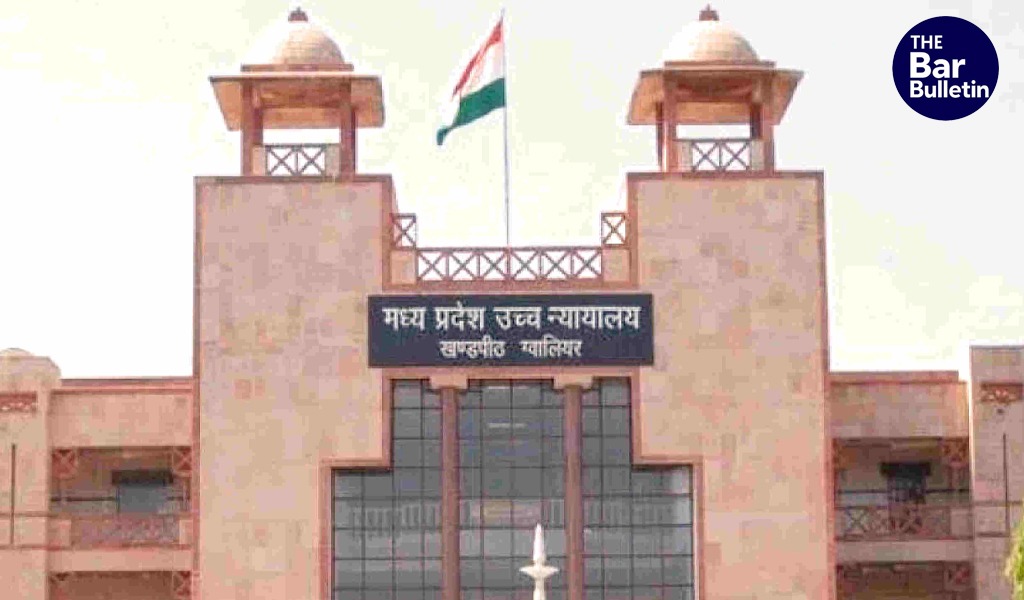

The Madhya Pradesh High Court has dismissed a writ petition filed by a judicial officer challenging disciplinary proceedings initiated against him, holding that the mere pendency of a criminal prosecution on the same set of facts does not warrant quashing or staying a departmental inquiry.
A Division Bench of Justice Anand Pathak and Justice B.P. Sharma was hearing a petition filed by Vijendra Singh Rawat, a member of the Madhya Pradesh Judicial Service, assailing a charge-sheet issued by the High Court under the Madhya Pradesh Civil Services (Classification, Control and Appeal) Rules, 1966. The disciplinary proceedings arose from allegations that, while serving as V Civil Judge, Senior Division, Indore, he prepared an acquittal judgment in a criminal case despite the trial not having been lawfully concluded, allegedly to confer an undue advantage upon the accused.
Also Read Delhi High Court Orders Unblocking of Cockroach Janata Party’s X Account
The petitioner contended that the charge-sheet was issued after an unexplained delay of nearly five years and that the departmental proceedings ought to be stayed because a criminal prosecution based on the same allegations was pending. He argued that continuation of the inquiry would prejudice his defence in the criminal case.
Rejecting the contention, the High Court held that judicial review against a charge-sheet is available only in exceptional cases where the disciplinary authority lacks jurisdiction or acts in a patently arbitrary or illegal manner. It observed that allegations involving the preparation of a forged acquittal judgment by a judicial officer were of the gravest nature, affecting the integrity of the judicial institution, and therefore warranted a thorough disciplinary inquiry.
On the issue of delay, the Bench held that the petitioner had failed to demonstrate any actual prejudice caused by the time taken to initiate disciplinary proceedings. The Court observed that matters concerning judicial officers necessarily require detailed vigilance scrutiny before disciplinary action is commenced and that delay, by itself, is insufficient to invalidate such proceedings.
The Court further clarified that the Supreme Court’s decision in Capt. M. Paul Anthony v. Bharat Gold Mines Ltd., (1999) 3 SCC 679 does not lay down an absolute rule requiring departmental proceedings to be stayed whenever a criminal case is pending. It reiterated that while a stay may be appropriate in certain cases involving identical facts and complicated questions of law and fact, there is no legal prohibition against simultaneous continuation of criminal and departmental proceedings.
Also Read Justice Ashok Bhushan: Bridging The Letter of Law With The Spirit of Justice
Emphasising the need to preserve public confidence in the judiciary, the Bench observed that disciplinary authorities are duty-bound to examine whether a judicial officer has adhered to the standards of integrity and propriety expected of the office. Such inquiries, it held, cannot be indefinitely postponed pending the outcome of criminal proceedings, the duration of which remains uncertain.
Accordingly, the High Court dismissed the writ petition and permitted the disciplinary authority to proceed with the departmental inquiry in accordance with law, clarifying that its observations were confined to deciding the writ petition and would not influence the inquiry on merits.
