
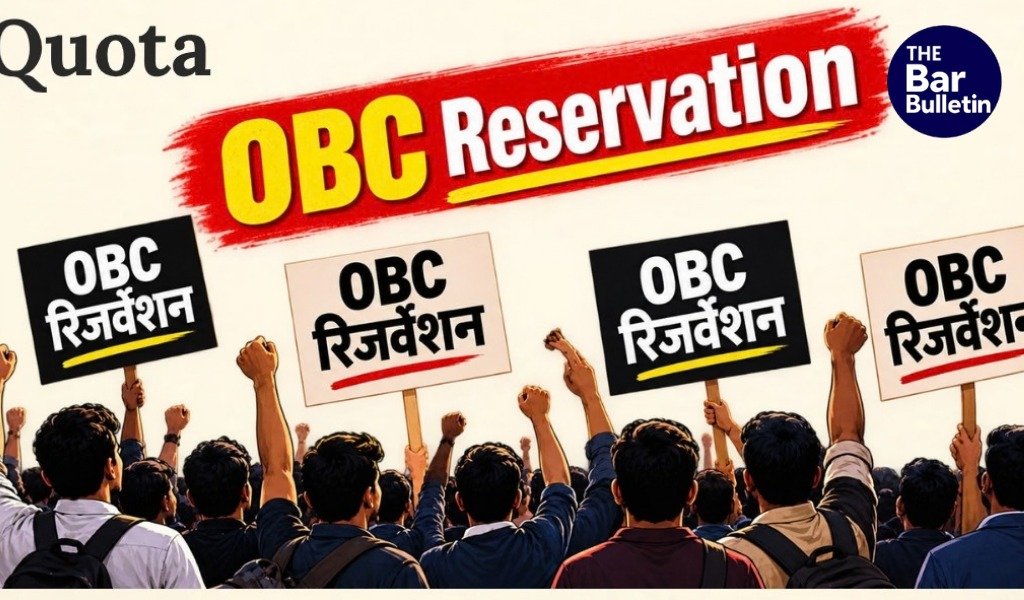
The Madhya Pradesh High Court (Jabalpur Bench) has struck down the Madhya Pradesh Ordinance No. 2 of 2019 and the Madhya Pradesh Lok Seva (Reservation) Amendment Act, 2019, which had raised the Other Backward Classes (OBC) reservation in public services and higher education from 14% to 27%, taking the aggregate reservation in the State to a steep 63%. The Court held that providing reservation beyond 50% is a ‘major policy matter’ requiring effective consultation with the National Commission for Backward Classes, and the State’s failure to do so vitiated the legislative process.
The High Court asserted that where a State seeks to breach the 50% reservation ceiling fixed by the Nine-Judge Bench in Indra Sawhney v. Union of India [1992 Supp (3) SCC 217], it must demonstrate (a) extraordinary circumstances inherent in the great diversity of the country and the people, (b) contemporaneous quantifiable data showing backwardness and inadequacy of representation, and (c) effective and meaningful consultation with the National Commission for Backward Classes under Article 338B(9) of the Constitution. Failure on any of these counts, coupled with reliance on outdated and methodologically flawed reports, renders the enactment ultra vires Articles 14, 15, and 16 of the Constitution and liable to be struck down.
The order arose out of a clutch of petitions, the lead matter being Ashita Dubey and Others v. State of Madhya Pradesh, filed by general-category MBBS aspirants, civil service candidates, consumer groups, and social organisations such as Youth for Equality, who challenged the constitutional validity of the enhanced reservation as being violative of Articles 14, 15, 16, 19, and 21 of the Constitution.
Briefly, the factual backdrop reveals that on 8 March 2019, just a day before the Model Code of Conduct for the 2019 General Elections came into force, the State Government promulgated Ordinance No. 2 of 2019 amending Section 4(2) of the M.P. Lok Seva (SC, ST & OBC Reservation) Adhiniyam, 1994, thereby raising OBC reservation from 14% to 27%. On 14 August 2019, the Ordinance was replaced by the Amendment Act, 2019. On 19 March 2019, a Division Bench of the High Court, as an interim measure, directed that OBC reservation shall not exceed 14% in admissions and appointments. Subsequently, on 29 September 2022, the State Government itself issued a GAD order directing that results be declared in two parts, 87% posts were to be filled outright, and the remaining 13% posts (covering both OBC and UR candidates) were to be kept provisional, subject to the final outcome of these petitions. Notably, this was not the first such attempt.
In 2003, a similar 27% OBC reservation by way of a Government Resolution was struck down by the same High Court in Manish Mishra v. State of M.P. (W.P. No. 2798/2003), and the State’s SLP against that order was pending before the Supreme Court when the 2019 Ordinance was promulgated. The 2019 Amendment Act also contained drafting defects, it sought to amend sub-clauses (a) and (b) of Section 4(2) of the 1994 Act, which had already been merged into Clause 1 by the 2002 Amendment Act and had ceased to exist, making the amendment a legal nullity on the face of the statute.
The Division Bench comprising Justice Anand Pathak and Justice Vinay Saraf undertook a comprehensive journey through the history of reservation in India, from Maharaja Shahu of Kolhapur’s 1902 law capping reservation at 50%, the Kaka Kalelkar Commission of 1955, the M.R. Balaji and Indra Sawhney Constitution Bench decisions, the Mandal-era debates, the M. Nagaraj verdict, the Janhit Abhiyan EWS reservation case, down to the Constitution Bench decision in Jaishri Laxmanrao Patil vs Chief Minister [(2021) 8 SCC 1]. It also undertook a comparative survey of affirmative action models across the United States, the United Kingdom, South Africa, Brazil, Canada, and the European Union.
On the factual evidence, the Court placed strong reliance on the statistics placed on record by the petitioners to demonstrate that OBCs in Madhya Pradesh are not a backward, marginalised community ‘out of the mainstream of national life’, rather, they form the very core of political and administrative power. The Court recorded that OBCs have produced five Chief Ministers in the last 20 years, hold about 40% of the Council of Ministers, constitute roughly 27% of the Legislative Assembly, and have shown cross-party solidarity in demanding enhanced reservation.
Also read Delhi High Court Grants Time to Amitabh Bachchan to Formalise Settlement in Personality Rights Suit
The 2023 BRAUSS Report, which the State relied upon, was found to be a post-facto exercise covering only about 10,000 respondents out of a population of over 7.26 crore (a minuscule 0.00014%), surveying only OBC respondents, thereby precluding any comparative assessment with SC, ST, or General categories. The Court further noted that even the Mahajan Commission Report of 1983, on which the State’s case fundamentally rested, was outdated by over four decades, that the State had not conducted any periodic survey as mandated under Section 11 of the M.P. Backward Classes Commission Act, 1995, and that the State had itself failed to fill 51.17% of the sanctioned OBC posts (and 68.24% of Class-I posts), a failure that could not be used as a ground to breach the 50% ceiling.
The AISHE data showing 39% OBC enrolment in higher education, the 23.91% OBC graduate attainment (5.4 times the State average), and the OBC dominance in Central Government services (28.16%, double their 14% reservation quota) all underlined that OBCs are, in fact, ‘insiders to power’ and not a community inhabiting ‘far-flung and remote’ areas outside the national mainstream, added the Bench.
