
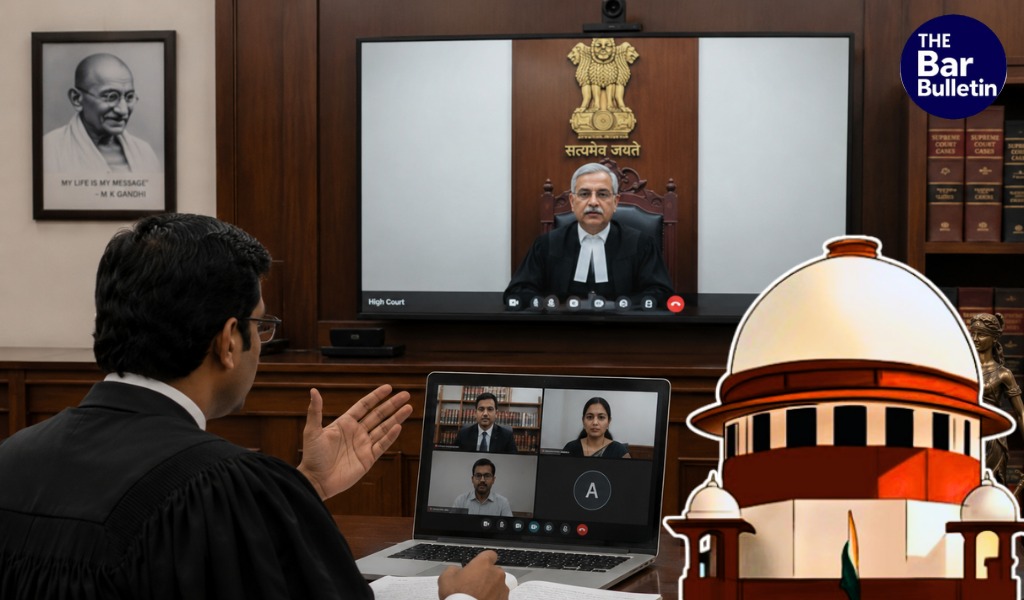

The Supreme Court on Wednesday declined to issue judicial directions mandating virtual hearings for miscellaneous matters as a temporary measure to address fuel consumption, traffic congestion and environmental concerns, while observing that such issues must be resolved through “persuasion and cooperation between the Bar and court administration rather than by judicial command.”
Hearing a plea seeking directions for virtual hearings for three months, the petitioner urged the Court to adopt temporary measures to reduce fuel consumption and ease hardships faced by lawyers commuting to courts. “As a head of the family (Judiciary, my Lord (CJI Surya Kant) may issue temporary directions. We are the strongest pillar of society. I am seeking only three months’ directions, my Lord. One month is a vacation, my Lord. In two months, we will contribute as a nation, my Lord, to dealing with the fuel crisis.”
The petitioner argued that such a move would help conserve petrol and diesel and reduce environmental burden. Referring to conditions outside the courtroom, she submitted:
“Yesterday I was just going outside the court, my Lord. Two, three drivers, my Lord, the lawyers were inside the court, they switch on the cars, close the windows and then they’re using the ACs, my Lord.”
The Bench, however, observed that while it appreciated the concerns raised, such measures could not be imposed through judicial orders. The Court remarked:
“We are 100% with you on this issue. But the point is that it cannot be enforced through a judicial order. On the basis of persuasion, collaboration, the Bar Association is here, the Bar Council is here, all of you join hands, sit together and resolve.”
The Court further said that it was willing to provide all necessary infrastructure and logistical support for virtual participation if the Bar collectively decided to adopt such measures. CJI observed:
“As a head of the family, I can only request, I can make an earnest appeal to the members for it… because to impose a restriction on the members that you don’t enter the Supreme Court or you don’t enter the court, that would be very difficult.”
The petitioner also raised concerns about the transportation of prisoners to courts, claiming that almost 230 buses daily transported inmates from jails for routine remand proceedings. In response, the Court noted that many States already conduct such proceedings virtually and said any specific administrative difficulty could be brought to its notice on the administrative side.
Emphasising that technological infrastructure created during the Covid-19 pandemic remained available, the Court nevertheless reiterated that adoption of hybrid or virtual systems was ultimately a matter for the Bar and judicial administration to work out collectively rather than through coercive judicial directions.