
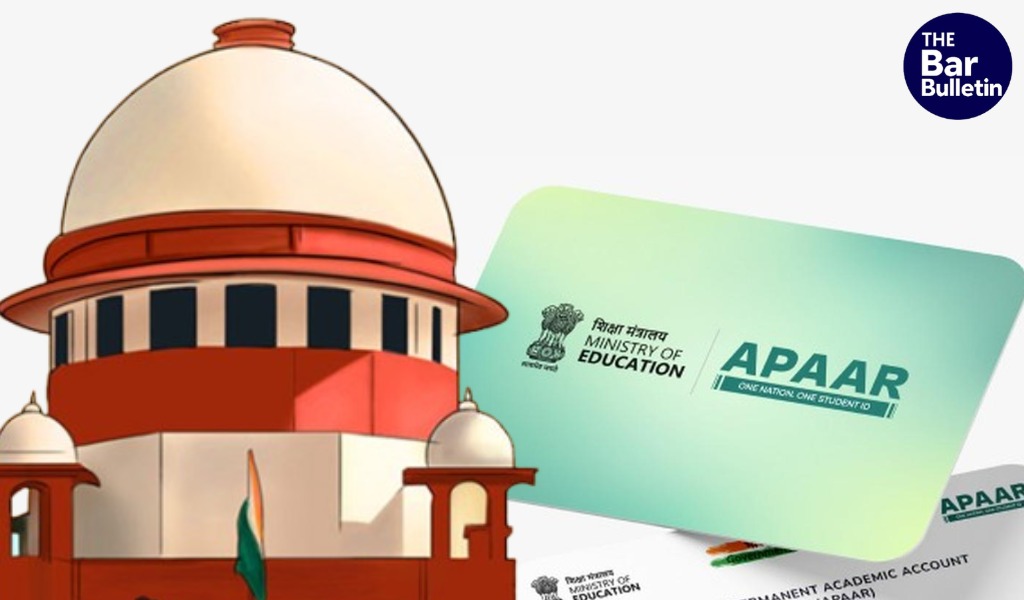

The Supreme Court on Monday directed the Central Board of Secondary Education (CBSE) to examine concerns raised over the consent mechanism adopted for the creation of APAAR IDs and, if necessary, suitably clarify its policies, while hearing a plea challenging the implementation of the APAAR ID scheme in CBSE-affiliated schools.
The petition challenges CBSE circulars implementing APAAR IDs by using Aadhaar as the primary identifier for students. The petitioners contend that although the scheme is described as voluntary, it effectively compels students to obtain Aadhaar and create an APAAR ID for inclusion in the List of Candidates (LOC) for Classes X and XII Board examinations.
Appearing for the petitioners, Senior Advocate Indira Jaising submitted that the scheme, introduced through executive circulars, infringes children’s fundamental right to privacy and is inconsistent with the Supreme Court’s Aadhaar judgment, which held that Aadhaar cannot be made mandatory for access to education.
“
“My argument here is that this scheme which they have put in place through a circular… has become mandatory for children to have an Aadhaar card in order to be included in the list of candidates who are sent up for Class X and Class XII.”
She argued that while digitisation and seamless transfer of academic records may constitute a legitimate objective, any scheme involving collection and processing of children’s personal data must satisfy the requirements of legality, proportionality and informed consent. She further submitted that the Digital Personal Data Protection Act, 2023 requires consent to be free, informed and specific, safeguards which, according to him, were absent from the existing consent forms.
During the hearing, the Bench of Chief Justice Surya Kant, Justice Joymalya Bagchi and Justice V Mohana observed that digitisation of educational records could facilitate school transfers and assist authorities in educational planning by generating macro-level data. At the same time, it noted that concerns regarding individual students’ data would continue to be governed by the safeguards contained in the Digital Personal Data Protection Act, including purpose limitation and restrictions on disclosure without consent.
Referring to an Orissa High Court judgment directing modification of the APAAR consent form to provide an effective opt-out option, Ms Jaising urged the Supreme Court to extend similar safeguards across the country by directing CBSE to align its consent forms with Section 6 of the DPDP Act.
After hearing the submissions, the Bench noted that the controversy appeared to lie within a narrow compass and directed CBSE to examine the issues raised by the petitioners.
“
“On the other issue which you have raised, we are directing the CBSE to examine those issues and, if need be, to suitably clarify their policies.”