
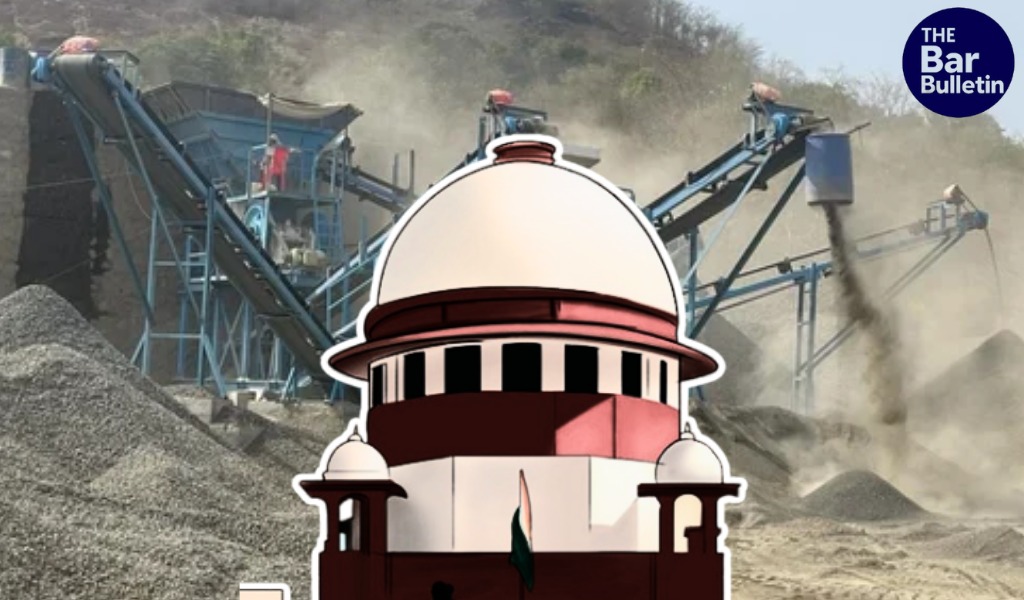

The Supreme Court on Thursday declined to interfere with interim observations made by the Jharkhand High Court in a matter concerning the permissible distance between stone crushing units and forest areas, observing that it could not sit in appeal over every observation made by a constitutional court while the matter remained pending before it.
The matter arose from a challenge by the Jharkhand State Pollution Control Board to orders of the Jharkhand High Court concerning the reduction of the buffer distance for stone crushers from 500 metres to 250 metres from forest boundaries. The High Court had questioned the validity of the reduction and made observations regarding environmental protection and preservation of natural forests.
Appearing for the Pollution Control Board, counsel argued that the State’s decision was based on recommendations of a technical committee comprising environmental engineers and officials from the departments of mines, geology and industries. It was submitted that several States, including Himachal Pradesh and Odisha, followed similar distance norms ranging between 200 and 250 metres.
Senior advocate Meenakshi Arora contended that the High Court’s observations were virtually final in nature despite the matter being pending adjudication and expressed concern that quarrying and crushing activities had effectively come to a standstill. The Bench, however, appeared unconvinced. Stressing the need to protect ecologically sensitive areas, Chief Justice of India Surya Kant observed:
“
“Some of the States which have nature’s paradise gift of having natural forests, they need to at least overzealously protect it.”
An intervenor, identifying himself as a mining leaseholder with valid environmental and forest clearances, sought to oppose the High Court’s observations, arguing that mining and stone crushing were distinct activities and that he had not been heard before the orders were passed. The Court declined to examine the merits at this stage, noting that the matter was already listed for final hearing before the High Court.
When counsel urged the Bench of Chief Justice Surya Kant and Justice V Mohana to clarify that the High Court’s observations should not be treated as final, the Bench firmly refused.
“
“We can’t demoralize our High Courts like this. Please do not consider us like a headmaster sitting here that we keep on advising High Courts what they should write and what they should not write. Constitutional Courts, their powers under Article 226 are sometimes better than our powers.”
The Bench ultimately expressed its disinclination to entertain the special leave petition. Faced with the Court’s observations and noting that the matter was already fixed for final hearing before the High Court, the petitioners chose to withdraw the plea.