
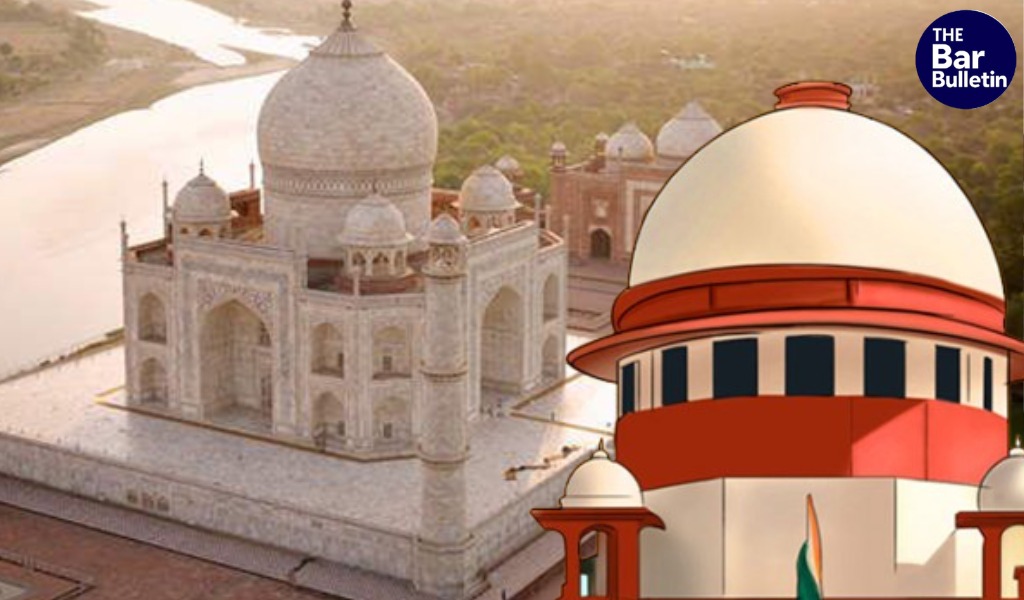

The Supreme Court on Thursday cleared the way for the processing of more than 410 pending applications seeking establishment, expansion and relocation of industries in the environmentally sensitive Taj Trapezium Zone (TTZ), while simultaneously strengthening safeguards to ensure that industrial development does not compromise the ecological protection of the Taj Mahal.
The Court directed that the Taj Trapezium Zone Authority (TTZA) may begin processing the long-pending applications instead of keeping them in abeyance. However, it made the exercise subject to mandatory scrutiny by experts from the National Environmental Engineering Research Institute (NEERI) and the Central Empowered Committee (CEC), holding that any proposal objected to by either expert body cannot be approved without obtaining the leave of the Supreme Court.
Also Read: Supreme Court to Hear State’s Pleas Seeking Modification of Taj Trapezium Zone Directions Next Week
Observing that environmental protection cannot become a reason for indefinitely freezing legitimate industrial activity, while at the same time emphasising that economic development must remain subject to stringent environmental safeguards, the Bench of Chief Justice Surya Kant, Justice Joymalya Bagchi and Justice V Mohana held that the pendency of studies relating to sectoral guidelines, cumulative impact assessment and the final definition of “non-polluting industries” should not prevent authorities from acting on hundreds of applications awaiting consideration. The Court, however, stressed that every proposal must be examined under the precautionary principle and under the close supervision of domain experts. The Bench observed:
“
“While all three pending initiatives are undoubtedly required to be completed at the earliest and in a time-bound manner, it seems to us that an interregnum should not be an impediment in processing hundreds of applications which the TTZ Authority has already received. What is of utmost importance is that well-known precautionary principles will be observed under the direct supervision of the domain experts.”
Recognising the need to balance industrial growth with preservation of one of the world’s most celebrated heritage monuments, the Court evolved a detailed mechanism requiring independent scientific scrutiny at every stage of the approval process. It ruled that no meeting of the TTZ Authority for considering industrial applications would be valid unless both NEERI and CEC experts were present. Further, where either expert concluded that a proposed industry could not be classified as “non-polluting”, the application would have to be placed before the Supreme Court before any clearance could be granted. The Court directed:
“
“The TTZ Authority may process the pending applications, but in every such meeting an expert representative of the CEC and another expert representative of NEERI shall be invited and no meeting shall take place unless both the subject experts are present. In the event of one of the two experts objecting to the nature of an industry, namely classifying it not to be a non-polluting industry, such application shall not be accepted without first obtaining the leave of this Court.”
The Bench also sought to infuse greater transparency into the approval process by requiring every clearance granted under the mechanism to be placed in the public domain. It held that members of the public must be afforded an opportunity to raise objections, which would then have to be considered by the TTZ Authority in consultation with the expert bodies before a final decision is taken. Emphasising transparency and public participation in environmental governance, the Court held:
“
“Those cases where both the experts (NEERI and CEC) are unanimous along with the TTZ Authority may be processed and taken to their logical conclusion without any reference to this Court. However, all such decisions shall also be uploaded on the website of the CEC, enabling public-spirited persons to submit their objections and suggestions, if any. Those objections and suggestions shall also be considered by the TTZ Authority in consultation with the experts from NEERI and CEC.”
Directions
● The TTZ Authority may process the more than 410 pending applications relating to establishment, expansion and relocation of industries in the Taj Trapezium Zone.
● Every meeting of the TTZ Authority must be attended by one expert nominated by NEERI and one expert nominated by the CEC. No meeting shall take place unless both experts are present.
● If either expert objects to a proposal on the ground that it is not a non-polluting industry, the application cannot be approved without obtaining the leave of the Supreme Court.
● Applications unanimously approved by the TTZ Authority, NEERI and the CEC may be processed without approaching the Court.
● All approvals must be uploaded on the CEC website, enabling public-spirited persons to file objections or suggestions.
● Such objections and suggestions must also be considered by the TTZ Authority in consultation with NEERI and CEC experts.
● The arrangement will continue to govern future applications as well until the pending exercises relating to sectoral guidelines, cumulative impact assessment and the final definition of non-polluting industries are completed.