
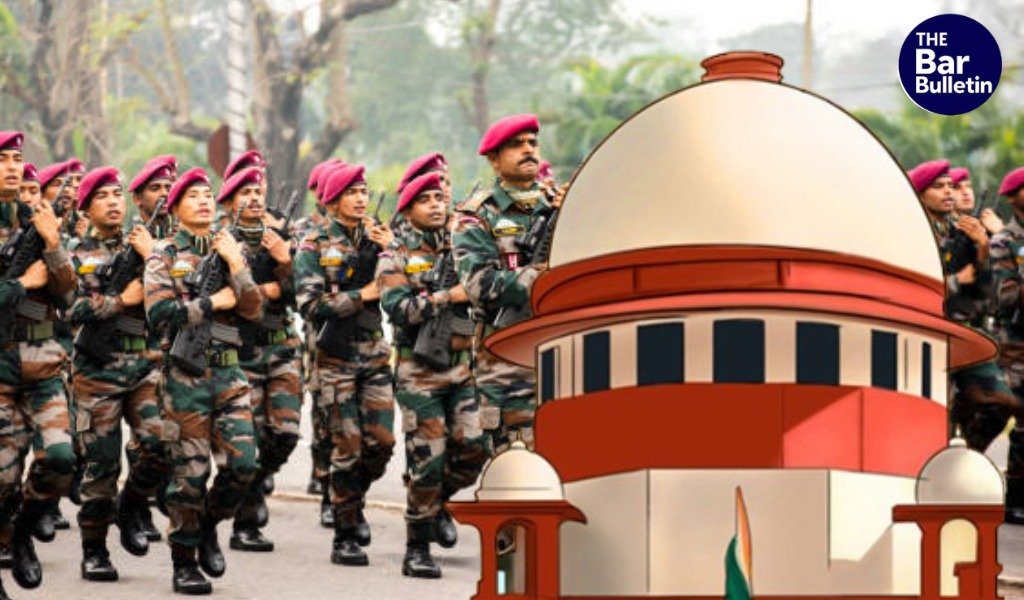

The Supreme Court has clarified that a specially notified military operation falling under Category E(i) of the Ministry of Defence (MoD) policy must receive the benefits expressly contemplated by the policy unless specifically excluded. The Court held that Operation Rakshak, being a specially notified military operation, falls within the scope of Category E(i) of the Ministry of Defence Policy dated 31 January 2001, in the absence of any express exclusion. Consequently, personnel suffering disability attributable to such operations cannot be denied the corresponding pensionary benefits.
The Court reiterated that where the wording of a beneficial policy is clear, authorities cannot read additional restrictions into it. Administrative interpretations cannot override the plain language adopted by the policymaker. Since the Union of India failed to produce any policy document showing that Operation Rakshak stood excluded from the ambit of Category E(i), the Court held that an exclusion affecting pensionary rights must be clearly and specifically stated.
Emphasising the welfare character of pensionary provisions, the Court observed that beneficial policies relating to armed forces personnel should receive a liberal and purposive interpretation, particularly where the language employed is broad and inclusive. The Court noted the continuing confusion arising from multiple rules, regulations and executive instructions governing disability and war-injury benefits. It suggested that the Ministry of Defence consider issuing a comprehensive and clearly identifiable legal framework to ensure uniform application and reduce litigation.
Briefly, the respondent, a soldier in the Indian Army, was enrolled in service in December 1996 and was posted at Kargil from July 2003 to July 2005 as part of Operation Rakshak. During that tenure, he developed Rheumatoid Arthritis (Seropositive). Later, he also suffered from certain spinal ailments. At the time of his discharge in January 2013, the Release Medical Board held all his disabilities to be aggravated by military service and assessed the disability at 70%, rounded off to 75% for life. He was accordingly granted Disability Pension comprising both the Service Element and Disability Element.
About six years after discharge, the respondent approached the Armed Forces Tribunal seeking War Injury Pension instead of ordinary Disability Pension for Rheumatoid Arthritis. His case was that the disease had arisen while serving in Kargil under Operation Rakshak, which was a specially notified military operation falling within Category E(i) of the Ministry of Defence Policy dated 31 January 2001. The Armed Forces Tribunal accepted his claim and the High Court affirmed the decision.
A Two-Judge Bench comprising Justice PS Narasimha and Justice Alok Aradhe observed that Category E of the MoD Policy deals with death or disability arising from situations akin to war, armed conflict, extremist violence, peacekeeping missions, border skirmishes, mine operations and other similarly serious operational circumstances. The Court noted that Category E stands apart from the other categories because it specifically addresses exceptional and hazardous military situations.
The Court held that Category E(i), which covers “operations specially notified by the Government from time to time”, was deliberately incorporated to give flexibility to the Government to include operations that may not precisely fall within the earlier clauses but nevertheless involve war-like circumstances. According to the Court, the provision is enabling in nature and broad enough to accommodate specially notified military operations.
The Bench found that the Government had not produced any material showing that Operation Rakshak was expressly excluded from the ambit of Category E(i). Mere oral submissions that Operation Rakshak was not intended to be covered were held insufficient to curtail the plain language of the policy.
The Court emphasised that policy makers are free to frame eligibility conditions, but those conditions must be clearly expressed. Where a policy uses broad and unrestricted language, courts cannot read limitations into it merely on the basis of administrative interpretation. If the Government wishes to deny a benefit under a policy, the exclusion must be stated expressly and unambiguously.
In an important observation, the Court stated that while interpreting a policy, courts must give effect to what the policy actually says and not to what may be in the imagination of the policymaker. It also reiterated that pensionary provisions deserve a liberal interpretation, especially where the language of the policy is beneficial and unrestrictive.
The Court further remarked that there continues to be uncertainty regarding the multiple rules, regulations and policy instructions governing defence personnel and suggested that the Ministry of Defence should issue a comprehensive and clearly identifiable subordinate legislation to ensure fairness and clarity in administration.
