
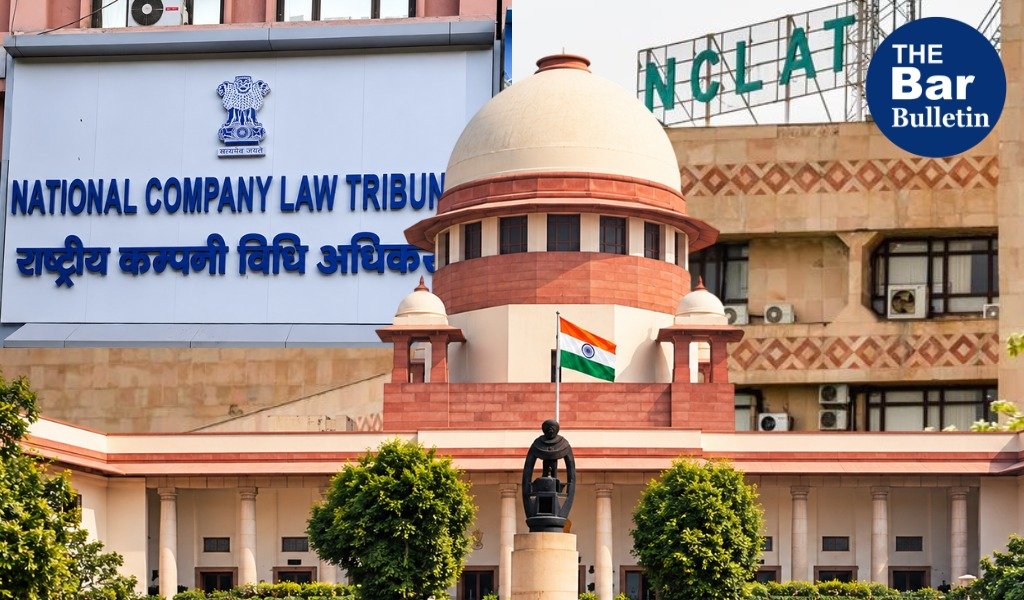

The Supreme Court on Thursday expressed serious concern over the functioning of the National Company Law Tribunal (NCLT), observing that its administration had been “completely hijacked” by the Ministry of Corporate Affairs (MCA) and that the Ministry’s control was impinging upon the tribunal’s institutional autonomy.
A bench comprising Chief Justice of India Surya Kant, Justice Joymalya Bagchi and Justice V Mohana made the observations while hearing a suo motu case concerning inadequate infrastructure, staff vacancies and administrative difficulties affecting the NCLT. During the hearing, the Court also considered a petition challenging the outsourcing of staff recruitment to a private company.
Senior Advocate Sanjiv Sen, appearing for the NCLT Bar Association, submitted that the infrastructure was in a state of disrepair, with floors having been shut down and courts functioning at half strength.
“The roofs are collapsing, 8th floor of the Principal Bench has been shut down, 7th floor has been shut down, two floors have been shut down. All courts are functioning at half strength. It is in shambles,” he submitted.
Attorney General R Venkataramani submitted that recommendations for appointments were already in the pipeline and proposed a joint meeting involving the government, the NCLT President and representatives of the Bar to address the difficulties faced by the tribunal.
The bench said that the presidents of the NCLT and the National Company Law Appellate Tribunal (NCLAT) would be best placed to identify the institutions’ requirements and asked them to submit comprehensive proposals covering infrastructure, staffing and other administrative needs.
It was submitted that of the 320 regular administrative posts at the NCLT, only 67 had been filled, leaving 253 vacancies. Expressing concern over the shortage, the Chief Justice stressed the need to bring experienced government officials on deputation in the first instance, while undertaking regular recruitment in a phased manner.
“
“Moreover, the regular appointments must be made. First, they should bring the people on deputation, some experienced persons from the government department. Meanwhile, in a phased manner, they should go for their own recruitment. Permanent employees,”
the Chief Justice observed.
The bench also questioned the extent of the Ministry of Corporate Affairs’ control over the tribunal’s administration.
“
“We are compelled to observe this has been completely hijacked by Ministry of Corporate Affairs. That is the problem. And that is impinging with the autonomy of the institution. The Ministry wants to have complete grip over the institution. And that’s what’s most unfortunate,” the Court said.
The bench requested the presidents of the NCLT and NCLAT to submit comprehensive proposals identifying their infrastructure, staffing and administrative requirements. The proposals may include the need for land and buildings, supporting staff, and officers of Deputy Registrar or Joint Registrar rank at every bench to maintain judicial records. The information is to be submitted within four weeks.
The Court also raised concerns over delays in matters arising under the Companies Act, observing that insolvency proceedings were receiving priority over other categories of cases. It sought a clearer assessment of pendency across different categories to understand the extent of the problem.
Separately, in Ziyaul Haq and Others v. Union of India, W.P. (C) No. 1385/2026, the court issued notice on challenge to the outsourcing of recruitment for various administrative positions in the NCLT, including Deputy Registrars, Assistant Registrars and stenographers.
Senior Advocate Meenakshi Arora, appearing for the contractual employees, submitted that the Ministry had awarded a contract on October 6 to a foreign company operating in India for deploying administrative personnel. The arrangement, it was argued, could result in existing contractual employees being displaced from November 1 or 2.
The Court, however, declined to grant interim protection to the employees merely on the basis of their length of service. The bench questioned whether contractual employees who had not undergone a competitive recruitment process could claim regularisation or an entitlement to continue in service. It also referred to concerns regarding alleged instances of judicial records being removed and criminal cases being registered.
The bench nevertheless indicated that the outsourcing arrangement would be examined from the standpoint of the tribunal’s functioning and institutional autonomy, rather than merely as a dispute concerning the service interests of the existing contractual employees.
The Chief Justice made it clear that although the recruitment process could be outsourced, the employment relationship should remain with the tribunal.
“Recruitment can be outsourced. The process of recruitment may be outsourced but the employees have to be that of NCLT. Recruitment can be outsourced but the employer-employee relationship must continue. We will not allow these private contractors to continue. Let the reference come from the NCLT President. The entire power of appointment must be with the President only,” the bench said.
The Court emphasised that the presidents of the NCLT and NCLAT should have autonomy over the functioning of their respective institutions. “Complete autonomy must be with both the presidents. The captain of the ship,” the Chief Justice observed.