
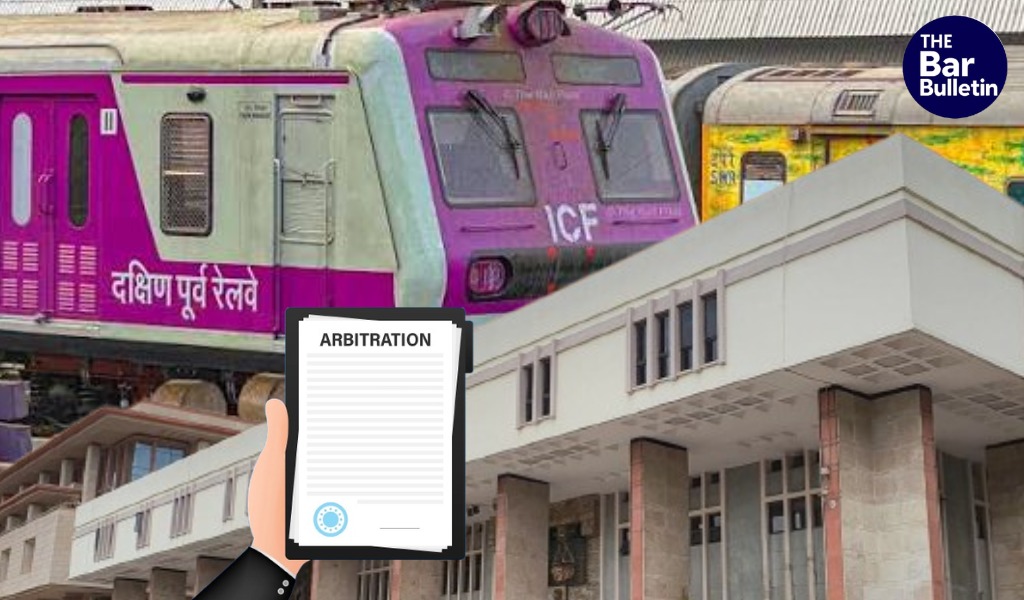

The Delhi High Court has upheld an arbitral award directing South Eastern Railway to pay over ₹130 crore to Sara International Pvt. Ltd. in a dispute arising under the Wagon Investment Scheme (WIS), reiterating that proceedings under Section 34 of the Arbitration and Conciliation Act, 1996 are not appellate in nature and that courts cannot reappreciate evidence or substitute an arbitral tribunal’s plausible view merely because another interpretation is possible.
Justice Jasmeet Singh dismissed the Railways’ challenge to the award dated June 9, 2021, holding that the arbitral tribunal had adopted a plausible interpretation of the contract after appreciating the evidence on record and that none of the limited grounds for interference under Section 34 such as patent illegality, perversity or violation of the fundamental policy of Indian law were made out.
The dispute arose from a Wagon Investment Scheme Agreement dated December 26, 2006, under which Sara International invested ₹28.33 crore to procure two railway rakes for induction into the Railways’ common pool. In return, the Railways undertook to provide the company with a guaranteed supply of six rakes every month for ten years, together with a 10% freight rebate and two additional bonus rakes each month without freight concession. Upon expiry of the agreement, ownership of the rakes was to vest in the Railways. Sara International alleged that the Railways failed to provide the guaranteed number of rakes and later unilaterally altered the contractual arrangement by issuing circulars restricting transportation of third-party goods, resulting in substantial commercial losses.
Also Read Delhi HC Holds Aaj Tak Liable for Disclosing POCSO Victim’s Details
The arbitral tribunal found that against the contractual entitlement of 1,920 rakes over the ten-year period, the Railways had supplied only 586 rakes, resulting in a shortfall of 1,334 rakes. Holding the Railways to be in breach of the WIS Agreement, the tribunal awarded ₹42.56 crore towards loss of profits between 2007 and 2010, ₹74.28 crore towards loss of freight rebate for the period March 2010 to February 2017, and ₹13.16 crore towards loss of premium on two additional bonus rakes, together with pendente lite and future interest at 8% per annum, besides arbitration costs, taking the total award to over ₹130 crore.
Before the High Court, the Railways contended that the award suffered from patent illegality as the tribunal had mechanically relied upon the claimant’s expert report without independent scrutiny, denied it a fair opportunity to cross-examine witnesses and present its case, improperly rejected its counterclaim, and awarded damages unsupported by the contractual framework or evidence.
Rejecting these submissions, the Court held that the tribunal had not mechanically accepted the expert evidence. Rather, it had independently scrutinised the calculations, reduced the claimant’s original figures under different heads of claim, and accepted the expert report only after finding that the Railways had neither cross-examined the expert witness nor led any evidence to rebut the claimant’s case despite repeated opportunities. The Court observed that once the evidence remained unrebutted, the tribunal was justified in relying upon it, and the court adjudicating Section 34 petition could not undertake a fresh evaluation of the evidence.
The Court also rejected the Railways’ plea that it had been denied a fair opportunity to present its case. It noted that the arbitral record revealed repeated adjournments sought by the Railways, changes of counsel, failure to cross-examine both the fact witness and the expert witness despite multiple opportunities, failure to file witness affidavits within the prescribed time, and persistent non-cooperation during the proceedings. The Court further observed that the Railways’ conduct had delayed the arbitration for 822 days, and therefore it could not subsequently invoke principles of natural justice to challenge the award.
Justice Singh also upheld the tribunal’s decision to strike off the Railways’ counterclaim under Section 38(2) of the Arbitration and Conciliation Act after it repeatedly failed to deposit its share of the arbitral tribunal’s fees despite several directions. The Court noted that the claimant was ultimately compelled to deposit the Railways’ share of the arbitral costs to ensure continuation of the proceedings.
Reaffirming the settled law governing judicial review of arbitral awards, the Court held that once an arbitral tribunal adopts a plausible interpretation of the contract and records findings based on evidence, a court exercising jurisdiction under Section 34 cannot substitute its own view merely because another interpretation may also be possible. Finding no patent illegality, perversity or violation of the fundamental policy of Indian law, the Court dismissed the petition and upheld the arbitral award in its entirety.
