
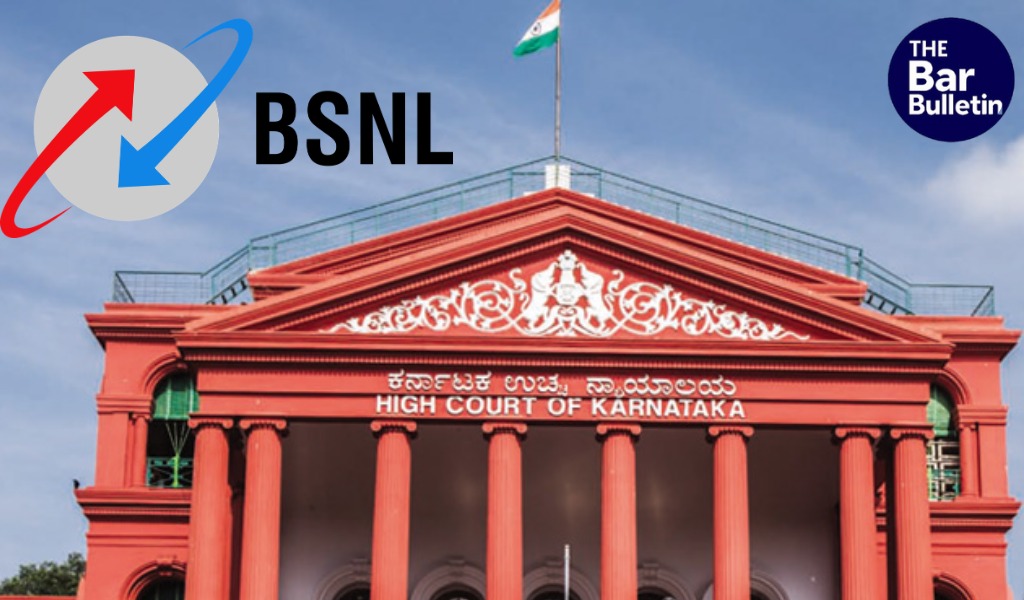

The Karnataka High Court at Bengaluru Bench has clarified that a civil compensation claims against a telecom service provider for negligent issuance of a duplicate SIM card, resulting in diversion of OTPs and fraudulent banking transactions, is maintainable before a Permanent Lok Adalat as a dispute concerning deficiency in a public utility service, notwithstanding the existence of parallel criminal proceedings arising from the same facts.
The Court held that where a duplicate SIM is issued without proper verification, such issuance constitutes negligence and deficiency in service, and if it enables OTP diversion and fraudulent withdrawals, it is the proximate cause of the resulting financial loss. The telecom service provider is vicariously liable for such wrongful acts of its officials when committed in the course of their authorised functions. Direct recoveries of the defrauded amount reduce the net loss, but insurance proceeds received from an independent insurer do not reduce the wrongdoer’s liability.
Accordingly, the High Court modified the Permanent Lok Adalat’s award by directing BSNL to pay the Co-operative Bank: (i) Rs. 50.50 lakhs as compensation for the net financial loss; (ii) interest on that amount at 9% per annum from Feb 07, 2019 until actual payment; and (iii) Rs. 5 lakhs towards consequential damages for reputational harm, loss of public confidence, liquidity disruption and operational costs. These amounts were directed to be paid within three months from the date of the order, failing which the outstanding amount would carry interest at 12% per annum from the date of default. The Court also affirmed that Canara Bank had no liability and directed that the criminal proceedings should continue unaffected.
Also Read Supreme Court Releases Draft AI Regulations for Courts; Invites Public Comments Till June 20
A Single Judge Bench of Justice Suraj Govindaraj observed that the dispute was a civil compensation claim for deficiency in telephone service and therefore fell within the jurisdiction of the Permanent Lok Adalat under Sections 22A and 22C of the Legal Services Authorities Act, 1987. It rejected BSNL’s contention that the matter was excluded merely because the underlying facts also involved allegations of fraud and criminal conduct. The Bench observed that a civil compensation claim does not become a “matter relating to an offence” only because the same facts may also give rise to criminal proceedings, and that civil and criminal remedies may proceed independently.
The Bench further held that the unauthorised issuance of a duplicate SIM card without proper verification amounted to negligence and deficiency in service attributable to BSNL. It found that the duplicate SIM enabled diversion of OTPs and was the proximate cause of the fraudulent transactions. The Bench emphasised that the OTP was the final and indispensable authentication step, and without the duplicate SIM the fraud could not have been completed. It also drew an adverse inference against BSNL for not producing its SIM issuance and verification records and held that the doctrine of res ipsa loquitur applied in the circumstances.
On liability, the Bench held BSNL vicariously liable for the acts of its official involved in issuing the duplicate SIM, observing that SIM issuance was squarely within the functions entrusted to the official and that wrongful performance of an authorised function does not take the act outside the course of employment. At the same time, the Bench affirmed that Canara Bank bore no liability, since its system employed a two-factor authentication model, the OTP channel was externally subverted through the BSNL-side SIM swap, and no independent negligence or deficiency on the part of Canara Bank was established.
The Bench also held that while the reverse credit of Rs. 30 lakhs and the police recovery of Rs. 7.12 lakhs were direct recoveries that reduced the gross loss, the insurance proceeds received by the Co-operative Bank did not reduce BSNL’s liability. Applying the collateral source rule, it held that insurance proceeds arose from an independent contractual arrangement between the Bank and its insurer and could not be used by BSNL to avoid or reduce its own liability. It also recognised that the Co-operative Bank had suffered consequential harm including liquidity stress, operational disruption and reputational damage.
Briefly, the case arose from unauthorised RTGS/NEFT transactions carried out in 2019 from the current account of Basaveshwara Pattana Sahakara Bank Niyamitha maintained with Canara Bank, aggregating to Rs. 87.70 lakhs. The Co-operative Bank had registered a BSNL mobile number for internet banking OTP authentication. It alleged that unknown persons obtained a duplicate SIM card for that registered number from BSNL without any request, consent or authority from the Bank, intercepted the OTPs, and thereby effected the fraudulent transfers. Out of the siphoned amount, Rs. 30 lakhs were reverse-credited and Rs. 7.12 lakhs were later recovered through police proceedings.
The Co-operative Bank initiated proceedings before the Permanent Lok Adalat seeking recovery of the unrecovered amount and compensation, while BSNL resisted liability and Canara Bank contended that its banking system was not at fault. The Permanent Lok Adalat partly allowed the claim and directed BSNL to pay Rs. 5 lakhs with interest at 6% per annum from March 01, 2021, while dismissing the claim against Canara Bank. Both BSNL and the Co-operative Bank challenged that award in separate writ petitions before the High Court.
Appearances:
Mahesh R. Uppin., Advocate, for Petitioners
- Mohan Rao., Advocate for Respondent no.1
Gangadharaiah. A.N., Advocate for Respondent no.2
Mahantesh Shetter, AGA, for Respondent no.3