
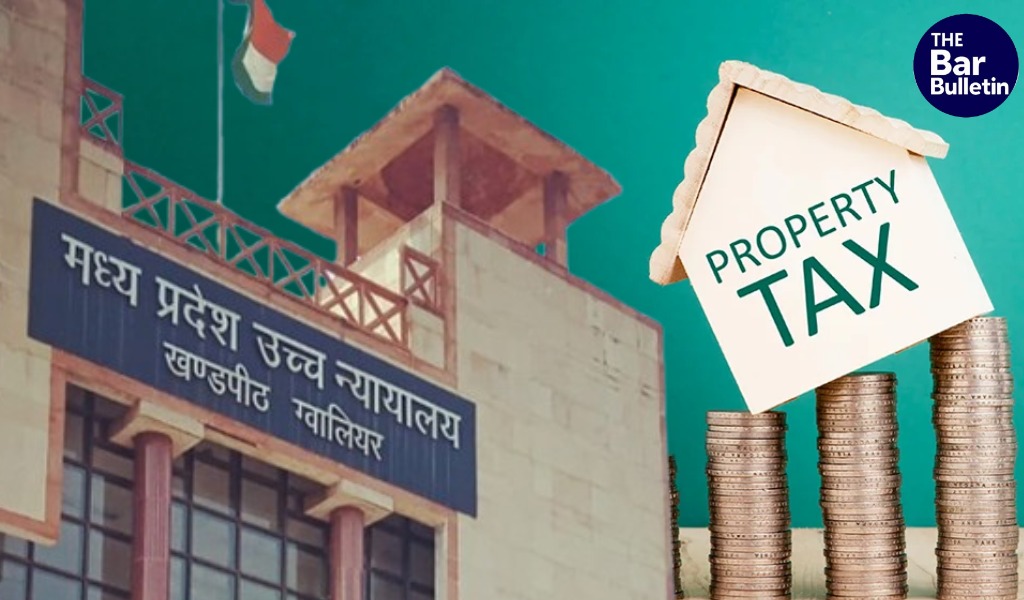

The High Court of Madhya Pradesh at Jabalpur Bench has held that where a property is owned or held through a government company registered under the Companies Act, such company is a separate legal entity, and the exemption under Section 136(a)(ii) of the Madhya Pradesh Municipal Corporation Act, 1956, applicable to buildings and lands owned by the State Government, cannot automatically be claimed in respect of a building constructed and commercially exploited through that company.
Further, the Court clarified that a private entity occupying and using such building for a profit-oriented commercial activity may be held liable to property tax and related charges, even if the underlying case advanced is that the land has a governmental character. However, such liability can arise only for the period during which that private entity was actually in occupation pursuant to its agreement, and not for any prior period when it had no nexus with the property.
Accordingly, the Court directed that the petitioner would be liable to pay property tax and other charges only from the date on which it entered into the agreement with MPSTDC, and not for the period from 2010-11 as demanded by the Municipal Corporation, Katni.
Also Read ‘India Has Travelled Far in Arbitration, But Is Still Short of the Destination’: Justice Chandrachud
A Single Judge Bench of Justice Vishal Mishra reproduced Sections 135 and 136 of the Madhya Pradesh Municipal Corporation Act, 1956 and examined the nature of the property and the status of MPSTDC. It observed that MPSTDC is a company registered under the Companies Act, 1956, and therefore a legal person separate and distinct from the State and its members. On that reasoning, the Bench held that it could not be said that the property in question was owned by the State so as to attract the exemption under Section 136(a)(ii).
The Bench further observed that the building in question had been constructed by MPSTDC and had been given to the petitioner for running a private motel for commercial purposes. Accordingly, the constructed building housing a private motel could not be treated as State Government property merely because it stood on land claimed to be exempt.
The Bench also observed that the exemption under Section 136 operates in relation to the owner of the building and does not protect a private commercial operator conducting a profit-oriented activity in the premises. It noted that the petitioner was in occupation of the building and using it for commercial hotel operations, and therefore was liable for property tax, urban development cess, and education cess. At the same time, the Bench found from the agreement that the petitioner entered into the arrangement with MPSTDC only in 2019, and therefore the demand raised for the earlier period from 2010-11 was unsustainable as against the petitioner.
Also Read “Law Must Think Earlier About Emerging Risks”: Mark Evans on Disputes at the Frontiers at LIDW 2026
Briefly, the petitioner challenged an order by which property tax and other surcharges were levied in respect of Tourist Motel, Katni. The petitioner’s case was that it had only been granted the hotel on licence for operation and management pursuant to a letter of award and an agreement executed with Madhya Pradesh State Tourism Development Corporation Ltd. (MPSTDC), and that the property belonged to the State Government.
On that basis, it argued that the property was exempt from property tax under Section 136 of the Madhya Pradesh Municipal Corporation Act, 1956, and in any event, the petitioner, being only a licensee and not the owner, could not be made liable for tax, particularly for the period from 2010-11 onwards when it had no connection with the property.
The respondents contended that MPSTDC, being a company registered under the Companies Act, was a distinct legal entity, that the constructed building was not to be treated as State Government property for the claimed exemption, and that the petitioner, as the occupier running the motel commercially, was liable to pay the tax.
Appearances:
Anshuman Singh, Advocate with Anuj Shrivastava, Advocate for the Petitioner
Prabhanshu Shukla, Government Advocate for the Respondents/ State
Utkarsh Agrawal, Advocate for the Respondent no. 3