
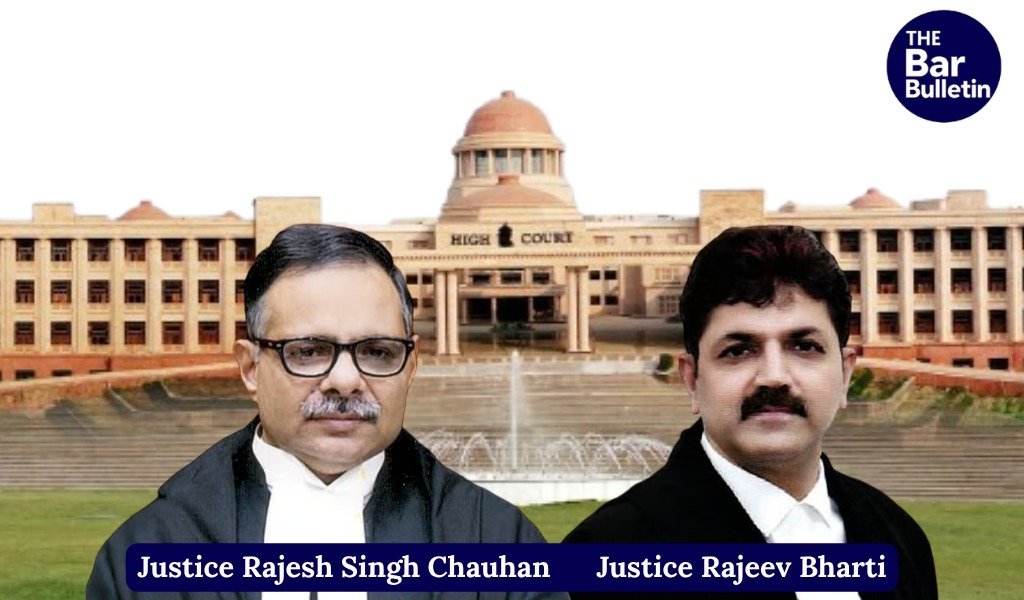

The Allahabad High Court (Lucknow Bench) has recorded serious concern over the absence of any criminal-antecedent filter in the Legal Remembrancer’s (LR) Manual, the lack of a documented needs assessment, and the appointment of six Chief Standing Counsels without justification, and accordingly carved out eight guidelines covering needs assessment, transparent eligibility criteria, extension of disclosures to all categories of cases, public-domain transparency, adequate representation of women advocates, mandatory FIR reporting to the Advocate General, mandatory NOC for State Law Officers appearing against the State, and a stakeholder consultation on Bar election participation.
The Court pointed out that the LR Manual contains no provision prescribing disqualification for appointment or continuation of a State Law Officer against whom serious or heinous criminal cases are pending, and observed that the standard of scrutiny for State Law Officers ought to be higher than for advocates generally. The Court also noted that the State failed to place on record any material indicating that a reasoned needs assessment was undertaken before appointing approximately 2,100 Government Counsel, and held that the State’s discretion under the LR Manual cannot be exercised arbitrarily or for appeasement.
Further, the High Court recorded that no explanation was furnished by the State for appointing six Chief Standing Counsels against the statutory prescription of one for Allahabad and one for Lucknow, and directed that any future appointment beyond the prescribed number must be supported by a reasonable and objective workload assessment.
Briefly, the petitions raised a common grievance against the procedure adopted by the State of Uttar Pradesh for appointment of State Law Officers, namely Government Advocate, Additional Government Advocate, Chief Standing Counsel, Additional Chief Standing Counsel, Standing Counsel and Brief Holders (civil and criminal). The petitioners contended that the appointments were made in violation of the principles laid down by the Supreme Court in State of Punjab v. Brijeshwar Singh Chahal [(2016) 6 SCC 1].
In 2017, a list of Government Counsels was released by the Law Department, which was challenged, and the Court by order dated July 21, 2017, asked the State to reconsider, and a revised list was issued on Oct 23, 2017. In 2022, a PIL was filed seeking similar relief, and the Court by order dated Aug 24, 2022, directed the State to file an affidavit explaining the steps taken to implement the Chahal principles. In 2023, a fresh list of State Law Officers was published.
The petitioner alleged that approximately 2,100 persons were appointed as Government Counsel, with 25–30 counsel per Court, resulting in an excess of about 1,000 counsels over the assessed requirement and a monthly burden of nearly Rs. 5 crores on the State exchequer at an honorarium of approximately Rs. 50,000 per counsel. An RTI application seeking information on criminal cases pending against the appointed counsel was replied to by the authorities stating that the question itself was ‘misleading’.
Two intervention applications were also filed, one by Manisha Srivastava seeking adequate representation of women advocates and challenging the LR Manual as ultra vires Articles 14, 15 and 16 of the Constitution, and another by Arun K. Tiwari seeking a mechanism for supervision, accountability, grievance redressal and regulation of private practice and Bar elections by State Law Officers.
The Division Bench comprising Justice Rajesh Singh Chauhan and Justice Rajeev Bharti observed that the Apex Court’s judgment in State of Punjab v. Brijeshwar Singh Chahal [(2016) 6 SCC 1] was rendered on the foundation of a CAG report concerning Punjab and Haryana and the complete absence of any norm for appointment of Government Advocates in those States, and that no comparable CAG report had been placed on record for Uttar Pradesh. The Court further noted that unlike Punjab and Haryana, which follow a fixed consolidated monthly salary structure, Uttar Pradesh follows a hybrid fee structure consisting of a base monthly retainership supplemented by per-hearing or daily appearance fees. The Court therefore found substance in the Advocate General’s submission that the ratio of Chahal could not be mechanically applied to Uttar Pradesh.
However, the Court expressed serious concern that the LR Manual contained no provision prescribing any disqualification for appointment or continuation of a State Law Officer on account of pending serious or heinous criminal cases. The Court remarked that ‘the robe of a lawyer cannot conceal the stain of criminal conduct, nor can a law degree confer immunity from the law’, and observed that the standard of scrutiny for State Law Officers ought to be higher than for advocates generally. The Court also noted that the State had failed to place on record any material indicating that a reasoned needs assessment had been undertaken before making the appointments.
The Court observed that the intervention application by Ms. Srivastava, to the extent it sought to declare the LR Manual as ultra vires, was not maintainable because an intervener cannot enlarge the scope of the lis or introduce a distinct cause of action. The Court further observed that the existing supervisory mechanism under the LR Manual was adequate and creation of a separate grievance redressal committee was not warranted, though the disclosure should extend to all categories of cases and not be confined to criminal cases alone. The Court also recorded that the State had constituted a Committee under the Chairmanship of the Advocate General for scrutinising the names of advocates proposed for engagement as State Law Officers.
