
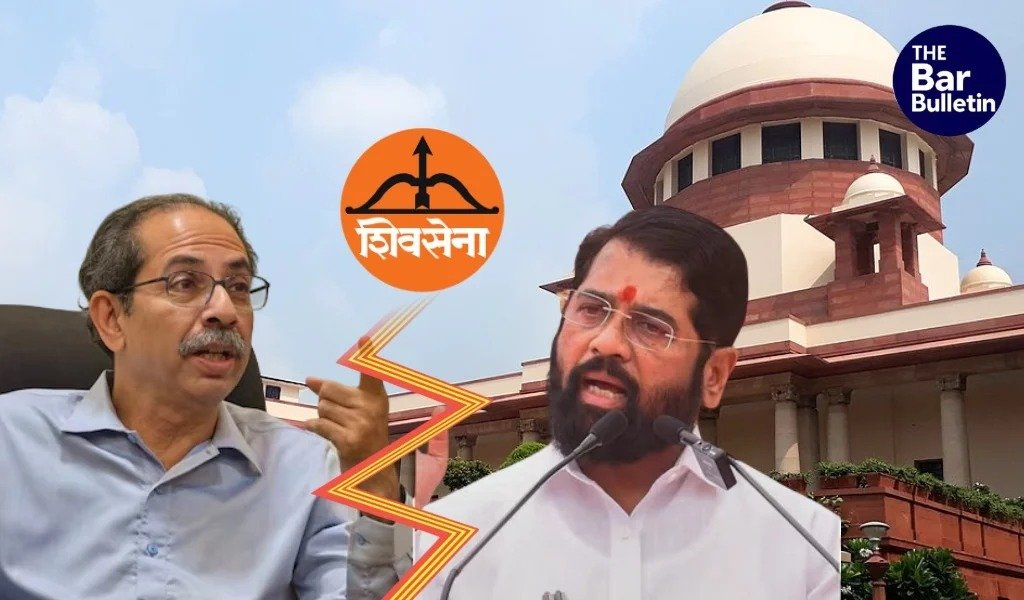
Senior Advocate Dhruv Mehta, appearing for the Eknath Shinde-led Shiv Sena faction, on Wednesday argued before the Supreme Court that the Uddhav Thackeray faction cannot rely on subsequent political developments, including the formation of the Shinde government, to establish allegations of defection against the rebel MLAs.
He submitted that the disqualification petitions must be examined strictly on the basis of the allegations and material available when they were originally filed. He argued that the formation of the Shinde-led government on June 30, 2022, the Speaker’s election on July 3 and the confidence motion on July 4 could not subsequently be introduced to strengthen the original case.
Also Read: Tenth Schedule is Being Rendered Ineffective; Kapil Sibal Moves Supreme Court Over Defections
Referring to the factual chronology recorded by the Supreme Court in Subhash Desai v. Principal Secretary, Governor of Maharashtra, 2023 INSC 516 Dhruv Mehta pointed out that the original disqualification petitions against the Shinde faction had been filed before the formation of the Shinde-led government. He argued that subsequent developments, including the election of the Speaker and the trust vote, could not be introduced retrospectively to strengthen the case for disqualification.
He argued that the Thackeray faction had subsequently attempted to characterise the entire sequence of events as one continuous act of defection, even though the later developments had not formed part of the original allegations. He submitted:
“
“The case which the respondents were called upon to meet was accordingly fixed as on that date upon the materials. It follows that petitioners cannot now travel beyond those pleadings. The reliance now placed upon the formation of the government on 30 June 2022, the Speaker’s election on 3 July 2022, and the confidence motion on 4 July 2022 is not elaboration of a pleaded case. It is an improvement upon it. It’s a completely new cause of action. A party who has pleaded the specific set of acts as constituting voluntary relinquishment of membership and has failed to prove those acts cannot sustain the same petition by substituting a different and later set of acts which had not even occurred when he pleaded.”
He further argued that a subsequent political development cannot retrospectively convert earlier conduct into voluntary relinquishment of membership under the Tenth Schedule. If the conduct between June 21 and June 24 did not constitute abandonment of party membership, the subsequent change in government could not alter its legal character.
He also addressed the reliance placed by the Thackeray faction on Ramchandra Prasad Singh v. Union of India, AIR 2020 SC 2847, arguing that the judgment did not permit a party to introduce an entirely new cause of action through subsequent events. He submitted that the decision concerned the consideration of additional evidence in proceedings challenging a Speaker’s disqualification order and could not be applied to enlarge the original grounds of a disqualification petition.
On the June 21, 2022 resolution, Mr Mehta reiterated that the communication reflected dissatisfaction among a section of Shiv Sena MLAs with the functioning of the Maha Vikas Aghadi government, but did not establish an intention to withdraw support from the government or leave the party.
He also challenged the allegations concerning the violation of party whips during the Speaker’s election and the confidence motion. He argued that the whip issued by Sunil Prabhu had not been proved to have been served on the MLAs and that the Speaker’s election was a non-partisan exercise.
Regarding the July 4 confidence motion, he submitted that the Shinde faction had voted in favour of a government headed by its own party leader and could not be disqualified for supporting a Shiv Sena-led government. He also submitted that the disqualification proceedings had become infructuous following the completion of the term of the 14th Maharashtra Legislative Assembly in 2024.
Yesterday, Sr Adv Dhruv Mehta had argued that dissent within a political party, including the failure of some MLAs to attend a party meeting, does not by itself amount to voluntarily giving up membership under the Tenth Schedule. He had also submitted that the Shinde faction’s presence in BJP-ruled states and allegations that its members had acted in concert with the BJP could not, without supporting material, constitute grounds for disqualification.
On the alleged violation of party whips during the Speaker’s election and the confidence motion, he argued that the whip issued by Sunil Prabhu had not been proved to have been served on the MLAs. He also contended that the Speaker’s election was a non-partisan exercise and that the Constitution Bench ruling in Kihoto Hollohan v. Zachillhu, AIR 1993 SC 412 did not extend the scope of party whips to such an election.
Concluding his submissions, he argued that the allegations under Paragraphs 2(1)(a) and 2(1)(b) of the Tenth Schedule had not been established either on facts or in law and that the disqualification petitions were liable to be dismissed.